
What if the most expensive mistake on your building project is the one you can’t even see once the brickwork is finished? It’s a natural concern for any developer or homeowner, especially given the varied terrain and complex drainage regulations found across our region. Choosing the right groundworks contractors North Wales ensures that your project starts on a stable footing, protecting you from the anxiety of hidden costs or future structural failure.
We understand that managing site preparation can feel overwhelming, particularly with the new building safety regime coming into force in Wales on 1 July 2026. This guide is designed to give you total confidence in your foundation. You’ll discover the essential stages of professional site preparation and learn how to select a contractor who understands the local geography. We will walk you through everything from SuDS compliance to the specific timelines involved, ensuring your build is both legally sound and built to last.
Groundworks represent the fundamental first phase of any building project. It’s the stage where the theoretical plans on paper meet the physical reality of the earth. Professional groundworks contractors North Wales don’t just dig holes; they prepare a site to withstand decades of environmental pressure. Think of this phase as “structural insurance.” While the brickwork and interior finishes are what people see, the groundworks are what keep those elements from shifting, cracking, or failing.
The process involves complex Earthworks in engineering, which include the movement and processing of soil or rock to create a stable platform. Skipping a professional site analysis is a gamble that rarely pays off. Without a thorough understanding of the subsoil, you risk drainage failure or subsidence. These issues are often buried beneath tonnes of concrete, making them incredibly expensive and disruptive to fix once the build is complete. Proper site preparation ensures that the ground’s load-bearing capacity is accurately assessed before a single brick is laid.
Modern groundworks encompass a wide range of essential tasks. This includes initial site clearance, bulk excavation, and the precise laying of foundations. In residential projects, the focus is often on preparing for extensions or new builds, whereas large-scale civils might involve complex road and sewer infrastructure. Crucially, this stage establishes the “datum point.” This is the fixed reference level that dictates the entire building’s height and position. If this measurement is off by even a few millimetres, it can cause significant issues for subsequent trades like bricklayers and joiners.
Our region presents a diverse landscape that requires specialised local knowledge. From the sandy, high-water-table areas along the North Wales coast to the hard shale and rock found near the Clwydian Range, every site demands a bespoke approach. Understanding these variations is vital for ensuring the ground can support the intended load. Professional groundworks contractors North Wales must also be adept at working across borders. For instance, the heavy clay soils prevalent in the neighbouring county require the expertise of site preparation contractors Cheshire to design foundations that won’t swell or shrink with changing moisture levels. This regional awareness prevents costly delays and ensures your project remains on a solid footing from day one.
Professional groundworks contractors North Wales provide a comprehensive suite of services that extend far beyond simple excavation. The process begins with site clearance and bulk earthworks, where vegetation, topsoil, and obstructions are removed to create a perfectly level platform. This stage is governed by the Common Minimum Standards for Construction, ensuring that all work meets mandatory safety and quality benchmarks. Once the site is clear, subcontractors manage the installation of essential utilities, including water, gas, and electricity ducts, ensuring they’re positioned correctly before foundations are poured.
Beyond the hidden infrastructure, groundworks also encompass “external works.” These are the visible elements that define the accessibility and finish of a site, such as kerbing, permanent access roads, and high-quality paving. These elements aren’t just decorative; they provide the necessary infrastructure for heavy machinery and delivery vehicles to navigate the site safely during the main construction phase. If you’re planning a new build or extension, partnering with an experienced builder in North Wales who understands the full lifecycle of groundworks can prevent logistical bottlenecks later.
The type of foundation required depends entirely on the soil conditions identified during the initial analysis. Foundation laying contractors North West typically choose between three main types:
Precision is vital here. Foundations must be accurate to the millimetre because any deviation will cause significant alignment issues for the brickwork and structural frame. In challenging ground, reinforced concrete is often used to provide additional tensile strength and prevent cracking over time.
Effective water management is a cornerstone of professional groundworks. This involves installing separate foul water and surface water drainage systems to meet modern environmental standards. In North Wales, where rainfall can be heavy, developers frequently use attenuation tanks. These underground systems temporarily store excess rainwater during storms, releasing it slowly into the main sewer to prevent local flooding. For a detailed breakdown of these systems and how they integrate with your build, you can read our guide on what is included in groundworks. These Sustainable Drainage Systems (SuDS) are now a legal requirement for most new developments, making professional installation more important than ever.
The geology of our region is remarkably varied, presenting distinct engineering hurdles for groundworks contractors North Wales. Along the coastal strip, from Prestatyn to Llandudno, we frequently encounter high water tables. This requires specialised dewatering techniques during excavation to prevent trench collapse and ensure the concrete cures in a dry environment. Conversely, moving inland towards Cheshire, the landscape shifts to heavy clay soils. These soils are notorious for their “shrink-swell” behaviour, where they expand when wet and contract during dry spells. Such conditions necessitate specific foundation designs, often requiring deeper trench fills or reinforced raft foundations to prevent future structural movement.
Logistical constraints also play a major role in site preparation. Historic towns like Conwy or Chester often feature narrow access routes that limit the size of plant machinery we can deploy. This demands meticulous planning to ensure materials are delivered and waste is removed without disrupting the local community. Additionally, projects situated near the borders of Snowdonia (Eryri) must adhere to strict environmental protections. Managing surface water runoff is critical here to prevent silt or pollutants from entering sensitive ecosystems, a task that requires both technical skill and a deep respect for the local landscape.
A comprehensive soil report is the non-negotiable first step for any groundworks and civils North West project. This investigation determines the ground’s load-bearing capacity, which directly dictates the depth and type of foundations required. In certain parts of North Wales, we must also account for the region’s industrial heritage. Site investigations often reveal contaminated land from former mining or manufacturing activities, requiring professional remediation before construction can safely begin. Identifying these issues early prevents the “hidden costs” that often plague projects during the excavation phase.
The regulatory landscape is becoming increasingly complex. With the new building safety regime coming into force in Wales on 1 July 2026, the roles of local authority building control in North Wales and Cheshire West have become even more pivotal. All groundworks must comply with the latest UK Building Regulations to ensure structural safety and environmental responsibility. It’s essential to work with a contractor who understands these shifting requirements, including the increased five-day notice period for building control authorities. A professional team will liaise directly with inspectors to ensure every stage of the groundwork is signed off promptly, keeping your project’s timeline on track.
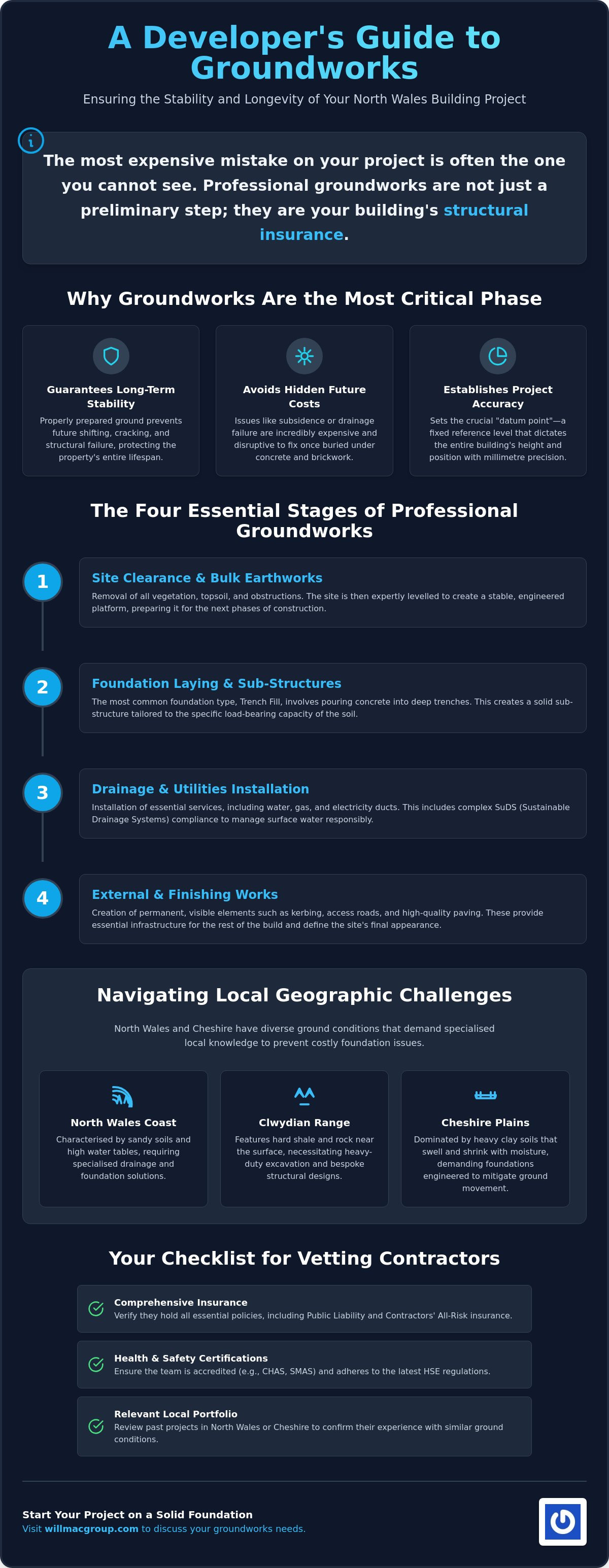
Selecting a partner for your site preparation is a decision that impacts the entire lifecycle of your build. You shouldn’t simply appoint the firm with the lowest quote; instead, look for a team that demonstrates technical competence and financial transparency. Follow these five steps to ensure you choose the right groundworks contractors North Wales for your specific needs.
If you require a partner who combines technical civil engineering skill with the practical perspective of a professional builder, we can help ensure your project starts on the right footing.
Deep excavation is inherently risky and requires specialist shoring to prevent trench collapse. When vetting groundworks contractors North Wales, check that all site operatives hold valid CSCS cards and that plant operators are CPCS qualified. A contractor with a clean safety record and robust risk assessments provides peace of mind, especially on complex sites with restricted access or proximity to existing structures. This commitment to safety is a hallmark of a professional, well-organised outfit.
Groundworks dictate the pace of the entire construction programme. Clear timelines are essential to keep your project on track; if the foundations aren’t finished on time, the rest of the build stalls. Professional contractors manage the unpredictable North Wales climate by building contingencies into their schedules rather than hoping for dry weather. You should expect a single point of contact who provides regular updates, ensuring that any unforeseen ground conditions are communicated and resolved without delay.
Many developers treat site preparation as a standalone package, often appointing the most affordable groundworks contractors North Wales can offer without considering the next phase of the build. This fragmented approach frequently leads to “handover friction,” where the bricklayers arrive on site only to find that foundation levels are slightly off or service entries are poorly positioned. By choosing a partner who provides integrated groundworks and construction services, you eliminate these inefficiencies. We approach every excavation with the final structural finishes in mind, ensuring a seamless transition from the sub-structure to the visible building.
Thinking ahead to the final stages of your build is just as important as the initial dig; for homeowners seeking high-quality exterior finishes, you can discover McCready Home Improvements for expert driveway and roofing solutions.
This “Willmac Advantage” is particularly valuable for residential extensions and bespoke new builds. When a single team manages the “below-ground to above-ground” transition, the accountability remains clear. Our background as a comprehensive civil engineering contractors Chester resource allows us to bridge the gap between heavy earthworks and refined masonry. Precise groundworks don’t just provide stability; they reduce the time and cost associated with correcting errors during the brickwork phase. If the foundation is perfectly square and level, the rest of the build proceeds with much greater speed and accuracy.
Superior masonry begins with the quality of the concrete pour. Perfectly level foundations allow for cleaner mortar lines and more consistent structural finishes, which is essential for high-end residential work. During the groundworks phase, we pay meticulous attention to the integration of the Damp Proof Course (DPC). Because we understand the requirements of specialist brickwork, we ensure the DPC is installed at the precise height and orientation required to protect the property’s long-term health. Our expertise in brickwork doesn’t just follow the groundworks; it informs them, making us more thorough and foresight-driven groundworks contractors North Wales.
Professional site preparation is the only way to guarantee the longevity of your investment. From navigating the high water tables of the coast to managing the heavy clays of the inland valleys, our team provides the technical skill and local knowledge required for success. We remove the anxiety of hidden costs and structural uncertainty, replacing it with a methodical, transparent process. If you’re planning a project and need a partner who values craftsmanship as much as you do, we encourage you to get in touch for a site-specific consultation. You can contact Willmac Group for your groundworks and construction needs to ensure your next build starts on the most reliable foundation possible.
Professional site preparation is more than just moving earth; it’s the critical first step in ensuring your building remains stable for decades. We’ve explored how understanding local soil conditions and managing complex drainage are vital for long-term structural integrity. By prioritising technical precision and selecting experienced groundworks contractors North Wales, you protect your project from the hidden costs and delays that often arise during excavation.
With over 25 years of industry experience, the Willmac Group brings a unique perspective to every site. We aren’t just experts in civils and groundworks; we’re specialists in high-end brickwork, ensuring that your foundations are perfectly prepared for the masonry that follows. As local experts serving Chester, the North West, and North Wales, we understand the specific challenges our regional geography presents.
Discuss your North Wales groundworks project with Willmac Group today and ensure your build starts with total precision. Your vision deserves a foundation that is as ambitious as the structure itself.
Groundworks is a specialised subset of civil engineering that focuses specifically on preparing a site for a building. While civil engineering is a broad discipline covering infrastructure like roads, bridges, and tunnels, groundworks involves the immediate tasks of site clearance, foundations, and utility installation for a specific project. It is the practical application of engineering principles to ensure a structure has a stable base.
The cost of groundworks varies significantly based on the specific conditions of your site and the size of the extension. Factors such as the soil’s load-bearing capacity, the depth of foundations required by building control, and the ease of access for machinery all influence the final quote. Every site presents different requirements, meaning a bespoke assessment is necessary to provide an accurate breakdown of the work involved.
A professional soil test is highly recommended as it identifies the ground’s composition and load-bearing capacity. This data allows groundworks contractors North Wales to determine exactly what type of foundation is required, such as trench fill or a reinforced raft. Identifying these factors early prevents the risk of structural failure and ensures that your initial quote reflects the reality of the ground conditions.
The groundworks phase for a standard new build typically takes between two and six weeks. This timeline includes the initial site clearance, bulk excavation, and the installation of drainage and utilities before the foundations are poured. The duration can be influenced by the complexity of the drainage design and the specific geological challenges found on the site.
Yes, groundworks can proceed during the winter months with the right preparation and equipment. Professional teams use specific strategies to manage wet ground and protect open trenches from frost, ensuring the concrete cures correctly. While heavy rain or freezing temperatures may cause short pauses for safety, a well-organised site can remain operational throughout the colder seasons.
SuDS stands for Sustainable Drainage Systems, which are designed to manage surface water runoff by mimicking natural processes. In Wales, most new developments require SuDS approval to ensure that rainwater is managed on-site rather than overwhelming the local sewer network. Compliance is a legal requirement for most projects, focusing on preventing flooding and protecting local water quality.
If unforeseen obstacles like hard rock or a high water table are discovered during excavation, the team will conduct a fresh assessment to adjust the plan. This might involve using specialised rock-breaking machinery or dewatering systems to manage groundwater. These issues are discussed transparently to ensure the foundation remains structurally sound while minimising the impact on your project’s schedule.
A building control officer must visit the site at critical milestones to sign off on the work. They typically inspect the foundations once the trenches are excavated but before any concrete is poured to verify that the depth and ground conditions meet UK Building Regulations. These inspections are essential for ensuring the safety of the build and obtaining the necessary completion certificates.