
The structural integrity of a project in North Wales is often decided by its ability to withstand one of the UK’s most unforgiving climates. Whether you are facing the salt-laden winds of the coast or the persistent moisture of the Snowdonia uplands, finding experienced brickwork contractors North Wales is no longer just about aesthetics; it’s a matter of technical survival for your build. It’s understandable if the prospect of managing multiple subcontractors while keeping pace with shifting regulations feels like a significant burden on your resources.
You probably recognise that a successful site requires more than just manual labour. With the new building safety framework coming into force in Wales on 1 July 2026, the emphasis on competence and statutory dutyholder roles has never been higher. This guide serves as a professional reference to help you understand masonry technical standards and regional material suitability. We’ll outline how specialist contractors manage these complex requirements, giving you the confidence to select a partner who ensures your new build or extension remains durable for decades. By the end of this article, you’ll have a clear perspective on navigating the latest Welsh building regulations and selecting materials that thrive in our unique environment.
Specialist brickwork represents a level of technical execution that exceeds standard residential repairs or small-scale alterations. It involves the management of complex structural masonry and precise decorative bonding on a scale that requires rigorous site-wide coordination. For large-scale projects, the role of professional brickwork contractors North Wales is to act as a primary technical partner. They ensure that every course laid contributes to the long-term stability and weather resistance of the building. This is where Specialist Brickwork Explained becomes relevant; it isn’t just about placing units in a line, but understanding the engineering behind load-bearing walls, moisture control, and thermal performance.
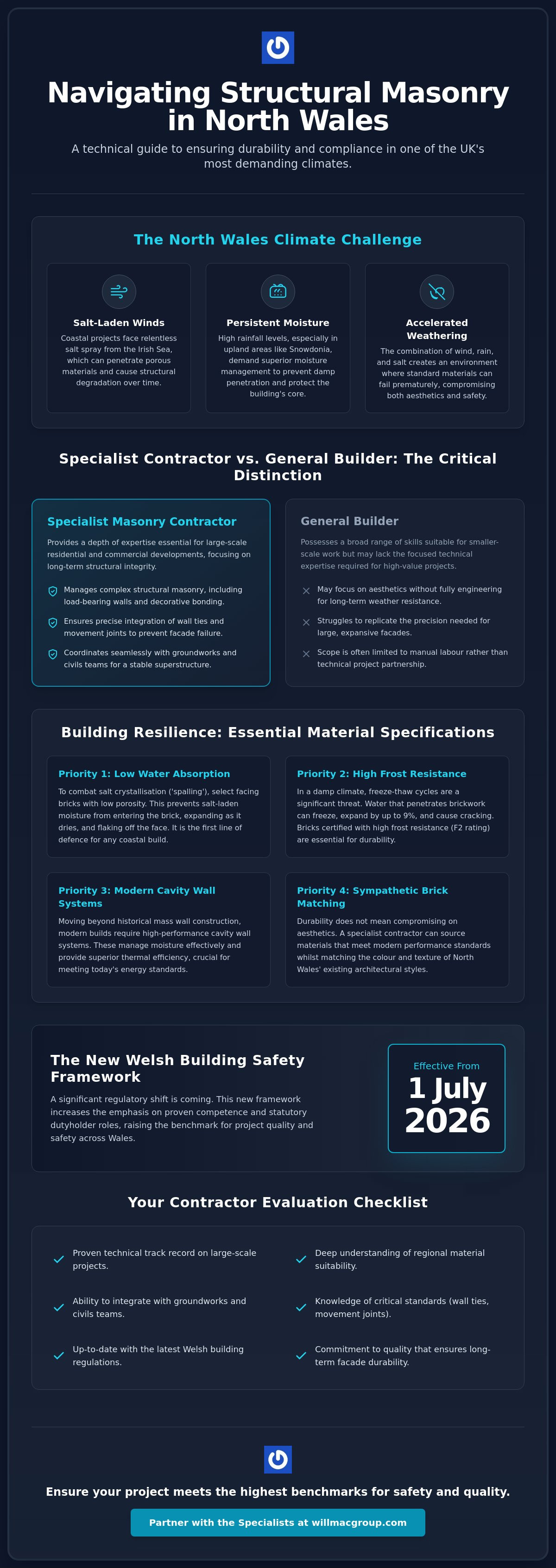
While a general builder may possess a broad range of skills, a dedicated masonry contractor provides a depth of expertise essential for high-value residential builds and commercial developments. Specialist contractors focus on the intricate details that prevent structural failure. They manage everything from the precise spacing of wall ties to the integration of movement joints in expansive facades. This focus on a single discipline allows for a level of precision that generalists often struggle to replicate. It’s particularly vital when coordinating with civils and groundworks teams to ensure the transition from the ground to the superstructure is seamless.
There is a sense of quiet confidence required when delivering high-value projects. It’s a commitment to quality that doesn’t need to shout to be heard. The scope of work for established brickwork contractors North Wales is comprehensive. It begins with the robust installation of foundations and extends to the crafting of structural arches and decorative finishes that define a property’s character. This thoroughness ensures that the final result is both aesthetically pleasing and structurally sound, providing a sense of stability for the client.
Masonry in North Wales has transitioned from traditional local stone to sophisticated brickwork systems designed for modern performance. Whilst historical structures relied on mass wall construction, today’s builds utilise high-performance facing bricks and cavity wall systems. This evolution reflects a need for better thermal efficiency and moisture management. Modern contractors must be adept at using these systems to combat the harsh coastal and upland conditions typical of the region.
Matching new brickwork to the existing architectural fabric of North Wales is a critical skill. Whether you are working amongst the Victorian terraces of coastal towns or modern developments in the interior, selecting the right colour and texture is vital. Specialist contractors ensure that new extensions or builds complement their surroundings. They achieve this by sourcing bricks that mirror the local aesthetic whilst meeting modern durability standards, maintaining the visual harmony of the community.
The North Wales coastline and its upland regions present a specific set of environmental challenges that directly influence masonry specification. High rainfall levels and persistent salt spray from the Irish Sea mean that professional brickwork contractors North Wales must prioritise durability over purely aesthetic considerations. Selecting the wrong material in these exposed zones leads to accelerated weathering, damp penetration, and structural degradation. Adhering to the technical requirements found in the UK Building Regulations ensures that materials are not only legally compliant but also fit for purpose in these demanding conditions.
The weather here is relentless. Whilst standard bricks might suffice in sheltered inland areas, coastal projects require materials with a high resistance to salt crystallisation. If a brick is too porous, salt enters the unit and expands as it dries, causing the face of the brick to flake off in a process known as spalling. Experienced brickwork contractors often recommend selecting facing bricks with low water absorption rates and high frost resistance to mitigate these risks. This technical foresight protects the client’s investment and ensures the building remains structurally sound for generations.
In coastal towns like Llandudno or Conwy, salt-air resilience is a primary concern for any new build. The expertise of seasoned brickwork contractors North Wales is essential for identifying bricks that can withstand the chemical aggression of a marine environment. Beyond the bricks themselves, the integrity of the cavity wall is paramount. Ensuring that wall ties are made of high-grade stainless steel prevents the corrosion that often plagues older properties in the region, where galvanised ties have failed due to the moist, salty air.
The mortar is the most vulnerable part of any masonry wall. In North Wales, using a standard mortar mix can lead to premature failure. Specialist contractors often utilise sulphate-resistant mortars in areas with high groundwater or coastal exposure to prevent chemical attack. The pointing technique also plays a critical role; a “weather struck” joint is frequently preferred in exposed areas because it encourages water to shed away from the mortar bed more effectively than a standard bucket-handle finish. This methodical approach to detail ensures that the building’s thermal performance and moisture resistance remain intact even during the heaviest Welsh winters.
Choosing between natural stone and high-quality brick involves balancing local heritage with modern performance. Whilst natural stone offers an unparalleled aesthetic that blends into the Snowdonia landscape, modern engineering bricks provide consistent durability and thermal efficiency. A professional contractor guides the client through this selection, ensuring the final build achieves a sense of harmony with its surroundings without compromising on longevity or technical standards.
Professional brickwork contractors North Wales operate within a strict framework of technical standards. These aren’t merely suggestions; they’re the foundation of structural safety and insurance eligibility. Adherence to NHBC (National House Building Council) and LABC (Local Authority Building Control) standards is non-negotiable for new build residential developments. These bodies provide the benchmarks for everything from mortar strength to the verticality of a wall. By following these guidelines, contractors ensure that a project is eligible for structural warranties, providing long-term peace of mind for the client.
The Brick Development Association offers comprehensive technical guidance that professional firms use to refine their onsite practices. One of the most critical aspects of large facades is the correct placement of structural movement joints. In a climate like North Wales, where temperature fluctuations can be significant, bricks expand and contract. Without properly spaced movement joints, this thermal movement leads to unsightly cracking and structural instability. Similarly, wall tie spacing must be calculated with precision to ensure the outer leaf of a cavity wall is securely anchored to the inner structure, especially in high-wind zones.
Safety and professionalism go hand in hand. A CSCS (Construction Skills Certification Scheme) card is often viewed as the bare minimum, but for specialist contractors, it represents a commitment to a safe and organised site. However, true quality control goes beyond certification. It involves a continuous process of “snagging” throughout the masonry phase. Rather than waiting until the scaffolding comes down to identify issues, a methodical contractor conducts daily inspections to ensure bed joints are consistent and weep holes remain clear of debris.
As of 1 July 2026, the new building safety framework in Wales has introduced more stringent dutyholder responsibilities. This means clients and contractors must now navigate a more formalised approval process, particularly for higher-risk buildings. Professional brickwork contractors North Wales must be fully conversant with these regulations to ensure that every stage of the build is documented and compliant with the latest statutory requirements, including the Building (Higher-Risk Buildings Procedures) (Wales) Regulations 2025.
Large-scale contracts require a level of logistical precision that smaller firms often lack. Managing the delivery and storage of thousands of bricks, coordinating with scaffolding teams, and maintaining a steady work rate requires significant director-level experience. It’s about more than just laying bricks; it’s about managing the rhythm of the entire site to prevent delays and ensure that the masonry phase integrates perfectly with the follow-on trades. This methodical approach reduces the friction often found between multiple subcontractors on complex sites.
Selecting a technical partner for a large-scale project requires a methodical approach to due diligence. It isn’t merely about comparing quotes; it’s about assessing the technical capability and organisational stability of the firm. Professional brickwork contractors North Wales should demonstrate a proven track record that spans both high-end residential builds and complex commercial masonry. This versatility indicates an ability to adapt to different structural requirements whilst maintaining a consistent standard of finish across diverse site environments.
A key indicator of professional maturity is the contractor’s ability to integrate seamlessly with civils and groundworks teams. On complex sites, the transition from the foundation to the first course of masonry is a critical phase where logistical friction often occurs. A contractor who understands the full project lifecycle can mitigate these risks, ensuring that the superstructure begins on a perfectly levelled and prepared base. This integrated mindset reduces delays and prevents the common “blame game” that occurs between disconnected subcontractors.
Insurance coverage is another area where professional firms distinguish themselves. You should verify that your chosen brickwork contractors North Wales carry specific insurance for structural masonry and site-wide liability. Standard public liability is often insufficient for the risks associated with large-scale developments. Comprehensive cover provides a safety net for the client, ensuring that structural integrity and site safety are financially protected throughout the construction phase.
Whilst basic CSCS cards are a site requirement, you should look for leadership with deep industry roots. Director-level experience is vital for managing the complex logistics of large masonry contracts, from material procurement to workforce scheduling. Evidence of long-term stability often manifests in a permanent, skilled workforce. In an industry frequently disrupted by labour shortages, a contractor with a loyal team of tradesmen can guarantee a level of continuity and craftsmanship that transient crews simply cannot match.
When reviewing a contractor’s portfolio, look beyond the initial visual impact. Examine the technical “handwriting” of the masonry. High-quality work is characterised by the absolute consistency of bed joints and the precise alignment of perpends. Look for evidence of clean weep holes and the expert execution of decorative features, such as intricate bonding patterns or structural arches. If a contractor can show you completed projects that have weathered several Welsh winters without showing signs of moisture ingress or spalling, it’s a strong indicator of their technical competence.
If you require a partner with a proven track record in delivering integrated construction and masonry excellence, discuss your project with our experienced team today.
Willmac Group brings a sense of stability and professional reliability to every project we undertake. With over 25 years of director-level experience across the North West and North Wales construction sectors, we understand the logistical complexities inherent in large-scale developments. Our role as brickwork contractors North Wales is defined by a commitment to technical precision and transparent communication. We don’t just provide labour; we provide a managed solution that ensures structural masonry meets the highest standards of durability and finish, providing a sense of reassurance for our clients.
A significant advantage of working with our team is the seamless integration of specialist brickwork contractors with our civils and groundworks expertise. This eliminates the common friction points that occur when multiple subcontractors handle different stages of the build. By managing the project from the initial excavation through to the final decorative brick course, we maintain total control over the structural integrity of the building. This holistic approach ensures that foundations are perfectly prepared to receive the masonry, preventing the levelling issues that can lead to long-term structural movement.
Our methodology is built on a deep understanding of the regional environment. We recognise that a build in North Wales must be resilient to withstand the specific pressures of the Welsh climate, from coastal salt spray to upland moisture. This is why we apply a methodical approach to commercial brickwork contractors North West management. We ensure every site receives the same level of care regardless of its scale, prioritising high-performance materials and technical pointing techniques that have been proven to endure.
Reliability is the cornerstone of our service. We provide a permanent, skilled workforce that understands the importance of consistent quality and technical accuracy. As brickwork contractors North Wales, we take pride in our ability to deliver structural finishes that aren’t just aesthetically pleasing but are built to last. Our director-led management ensures that every project stays on schedule and within technical compliance, providing a stable foundation for your long-term construction goals. We invite you to experience a partnership where craftsmanship and professional reliability are the standard, ensuring your project is handled with the thoroughness it deserves.
Building in the unique landscape of North Wales requires a strategy that balances aesthetic tradition with modern technical resilience. It’s a process that demands a deep understanding of how regional weather patterns affect material longevity and a strict adherence to the latest structural safety frameworks. By prioritising these standards, you ensure that your project remains a stable and durable asset for decades to come. The most successful developments are those where the transition from the ground up is managed with precision, reducing the friction between trades and maintaining a steady work rate.
Selecting brickwork contractors North Wales with a proven track record is the most effective way to protect your investment. With directors who possess over 25 years of industry experience, Willmac Group provides the stability and specialised knowledge required for both high-end residential and complex commercial masonry. Our ability to integrate comprehensive civils and groundworks with our brickwork services ensures a seamless, high-quality finish from foundations to the final course.
We invite you to discuss your North Wales masonry project with Willmac Group to see how our methodical approach can benefit your next build. Your project deserves a foundation of craftsmanship and professional reliability that stands the test of time.
You should prioritise firms that demonstrate long-term stability and possess a portfolio covering both high-end residential and commercial developments. Look for contractors with director-level experience who can provide evidence of their technical competence and a permanent, skilled workforce. Verifying their integration with civils and groundworks teams is also a strong indicator of a professional, methodical approach to site management.
The timeline for any masonry project depends on the specific scale and technical complexity of the build. A professional contractor will provide a detailed schedule that accounts for logistical factors and the current supply chain environment. For context, UK brick deliveries fell by 18.3% year-on-year in February 2026, so a reliable partner will plan material procurement well in advance to ensure the work rate remains consistent.
Many specialist masonry firms in the region are adept at working with both brick and natural stone to suit the local architectural heritage. This is particularly important for projects in Snowdonia or coastal conservation areas where stone is often required for planning compliance. A versatile contractor ensures that the transition between different masonry materials is handled with structural precision and aesthetic care.
A subcontractor must hold comprehensive public and employer’s liability insurance that specifically covers structural masonry and site-wide risks. For larger or higher-risk developments, it’s also advisable to check for professional indemnity insurance. This level of cover provides a necessary safety net for the client, ensuring that the project is financially protected against technical errors or site accidents.
The climate influences costs primarily through the selection of high-performance materials designed to resist salt spray and high rainfall. As of June 2026, standard machine-made facing bricks are priced between £480 and £900 per 1,000, whilst handmade or reclaimed Victorian bricks can reach up to £2,400 per 1,000. Selecting these more durable, weather-resistant options for exposed North Wales sites is a necessary investment in the building’s longevity.
Engaging specialist brickwork contractors North Wales for an extension is highly recommended to ensure the new structure integrates seamlessly with the old. Specialists understand the critical importance of matching mortar composition and correctly installing movement joints. This expertise prevents the cracking and damp issues that often occur when an extension is treated as a simple building task rather than a technical masonry project.
Facing bricks with low water absorption and high frost resistance are the standard for the region’s demanding environment. In June 2026, Class B engineering bricks, ranging from £480 to £680 per 1,000, are frequently used for damp-proof courses and foundations. For the main facade, developers often choose durable machine-made bricks or reclaimed Victorian units to achieve a balance between modern performance and traditional Welsh aesthetics.
Experienced brickwork contractors North Wales play a vital role in ensuring your project meets the latest statutory requirements. With the new building safety framework in Wales coming into effect on 1 July 2026, contractors must now navigate stricter dutyholder responsibilities. A professional firm will ensure that every phase of the masonry work, from wall tie spacing to cavity integrity, aligns with these updated regulations and NHBC standards.