
The lowest quote for your project is often the most expensive mistake you’ll ever make. In a region where ground conditions vary from stable clay to challenging peat, the price on paper rarely tells the whole story. Most developers and homeowners understand that the soil beneath their feet is the biggest wildcard in any build, yet many still find themselves blindsided by unforeseen muck-away fees or landfill tax surcharges that weren’t clearly defined at the start.
We recognise that accurate budgeting is essential for a successful build, especially as overall construction material prices have risen by 3.2% in the last year. This guide helps you master the variables of groundworks costs North West to ensure your project remains both on budget and structurally sound. You’ll gain a transparent framework for pricing, understand the technical differences between strip and piled foundations, and learn how the 2026 Future Homes and Buildings Standards impact your site preparation. By the end of this article, you’ll have the confidence to choose a specialist contractor who values precision over placeholders.
Groundworks represents the critical transition from an empty plot to a viable building site. It encompasses the entire substructure phase, beginning with the initial site clearance and concluding once the damp-proof course (DPC) is successfully laid. For many projects in 2026, understanding What is Included in Groundworks? is the difference between a project that starts smoothly and one that falters before the first brick is laid. This phase is the silent partner in your build’s success, providing the stability required for every subsequent layer of construction.
Whilst every project varies, the substructure typically accounts for a significant portion of the total build budget. For a standard residential extension, these costs often represent 30% to 40% of the total expenditure. In the context of 2026 market conditions, where residential construction in Manchester or Liverpool averages between £1,900 and £2,600 per square metre, the precision of your initial groundworks quote is paramount. Domestic residential work usually focuses on foundations and service connections, whereas larger commercial sites require more complex civil engineering to manage heavy-duty access and large-scale infrastructure.
This phase serves as the permanent structural anchor for your project. A failure to account for specific soil conditions or drainage requirements doesn’t just impact the budget; it compromises the longevity of the entire building. Accurate planning at this stage prevents the structural shifts or damp issues that can plague a property for decades. Understanding why are groundworks important for a new build is essential for any developer or homeowner who wants to protect their investment from long-term structural issues before a single brick is laid.
The process starts with a thorough site investigation (SI) and topographical surveys. These steps identify underground hazards and determine the soil load-bearing capacity, which dictates the foundation design. Following this, site clearance and “muck-away” begin. This involves the professional removal of spoil and hazardous waste. Muck-away is a major variable in groundworks costs North West, as landfill taxes and transport logistics must be calculated based on the specific volume of earth removed. Finally, excavation begins, following the structural engineer’s specifications to the millimetre to ensure the footings are perfectly aligned.
Modern groundworks packages must address the “civils” side of the project, which includes the installation of foul and surface water drainage systems. In 2026, this often incorporates attenuation tanks to manage rainwater runoff and comply with local environmental regulations. We also manage the provision for essential utilities, including gas, water, electricity, and telecommunications ducting. Before the groundworkers leave the site, they prepare the sub-base for hard landscaping, driveways, and heavy-duty access roads. This ensures that the site remains accessible for the heavy machinery required during the brickwork and superstructure phases. For those looking ahead to the long-term care of these external surfaces, JBM Custom Contracting provides expert property maintenance to keep them in pristine condition.
Accurate financial planning requires moving beyond generic “per square metre” estimates. In 2026, the operational reality of a site is defined by the synergy between plant efficiency and skilled labour. Daily rates for 360 excavator operators currently range between £180 and £245, reflecting the high demand for CPCS-qualified professionals who can navigate complex North West terrains with precision. General groundworker rates sit between £165 and £230. These figures, while substantial, represent the baseline for ensuring a project remains on schedule and compliant with the Building Safety Act 2022.
Material price volatility remains a factor that every developer must track. As of June 2026, we’ve seen a decrease in cement prices by 4.5% and concrete reinforcing bars by 5.2%. However, these savings are often offset by a 7.7% increase in the cost of gravel, sand, and clays. When Budgeting for Groundworks, it’s vital to account for these shifting variables. Fabricated structural steel has also seen an 8.5% rise, which directly impacts the cost of reinforced foundations and specialised piling projects.
Waste management is another significant cost driver often underestimated in initial quotes. The professional removal of spoil, known as muck-away, involves transport logistics and landfill taxes that can escalate quickly. We often recommend on-site soil stabilisation where possible. This process treats existing earth to improve its structural properties, reducing the volume of waste leaving the site and the amount of new aggregate required. Engaging a civils and groundworks specialist early in the design phase can help identify these opportunities for efficiency.
The choice of foundation is the primary variable in your substructure spend. Strip and trench-fill foundations remain the standard for stable ground, offering a balance between concrete volume and labour. On sites with lower bearing capacity, raft foundations distribute loads over a larger area, which can be more cost-effective than deep trenching. For poor soil conditions, piled foundations are the premium solution. These require specialist rigs and significant structural steel, but they provide the necessary security for builds on challenging North West plots. Working with experienced foundation laying contractors North West ensures the correct foundation type is selected based on a thorough understanding of local soil conditions and 2026 NHBC Standards.
In 2026, Sustainable Drainage Systems (SuDS) are a mandatory consideration for new developments. This regulatory shift means budgeting for more than just standard pipes. You must account for attenuation crates, soakaways, and permeable paving sub-bases designed to manage surface water on-site. Furthermore, North West water companies have specific requirements for sewer connections. Inspection charges and local authority fees should be integrated into your initial projections to avoid mid-project financial strain.
Geography and soil composition are the primary drivers of groundworks costs North West. While material prices follow national trends, the earth beneath your site is entirely unique. A major variable is waste classification. Disposing of “clean” inert muck is relatively straightforward, but if site investigations reveal contaminated soil, your disposal budget can triple overnight. This often occurs on brownfield sites where previous industrial use has left residues that require specialised treatment and significantly higher landfill taxes.
Environmental factors also demand careful consideration. High water tables in low-lying areas or near the coast require constant pumping and specialised shoring to prevent trench collapse during excavation. Similarly, the presence of protected trees isn’t just a planning hurdle. It often necessitates “no-dig” zones or the use of air-spades to protect root systems, which is a slower and more costly process than traditional digging. Adhering to standards set by the Professional Groundworks community ensures these risks are identified and managed before they become financial disasters.
Cheshire is famous for its heavy clay, which presents significant heave and shrinkage risks. Foundations here often need to be deeper to reach stable strata, especially when building near large trees or hedges. Conversely, projects in North Wales frequently encounter solid rock or steep gradients. Excavating through rock requires hydraulic breakers and significantly more machine hours than a standard dig. Local logistics also matter; the distance to the nearest compliant tip or aggregate quarry directly influences your muck-away and delivery quotes. If a site is remote, the fuel and time overheads for every load of stone will inevitably push the price higher. For a comprehensive overview of how to sequence and manage these regional challenges, our guide on site preparation contractors Cheshire provides a detailed roadmap for homeowners and developers navigating these conditions.
Site access can create a significant cost premium. A narrow urban plot in Chester city centre restricts the size of machinery we can use. If a standard 13-tonne excavator won’t fit, we must rely on micro-machinery or even labour-intensive hand-digging. These constraints often mean spoil cannot be stored on-site. Immediate muck-away becomes a necessity, requiring a constant cycle of grab lorries that must navigate tight streets and strict timing windows. Managing noise, dust, and vibration in these sensitive neighbourhoods isn’t just about courtesy; it’s a regulatory requirement that impacts operational speed and requires careful oversight from an experienced team.
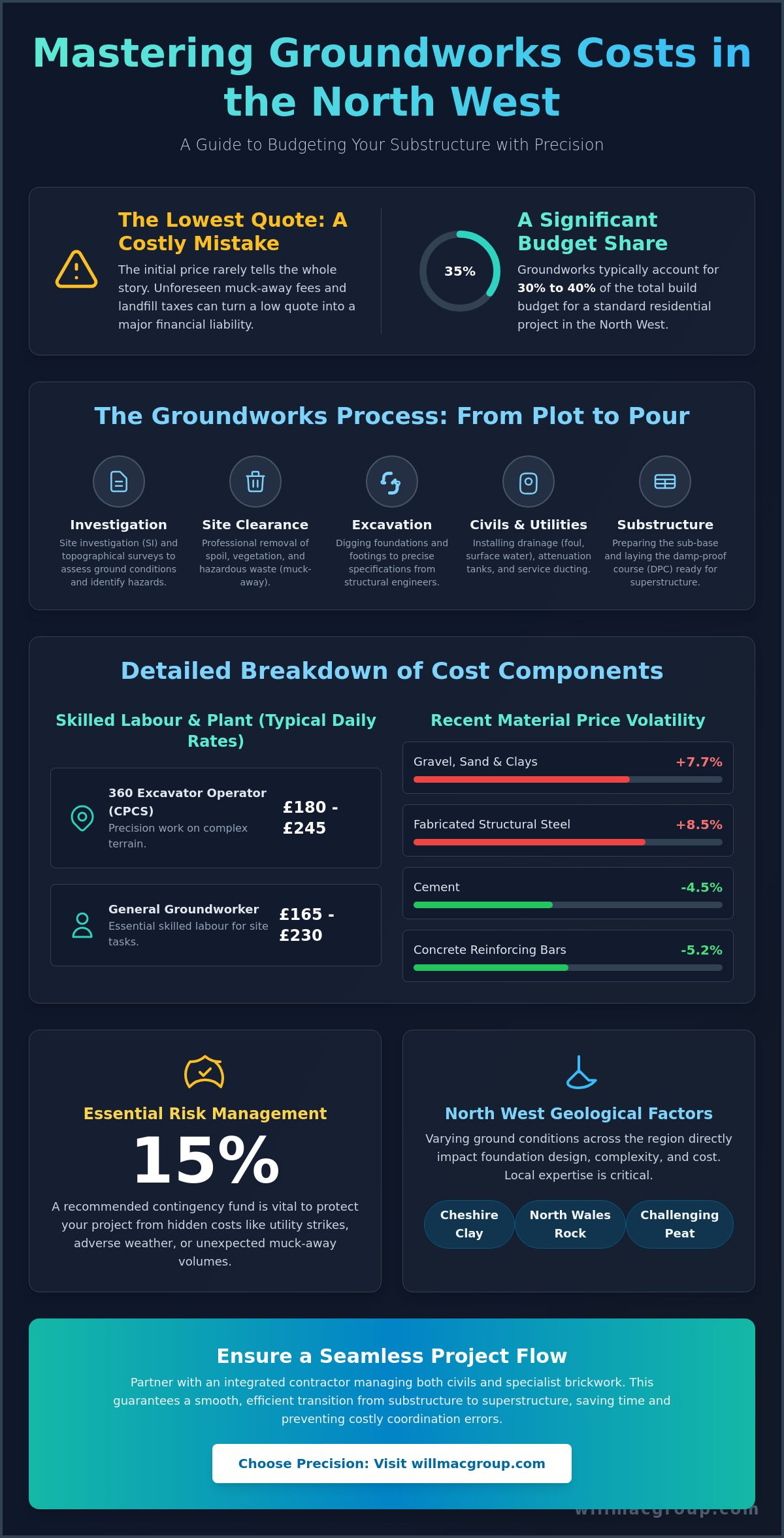
Groundworks are inherently the most unpredictable phase of any construction project. Unlike the superstructure, where materials are visible and measurable, the substructure deals with variables hidden beneath the surface. This uncertainty is why groundworks costs North West often fluctuate if a robust risk-management strategy isn’t in place. We advise clients to adopt a 15% contingency rule for this phase, rather than the standard 5% to 10% used later in the build. This buffer isn’t a sign of poor planning; it’s a professional acknowledgement that even the most thorough site investigation can’t account for every subterranean anomaly.
Utility strikes represent one of the most significant threats to both your budget and site safety. Hitting an unmapped high-voltage cable or a primary water main can lead to catastrophic repair fees and immediate site shutdowns. Beyond the direct repair costs, the resulting delays can cause a ripple effect through your entire build schedule. Relying on historic service drawings is rarely sufficient. Modern projects require active detection and protection of existing service runs to prevent these avoidable financial shocks.
Site Investigation (SI) reports are your best tool for achieving fixed-price certainty. These reports provide the data required to design foundations that are neither over-engineered nor insufficient. However, you must remain aware that Building Control inspections can still mandate changes. An inspector might examine an open trench and, based on the exposed soil, require deeper excavations than originally planned. This leads to an immediate increase in machine hours, concrete volume, and muck-away requirements. For a transparent breakdown of your project requirements, speak to our team about our civils and groundworks expertise.
Investing in topographical surveys allows us to calculate exact excavation and fill volumes, reducing the risk of “estimated” muck-away quotes that often grow mid-project. Trial pits and boreholes provide a physical look at the soil strata, identifying water tables or rock layers before machines arrive. On urban sites, Ground Penetrating Radar (GPR) utility mapping is essential for identifying non-metallic pipes or forgotten infrastructure that traditional cable avoidance tools might miss.
Budgeting must also include the administrative side of the substructure. Building Regulations application fees and structural engineer sign-off costs are standard, but Party Wall Agreements are often overlooked. If you’re working near a neighbouring boundary, legal and surveyor costs can escalate quickly. Additionally, ensure your budget covers environmental compliance, including waste transfer notes and the proper management of drainage discharge to meet local North West authority standards.
Willmac Group brings 25 years of industry experience to every project across the North West and North Wales. We understand that the foundation phase isn’t just about moving earth; it’s about preparing the site for the structural integrity of the brickwork that follows. By positioning ourselves as a local specialist for Chester and Cheshire, we’ve developed a deep understanding of the regional soil variations discussed throughout this guide. Our approach focuses on stability and high standards, ensuring that groundworks costs North West are managed with precision and professional reliability. As specialist foundation laying contractors North West clients trust, we navigate the complex geology of the region to deliver compliant, structurally sound results on every project.
We provide a unique advantage by managing both civils and specialist brickwork under one roof. This dual expertise eliminates the common friction points that occur when a groundworks contractor hands over a site to a separate building team. We take pride in our craftsmanship and maintain a commitment to quality that is both established and approachable. Our clients benefit from a partner who understands the full lifecycle of a project, from the first excavator bucket to the final damp-proof course. This integrated oversight allows for proactive ground risk management, identifying potential issues before they impact the construction schedule.
Transparency is the cornerstone of our quoting process. We don’t believe in aggressive sales tactics or hiding costs behind vague placeholders. Instead, we provide a structured and informative breakdown of every task. We use our specialized knowledge to guide you through the complexities of site preparation, ensuring you feel fully informed at every stage. This industrious and community-oriented personality has made us a dependable guide for developers and homeowners throughout the region.
Our brickwork expertise ensures that foundations are perfectly set for the first course of bricks. Precision at the substructure level is non-negotiable. When the same team manages the civils, groundworks, and builds, the efficiency gains are substantial. We reduce project timelines by coordinating these phases internally, which removes the delays often associated with subcontracted handovers. Our case studies across complex North West residential projects demonstrate how this methodical approach delivers solid foundations that stand the test of time.
To provide an accurate and reliable estimate, we require robust documentation, including structural engineer specifications and site investigation reports. We’re committed to offering fixed-price elements whenever the available data allows for a clear assessment of the ground conditions. This transparency builds trust and provides the financial predictability essential for a successful build. If you’re ready to secure the future of your project, Contact Willmac Group for a professional groundworks assessment. We look forward to providing the stable start your construction deserves.
Navigating the complexities of substructure work requires a balance of technical insight and regional expertise. We’ve explored how accurate site investigations and a robust 15% contingency buffer protect your budget from the hidden variables of soil composition and utility mapping. Understanding the specific demands of Cheshire clay or North Wales gradients is essential for managing groundworks costs North West effectively. This proactive approach transforms a high-risk phase into a controlled, predictable start for your build.
With over 25 years of industry experience, Willmac Group provides the specialist expertise in civils, groundworks, and brickwork needed to bridge the gap between the soil and the superstructure. We’re trusted by residential and commercial clients across the region for our transparent approach and commitment to structural excellence. Choosing a partner who understands the full lifecycle of your project ensures that your construction begins on stable ground. Secure your project’s foundation with Willmac Group today. Your build deserves a start that is as reliable as the finished structure.
Groundworks for a standard 3-bedroom house are calculated based on the total square metre rate of the build and the specific foundation design required. In 2026, residential construction in the region typically averages between £1,900 and £2,600 per square metre, with the substructure representing a significant portion of that investment. The final figure is determined by soil load-bearing capacity and the complexity of the drainage system identified during the initial site investigation.
The primary driver for higher groundworks costs North West in areas like Cheshire is the prevalence of heavy clay soil. This specific geology requires deeper foundations to reach stable strata and mitigate the risks of heave and shrinkage. Additionally, the proximity to protected trees in many Cheshire suburbs often necessitates specialised “no-dig” techniques or air-spade excavation, which increases both labour time and equipment costs compared to more straightforward plots.
Organising muck-away independently is rarely cost-effective and often introduces significant logistical risks to the build schedule. Professional contractors have established relationships with waste transfer stations and ensure full compliance with strict landfill tax regulations and waste transfer notes. If your self-organised grab lorry is delayed, it can halt the entire excavation process, leading to expensive plant hire standing time that far outweighs any minor savings on disposal fees.
A standard house extension in Chester usually requires two to three weeks for the groundworks phase to reach the damp-proof course. This timeline includes site clearance, excavation, foundation pouring, and the installation of essential drainage and utility ducting. However, restricted access in historic city centre plots or the discovery of unmapped utilities can extend this duration. We always provide a detailed schedule once the specific site constraints are fully understood.
Excavation and muck-away often represent the largest single expense in a comprehensive groundworks package. The cost is driven by the volume of spoil removed and the associated landfill taxes, which are particularly high if the soil is classified as non-inert or contaminated. On sites requiring deep foundations or piled solutions, the combination of specialist plant hire and structural steel reinforcement also becomes a primary cost driver for the project.
A professional soil test or site investigation is highly recommended before seeking a fixed-price groundworks quote. Without this data, any estimate is merely a placeholder that is likely to change once digging begins and the true ground conditions are revealed. Knowing the load-bearing capacity and chemical composition of the soil allows us to provide a precise breakdown of material requirements and disposal costs, giving you much greater financial certainty.
Discovering an unmapped utility pipe requires an immediate halt to mechanical excavation in the immediate area to ensure site safety. The relevant service provider must be notified to identify the pipe and determine if it is live or redundant. This situation often triggers a “hand-dig” requirement around the utility, which slows progress and impacts the budget. Using Ground Penetrating Radar mapping during the pre-construction phase is the best way to avoid these costly surprises.
Foundations must be deeper near trees to protect the structure from soil desiccation and the subsequent risk of subsidence. Trees extract large volumes of moisture from the ground, causing certain soil types, especially Cheshire clay, to contract significantly. By digging deeper, we ensure the footings are seated in stable soil that is not affected by seasonal moisture changes or root activity, preventing the structural movement that leads to cracking.