
The success of your Cheshire build is determined long before the first brick is laid; it’s won or lost in the soil. Engaging the right site preparation contractors Cheshire is the most effective way to mitigate the anxiety surrounding unforeseen ground conditions and the budget overruns that often follow. Whether you’re planning a new build or an extension, it’s natural to feel concerned about the complexities of drainage or the specific sequence of groundworks required to meet local standards.
This guide provides a clear roadmap to master the essential steps of site preparation, helping you avoid structural failures and maintain a cost-effective budget. We promise to show you how to ensure your project is fully compliant with evolving regulations, such as the Building Safety Levy effective from October 2026. We’ll explore the critical stages of ground assessment, navigate the latest Part L and Part O building regulations, and explain how to select a dependable local partner to safeguard your investment from the very start.
Site preparation is the comprehensive process of readying a plot of land for construction. It’s the most critical phase for the structural integrity of any build. While some might view it as simple land clearing, professional pre-construction services involve a detailed engineering approach to ensure the ground can support the intended load. Professional site preparation contractors Cheshire understand that the stability of your home or commercial development depends entirely on what happens beneath the surface before a single foundation is poured.
There is a significant distinction between basic site clearance and technical groundworks. Clearance typically involves removing debris and surface vegetation, whereas groundworks require precise excavation to specific formation levels based on soil analysis. In regions like Cheshire, where soil composition can vary from heavy clay to sandy pockets, understanding load-bearing capacity is vital. Failing to address these technical requirements often leads to catastrophic issues like subsidence or drainage failure. Poorly managed sites also risk planning breaches, especially when local council requirements for soil management or boundary protection aren’t strictly followed.
Successful site preparation acts as an insurance policy for your project. By identifying underground obstructions like old foundations, forgotten wells, or utility pipes early, site preparation contractors Cheshire help you avoid expensive delays later in the build. This phase also ensures your project remains compliant with building control teams at Cheshire West and Chester or Cheshire East Council.
Beyond compliance, a well-prepared site creates a safe, organised environment for subsequent trades. When the site is level, the drainage is in place, and the access routes are established, bricklayers and other contractors can work more efficiently. This methodical approach maintains the momentum of your construction schedule and prevents the chaos of overlapping trades on an unready plot. Taking the time to get the ground right isn’t just a technical requirement; it’s a financial safeguard.
A successful construction project relies on a methodical sequence of events that begins long before the first delivery of bricks arrives. Professional site preparation contractors Cheshire follow a structured programme to ensure the ground is stable, compliant, and ready for the build. Central to this process is the site manager, who coordinates specialized plant and personnel to keep the project on schedule. Attempting to rush these early stages often leads to complications during the structural phase, so it is vital to respect the order of operations.
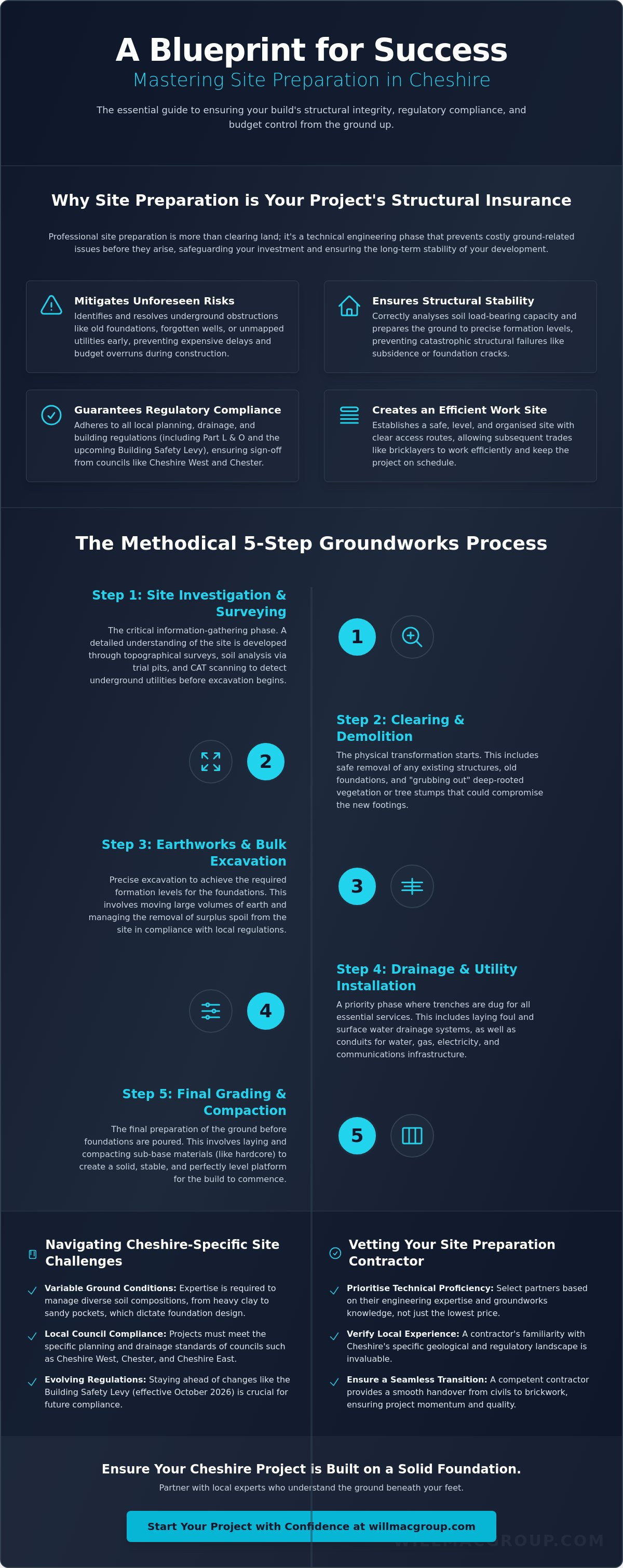
The scope of these works is broad. According to the official definition of site preparation, the process includes everything from earthmoving and technical levelling to the installation of temporary access roads. By following a rigorous five-step framework, developers can mitigate risks and ensure a seamless transition into the primary construction phase.
The first step is always information gathering. You cannot build with confidence until you understand exactly what lies beneath the surface. Commissioning a topographical survey is essential to map levels and boundaries with millimetre precision. Alongside this, soil analysis through trial pits determines the specific foundation type required, whether that’s standard strip footings or deep trench fill. Safety is paramount during this phase; site preparation contractors Cheshire use CAT scanning equipment to identify “unseen” services like high-voltage cables or water mains before any teeth enter the ground.
Once the surveys are complete, the physical transformation begins with site clearance. This involves “grubbing out” tree stumps and removing surface vegetation that could compromise the footings. If the plot contains existing outbuildings or masonry structures, these must be demolished safely. A professional approach involves more than just removal; it requires organising waste responsibly. We focus on recycling materials amongst local Cheshire facilities whenever possible to reduce the environmental impact of the build. If you are planning a complex project, consulting with a qualified local builder early can help identify which materials might be salvaged for reuse.
Precision is the hallmark of the excavation stage. Bulk earthmoving is required to achieve the correct formation levels dictated by the design. This isn’t just about moving soil; it’s about achieving the exact depths required by the structural engineer’s plan. Managing spoil heaps is a logistical challenge that requires careful planning to maintain site cleanliness and safety. Proper excavation ensures that the foundations are poured onto undisturbed, load-bearing ground, providing the stability your building requires for decades to come. To fully appreciate why are groundworks important for a new build, it’s worth understanding how each excavation decision directly influences the long-term structural performance of the finished property.
Cheshire presents a unique set of challenges that generic national advice often misses. For site preparation contractors Cheshire, local knowledge is a technical necessity rather than a marketing phrase. The region’s diverse landscape, ranging from the dense urban centres of Chester and Ellesmere Port to the narrow rural lanes of the Cheshire Plain, dictates the type of machinery and logistics required for a successful start. Understanding the specific constraints of our local geography is the only way to ensure a project remains on schedule and within budget.
The defining geological feature of our region is the prevalence of heavy clay soil. This material is notoriously temperamental, exhibiting significant volume changes based on moisture content. During dry summer months, clay shrinks, whilst heavy winter rainfall causes it to swell. This behaviour can exert immense pressure on foundations if not correctly managed from the outset.
To achieve Building Regulations approval, an accurate soil classification is mandatory. On many sites, this necessitates digging deeper foundations than the national average or installing specific “heave” protection measures, such as clayboard. These compressible materials create a void between the ground and the concrete, allowing the soil to expand without compromising the structural integrity of the build. Experienced site preparation contractors Cheshire will identify these soil types during the trial pit phase, ensuring the foundation design is fit for purpose from day one. For a deeper understanding of how specialist expertise addresses these geological challenges, our guide to civil engineering contractors Chester explores the technical nuances of working within the Cheshire landscape.
Managing surface water is a critical component of modern site preparation. Current planning policies in Cheshire West and Chester, as well as Cheshire East, place a heavy emphasis on Sustainable Drainage Systems (SuDS). The goal is to mimic natural drainage, preventing the local sewer network from being overwhelmed during heavy storms.
Integrating soakaways and attenuation tanks into the site preparation phase is essential for new developments. These systems store excess rainwater and release it slowly into the ground or the watercourse. Ensuring these connections to existing North West water networks are professionally managed requires precise levels and technical expertise. If your site has poor permeability due to high clay content, alternative SuDS solutions like oversized pipes or crates may be required to meet local authority standards.
The logistics of moving heavy plant through Cheshire’s rural areas require careful planning. Narrow lanes often limit the size of excavators and wagons that can reach a plot, making site-specific logistics plans a necessity. Additionally, the region is rich in biodiversity. Protecting local ecology, such as established hedgerows or nesting sites, during the clearance phase isn’t just an ethical choice; it’s a legal requirement that must be integrated into the initial site programme to avoid costly delays or fines from the local council.
Selecting the right team to handle your groundworks is a decision that dictates the pace and safety of your entire project. While it’s tempting to simply search for the most competitive price, professional site preparation contractors Cheshire provide value through technical foresight and local reliability. A contractor who understands the full build lifecycle, from initial excavation to the final brickwork, will anticipate problems that a plant-hire-only firm might overlook. This comprehensive understanding ensures that the handover between different construction phases is seamless and structurally sound.
A permanent local base in the North West is a significant advantage. It means the contractor is familiar with local council expectations and has established relationships with regional waste facilities. This local presence often translates to better accountability and a deeper commitment to maintaining the high standards expected in Cheshire’s residential and commercial sectors. Choosing a partner who prioritises stability and professional transparency is essential for a stress-free build.
Before signing any contract, you must verify that the firm holds the necessary legal and professional safeguards. At a minimum, ensure they carry Public Liability and Employers Liability insurance with cover between £5m and £10m. This protects you against claims arising from accidental damage or site injuries. You should also check that the crew holds valid CSCS cards and CPCS plant operator qualifications. These certifications prove that the individuals operating heavy machinery have been trained to the required safety and technical standards. Asking for recent case studies of similar projects in Chester or nearby villages will give you a clear indication of their capabilities.
A site visit is the best opportunity to gauge a contractor’s professionalism. Ask specific questions about their operational plans to avoid future disputes:
If you are looking for a team that combines technical groundworks expertise with a commitment to quality, consider discussing your project with an established Cheshire construction and groundworks specialist. Taking the time to vet your team now prevents expensive corrections later.
Site preparation is the silent foundation of a build, but the transition to visible construction is where many projects falter. By choosing site preparation contractors Cheshire who also specialise in brickwork and civils, you eliminate the friction that often exists between separate trades. Willmac Group provides a unified approach, ensuring that the precision achieved during the groundworks phase translates directly into a perfectly square and level structure. This continuity is vital for maintaining the long-term stability and aesthetic quality of your property.
One of the most common issues on construction sites is the “blame game” between different subcontractors. A bricklayer might find foundations slightly out of alignment or discover that the drainage points aren’t exactly where the plans dictate, leading to delays and remedial costs. When a single partner manages the project from the footings up, this risk is removed. Our 25 years of experience in the Chester area has taught us that efficiency is built on accountability. We ensure the transition from bulk excavation to the first course of bricks is handled with technical continuity and professional pride.
High-quality structural finishes don’t start at the damp proof course; they start at the bottom of the trench. Our expertise in civils and groundworks means we understand the complex requirements of drainage and load-bearing capacity discussed in previous sections. This knowledge allows us to prepare a site that isn’t just “ready” for a builder, but is optimised for the specific structural demands of a new build or extension. By managing the entire lifecycle of the ground-level works, we ensure foundations are perfectly level and ready for the first course of masonry without delay.
This integrated approach also leads to more efficient build times. Because our teams are used to working together, the handover between the excavation crew and the bricklayers is instantaneous. There’s no waiting for a new contractor to familiarise themselves with the site or for a third party to verify the levels. We take full responsibility for the accuracy of the work, providing you with a single point of contact and total peace of mind throughout the most critical phase of your project.
Every plot in the North West has its own personality, from the stubborn clay of the Cheshire Plain to the logistical constraints of urban Chester. We invite you to discuss your specific site challenges with our team to see how our experience can benefit your development. Whether you’re planning a residential extension or a bespoke new build, our “ground up” service provides the stability and transparency your project deserves. Contact Willmac Group for professional site preparation in Cheshire to ensure your construction journey begins on the best possible footing.
Organising site preparation is more than a preliminary task; it’s the structural foundation of your entire investment. By respecting the methodical process of surveying, clearing, and technical excavation, you protect your project from the unique challenges of Cheshire clay and complex drainage regulations. Selecting experienced site preparation contractors Cheshire ensures that these critical early stages are handled with the precision required for a seamless transition into the primary build.
Willmac Group brings directors with over 25 years of industry experience to every plot. Our specialist expertise in both civils and brickwork means we understand how to prepare the ground to deliver a superior finish from the footings up. As a local, Chester-based team, we take pride in supporting homeowners and developers across the North West and North Wales with reliable, high-standard construction services.
Enquire about our Site Preparation and Civils services today to discuss your upcoming project. We look forward to helping you turn your vision into a stable, compliant reality.
Site preparation for an extension typically includes clearing the immediate area of vegetation, removing existing paving or outbuildings, and excavating footings to the depth required by the structural engineer. It also involves identifying and rerouting any existing services that may be affected by the new footprint. Professional site preparation contractors Cheshire ensure these tasks are sequenced to avoid compromising the stability of the existing house whilst maintaining a clean and safe working environment.
You generally don’t need separate planning permission for simple site clearance, but you must ensure the work complies with your existing planning consent and any Tree Preservation Orders (TPOs). If the work involves demolishing a structure, you may need to submit a Section 80 notice to Cheshire West and Chester Council, which carries a fee of £236.00 as of June 2026. It’s vital to check if your site is in a conservation area before removing established greenery.
The duration of the site preparation phase varies based on the size of the plot and the complexity of the ground conditions, but it typically takes between one and three weeks. A small extension might be cleared and excavated in five days, whilst a larger residential development could take several weeks for bulk earthmoving and infrastructure installation. Factors such as weather conditions and the discovery of underground obstructions will influence this timeline.
Work must stop immediately to assess the situation and identify whether the service is live. Using CAT scanning equipment before digging helps prevent these encounters, but if an unmapped utility is found, your contractor will contact the relevant utility provider to arrange for safe diversion or protection. Professional site preparation contractors Cheshire have established protocols for managing these discoveries without causing significant delays or safety risks to the construction programme.
Whilst you can handle surface clearing and debris removal, technical tasks like bulk excavation and drainage installation require specialist plant and engineering knowledge. DIY errors in groundworks often lead to structural failures or drainage issues that are far more expensive to fix later. It’s usually safer and more cost-effective to hire a professional builder who understands soil behaviour and building control requirements to ensure the long-term stability of your project.
The cost of soil testing depends on the type of analysis required, such as simple trial pits or more complex borehole investigations. Whilst we don’t quote specific contractor prices here, you should budget for these professional surveys as a vital part of your pre-construction services. Accurate soil classification is mandatory for Building Regulations approval and determines whether you need specific heave protection in Cheshire’s clay-heavy soil.
Waste disposal is managed through a combination of on-site recycling and the use of licensed waste transfer stations. For projects in Cheshire West and Chester, skip licences currently cost £110.00 per licence as of April 2026. We aim to reuse clean spoil and crushed concrete on-site where possible to reduce environmental impact and transport costs, whilst non-recyclable materials are sent to local facilities amongst the North West network.
A topographical survey provides a precise map of the site’s levels, boundaries, and existing features, which is essential for accurate foundation design and drainage planning. Without this data, there’s a high risk of errors in the finished floor levels or issues with surface water run-off. This survey ensures that the building is positioned correctly according to the planning permission and that the groundworks are technically sound from the outset.