
The most critical phase of your construction project is often the one that remains completely hidden from view once the keys are handed over. It’s common to feel a sense of unease when looking at a muddy site, wondering why the budget is being spent on what looks like simple digging. However, understanding why are groundworks important for a new build is the first step in protecting your investment from long-term structural issues or drainage failures. These early works form the literal and metaphorical foundation of everything that follows, ensuring that your home remains stable and dry for decades.
You’re likely worried about encountering “hidden” costs beneath the soil or getting lost in technical jargon like attenuation and trench fill. We recognise that this phase can feel opaque, especially with the shifting landscape of UK building regulations and the introduction of the Building Safety Levy in October 2026. This guide provides a clear, professional overview of the entire groundworks process, from initial site clearance to the final foundation pour. You’ll gain a methodical checklist of what to expect on-site, a better grasp of essential terminology, and the confidence to choose a specialist contractor who prioritises precision over shortcuts.
Groundworks represent the collective set of activities required to prepare a plot of land for the main structural phase of a build. This isn’t just about clearing space; it’s about engineering the environment to support the immense weight of a new property. Understanding why are groundworks important for a new build involves looking at how these initial steps prevent future subsidence or moisture ingress. Without a methodical approach to this phase, the integrity of the entire structure is at risk from the very first day.
Whilst the terms are often used interchangeably, there is a technical distinction between groundworks and civils (civil engineering). Groundworks typically focus on the immediate footprint and infrastructure of a specific building, such as a house extension or a new home. Civils, however, usually encompass larger-scale infrastructure projects like roads, bridges, or major drainage networks. In professional practice, these fields overlap significantly through Earthworks (engineering), where the principles of soil mechanics and site stabilisation apply regardless of the project’s scale. Both disciplines require a deep understanding of how soil behaves under pressure.
The groundworks phase begins the moment a site is secured and planning permissions are finalised. It’s the first physical activity on-site. The process transitions to the ‘above-ground’ or superstructure phase once the foundations are poured, the damp proof course is established, and the sub-floor is complete. This transition is a major milestone for any developer or homeowner. It moves the project from the messy, subterranean engineering stage into the visible construction of walls and floors.
Before a single spade hits the dirt, professional soil analysis is a mandatory first step. In areas like Chester and across the North West, groundworkers frequently contend with heavy clay, which expands and contracts significantly based on moisture levels. A thorough investigation identifies these characteristics along with potential hazards such as high water tables or historical mine shafts amongst local sites. These findings dictate the specific foundation design required to ensure the building remains stable for its entire lifespan.
Once the soil’s load-bearing capacity is confirmed, the physical work begins with site clearance. This involves the systematic removal of vegetation, topsoil, and any existing structures through controlled demolition. We then perform a ‘reduced level dig’ to reach the specific formation level required by the structural engineers. Managing this process requires careful organisation of ‘muck away’ services to dispose of waste materials responsibly and efficiently, ensuring the site remains clear and safe for the subsequent stages of the build.
Foundations serve a singular, vital purpose: they transfer the entire weight of a building into the ground below. This is exactly why are groundworks important for a new build; without this engineered transfer, the structure would settle unevenly, leading to catastrophic cracks or structural failure. Foundations act as the structural transition between the earth and the masonry. To ensure longevity, the depth and width of these foundations aren’t guessed. They are strictly governed by Building Regulations and the specific soil quality identified during the initial investigation phase. In the UK, Building Control officers must inspect the open trenches before any concrete is poured to verify that the depth is sufficient to reach stable, load-bearing ground.
Achieving absolute precision during the pour is essential. If the concrete isn’t perfectly level, every subsequent course of brickwork will struggle to compensate, leading to aesthetic and structural issues higher up the building. Detailed Groundworks on construction projects often involve complex calculations to ensure the footing can withstand vertical loads whilst resisting lateral pressure from the surrounding soil. This phase is the point where the theoretical plans of an architect meet the physical reality of the site. It’s the most unforgiving stage of construction; a mistake here is incredibly difficult and expensive to rectify once the walls start rising.
The choice of foundation depends heavily on the specific site conditions and the type of structure being built. Strip foundations are the standard choice for traditional brickwork extensions in Cheshire, providing a cost-effective and reliable base for steady soil. For sites with unstable ground or nearby trees, trench fill foundations offer a deeper, concrete-heavy alternative that reaches stable strata. In contrast, raft foundations distribute the load across a large reinforced concrete ‘slab’, making them ideal for softer soils where individual footings might sink. Understanding why are groundworks important for a new build means recognising that the foundation type isn’t a choice of preference, but a necessity dictated by the land itself. Working with experienced foundation laying contractors North West specialists ensures that the correct foundation type is selected based on a thorough understanding of the region’s complex geology, from the heavy clay of Cheshire to the glacial till of the Mersey Basin.
The work doesn’t end once the concrete sets. Substructure brickwork, often called ‘footings’, involves building up from the foundation to the damp-proof course (DPC). This stage requires the expertise of specialist brickwork contractors who ensure the walls are perfectly aligned and squared. This substructure prepares the site for the main structural walls, creating a level and moisture-resistant platform for the rest of the build. It’s during this phase that internal drainage and service ducts are often integrated, ensuring they are positioned correctly before the floor slab is poured. If you’re looking for a reliable partner for this phase, engaging a proven builder ensures that the transition from ground to masonry is seamless.
The installation of subterranean services is another fundamental reason why are groundworks important for a new build. These systems act as the lifeblood of the property, managing waste and delivering essential resources. For maximum efficiency and site integrity, drainage must be installed concurrently with the foundations. This ensures that the pipework is safely embedded before the heavy machinery of the main construction phase arrives. It’s a logistical sequence that prevents the need for disruptive and costly excavations later in the project. Installing this primary infrastructure before any concrete floor slabs are poured is a non-negotiable standard for professional builders.
Precision is the hallmark of a high-quality drainage installation. To ensure efficient gravity-fed flow and prevent the accumulation of solids or standing water, drainage pipes must be laid with absolute precision, typically adhering to a minimum gradient of 1:40 for 100mm foul drains or 1:80 for 150mm pipes. Even a slight deviation in these levels can lead to persistent blockages that are difficult to resolve once the building is occupied. This level of technical accuracy is what separates a specialist groundworks team from a general labourer.
Modern construction requires a clear separation between foul water and surface water systems. Foul drainage carries sewage and greywater from kitchens and bathrooms to the main sewer network. In contrast, surface water systems manage rainwater runoff from roofs and paved areas. In many modern North West developments, we utilise attenuation tanks or soakaways to manage this runoff locally, preventing the public sewer system from becoming overwhelmed during heavy storms. We also install strategically placed inspection chambers, or manholes, at every change of direction or pipe junction to allow for essential system maintenance and future-proofing.
Beyond drainage, the groundworks phase involves preparing the site for electricity, gas, water, and telecommunications. We lay specific colour-coded ducts to protect these service lines as they enter the property’s footprint. It’s vital that these utility entries are correctly positioned to match the internal building layout; a misplaced water pipe or electrical conduit can delay the entire first-fix plumbing and electrical phase. For projects involving complex utility management or large-scale infrastructure, we often coordinate with civil engineering contractors in Chester to ensure all connections meet the stringent requirements of local utility providers. This methodical approach ensures that when the time comes to ‘turn the lights on’, the infrastructure is ready and reliable. Understanding why are groundworks important for a new build means recognising that the most important parts of a home’s functionality are often those you never see.
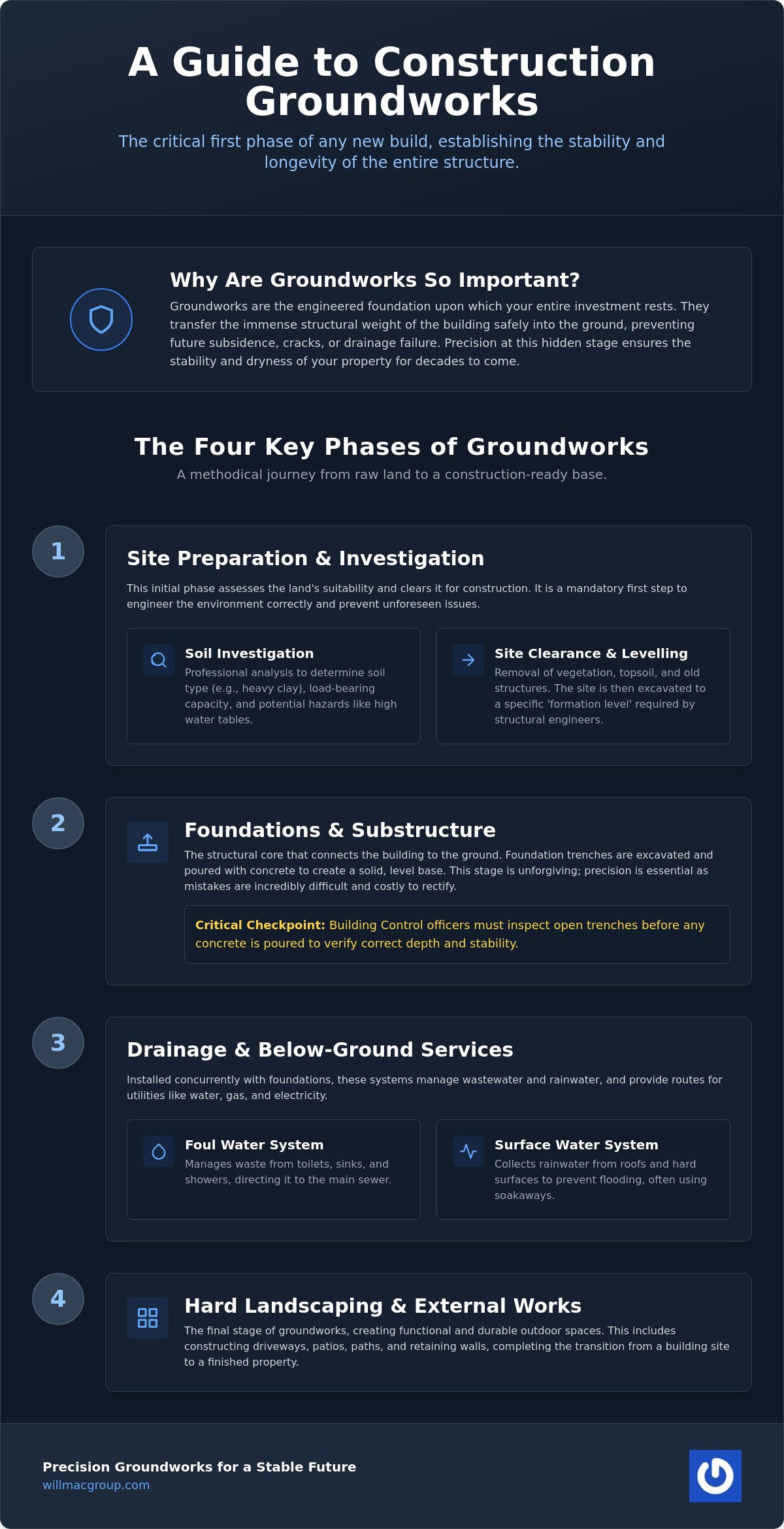
Professional groundworks extend far beyond the immediate footprint of the building. Whilst the foundations are the structural priority, the preparation of the surrounding site is equally vital for the functionality of the property. This holistic approach is another reason why are groundworks important for a new build; it ensures that your patios, driveways, and garden paths remain stable and level for years to come. Without proper site preparation, even the highest quality paving will eventually sink, crack, or suffer from poor drainage. We view the entire plot as an engineered environment where every square metre must be stabilised and managed correctly.
In regions like North Wales, where sites often feature varying elevations, groundworks play a crucial role in creating usable outdoor space. This involves more than just moving dirt; it’s about managing the literal weight of the land. Engaging specialist groundworks contractors North Wales professionals ensures that the complex drainage regulations and varied terrain of the region are managed correctly from the outset. We integrate retaining walls and complex drainage solutions into the early phases of the project, ensuring that the finished garden is as secure as the house itself. This early intervention prevents the need for disruptive remedial work once the main construction is complete and the landscaping phase begins.
The longevity of any driveway or road depends entirely on the quality of the sub-base. For heavy-load areas, we typically prepare the ground with a compacted layer of Type 1 MOT crushed stone. This layer provides the necessary load-bearing capacity to prevent the top surface from shifting under the weight of vehicles. We also install precise kerbs and edgings to define site boundaries and manage water runoff effectively. For large paved areas, we ensure the gradient is calculated to direct surface water into the correct drainage channels, preventing pooling and potential ice hazards during winter months.
Managing slopes and gradients requires professional earthmoving and ‘cut and fill’ techniques. By redistributing soil across the site, we can create level plateaus for construction and leisure. On more challenging plots, we build structural retaining walls using reinforced concrete or specialised masonry to hold back significant volumes of earth. These structures must be engineered to withstand lateral pressure and provide long-term stability for the entire site. For projects with complex levels or challenging soil, it’s wise to consult site preparation contractors in Cheshire who have experience in local terrain management. If you’re planning a project that requires expert site handling, our team provides the Civils & Groundworks expertise needed to ensure your land is perfectly prepared.
Success in groundworks isn’t just about moving earth; it’s about adhering to the strict legal framework that governs UK construction. This legal oversight is a major reason why are groundworks important for a new build, as it ensures that every subterranean element meets national safety standards. Building Control officers must visit the site at specific milestones, most notably to inspect open trenches before any concrete is poured. These inspections verify that the depth and soil conditions align with the structural engineer’s specifications. Failing to coordinate these visits correctly can lead to significant delays or even the forced removal of installed work.
Safety management is equally critical during this phase. Sites are often at their most hazardous when deep trenches are open and heavy machinery like excavators and dumpers are in constant motion. A professional contractor implements rigorous safety protocols to manage these risks, ensuring that excavations are properly shored and that the site remains secure for both workers and the public. Choosing a partner with deep experience in the North West landscape reduces the likelihood of unforeseen complications, as they are already familiar with the specific geological challenges and local authority requirements of the region. Engaging dedicated foundation laying contractors North West professionals who understand the 2026 NHBC Standards and local soil variations is essential to ensuring your project sits on a stable, compliant base from the outset.
An integrated approach to construction provides the most seamless experience for homeowners and developers. When the same team handles the initial site preparation and the subsequent masonry, the transition is smoother and the risk of communication errors is minimised. We’ve seen the value of this continuity firsthand through our work on house extensions in Chester, where precise groundworks lay the foundation for flawless brickwork and structural stability.
All groundwork activities must comply with specific sections of the UK Building Regulations, primarily Part A, which covers structural integrity, and Part H, which focuses on drainage and waste disposal. These regulations are the benchmarks for a safe and legal build. The scope of work is dictated by the structural engineer’s calculations, which account for the building’s load and the specific soil characteristics of the site. Once the services are installed, maintaining accurate ‘as-built’ records of all underground pipes and cables is essential for future maintenance and property sales. This documentation provides a clear map of the property’s infrastructure, which is invaluable for any future renovations or landscaping.
Our team excels in managing the complex transition from subterranean engineering to specialist brickwork. By overseeing the project from the first dig to the final course of masonry, we ensure that every measurement is exact and every regulation is met. We provide reliable service across Chester, the North West, and North Wales, bringing a sense of quiet confidence to every site we manage. We understand that the stability of your home depends on the quality of the work beneath the surface. If you are ready to start your project on the right footing, Contact Willmac Group today to discuss your groundworks and civils requirements.
Professional groundworks represent far more than just the opening phase of a build; they are the fundamental engineering that ensures your property remains stable, dry, and compliant for its entire lifespan. By meticulously managing site clearance, foundation precision, and subterranean drainage, you protect your investment from the ground up. Understanding why are groundworks important for a new build is the key to transitioning smoothly from a muddy plot to a structural masterpiece without the stress of “hidden” costs or regulatory failures. This phase dictates the success of every brick laid thereafter.
Success depends on choosing a partner who understands the technical overlap between site preparation and masonry excellence. With over 25 years of industry experience, Willmac Group provides specialist expertise in both civils and brickwork, ensuring every project is local authority compliant and fully insured. We pride ourselves on a methodical approach that builds trust through transparency and technical skill. Contact Willmac Group for expert groundworks and civils in Chester to discuss how we can bring precision to your next development. We look forward to helping you start your construction journey on solid ground.
The most expensive elements are typically the excavation and the disposal of waste material, commonly referred to as muck away. These costs can escalate quickly if the soil is contaminated or if the site has restricted access for heavy machinery. Large volumes of earthmoving require specialised equipment and skilled operators, which accounts for a significant portion of the initial budget for any construction project.
You absolutely need a structural engineer to provide the technical calculations required for Building Control approval. They determine the necessary foundation depth and type based on soil reports and the building’s specific load requirements. This ensures the structural integrity of your project from the very first day. We work closely with these professionals to ensure every trench and pour matches their specifications precisely.
Groundworks can certainly proceed during winter, although heavy rain and frost require careful management by the site team. Frozen ground can be difficult to excavate, and concrete shouldn’t be poured if temperatures are too low, as it won’t cure correctly. We use frost blankets and specific additives when necessary to maintain progress. Understanding why are groundworks important for a new build involves recognising that expert weather management is a key part of site stabilisation.
Foundations for a standard extension typically need to be at least 1 metre deep to reach stable soil and avoid the effects of frost heave. However, this depth often increases if there are nearby trees or if the ground consists of heavy clay. Building Control officers will always inspect the open trenches to confirm they’ve reached a suitable load-bearing strata before allowing the concrete pour to begin.
We immediately stop work to identify the service and determine whether it’s currently live. Unexpected utilities are common on brownfield sites or older properties where records might be incomplete. Once identified, we coordinate with the relevant utility provider to either protect the service in situ or arrange for a professional diversion. Safety is our priority, so we use cable avoidance tools before any digging starts to minimise these surprises.
Site clearance is generally included in a comprehensive groundworks quote, but you should always verify the specific scope of work before signing a contract. This typically covers the removal of vegetation, topsoil, and existing hardstanding. If there are large structures to demolish or hazardous materials like asbestos present, these may be listed as separate items. We provide transparent breakdowns so you know exactly what’s covered.
A professional site investigation is the only way to confirm if your soil is suitable for standard strip foundations. We look for firm, non-shrinkable soils that can support the building’s weight without excessive settling over time. If we encounter soft clay or peat, we’ll recommend trench fill or raft foundations instead. This investigative phase is a primary reason why are groundworks important for a new build, as it prevents future structural movement.
Groundworks for a standard residential extension usually take between one and three weeks to complete. This timeline includes site clearance, excavation, drainage installation, and pouring the foundations. Factors such as extreme weather, complex utility diversions, or difficult ground conditions can extend this period slightly. We provide a methodical schedule at the start of the project to help you manage the transition to the main building phase.