
In the North West, the ground beneath your feet is rarely as stable as it appears. From the heavy clay of Cheshire to the glacial till of the Mersey Basin, the region’s complex geology means that a standard approach to groundworks is often a recipe for structural disaster. When you’re searching for foundation laying contractors North West, you need more than just a team with a digger. You require specialists who understand how to navigate the 2026 NHBC Standards and the specific demands of local soil variations.
It’s natural to feel concerned about the long-term stability of your build or the daunting complexity of Part A building regulations. A foundation failure isn’t just a technical error; it’s a threat to your entire investment. This guide will show you how to identify a specialist who can manage the entire groundworks lifecycle whilst ensuring your project sits on a stable, compliant base. We’ll explore the specific structural solutions required for our unique regional soils and explain how to ensure your project meets the latest Future Homes and Buildings Standards.
Every successful build begins beneath the surface. In the North West, where soil conditions vary from heavy clays to sandy deposits, the initial groundworks phase dictates the entire project’s lifespan. Choosing experienced foundation laying contractors North West ensures that the building’s weight is correctly distributed, preventing future issues like subsidence or heave. A properly engineered Foundation (engineering) serves as the structural interface between the earth and the edifice, making it the most critical investment in any construction lifecycle.
Professional groundworks do more than just provide stability; they set the pace and accuracy for the entire build. When the base is established correctly, every subsequent trade can work more efficiently. This reliability is the hallmark of a disciplined contractor who understands that a project’s success is determined in the first few weeks on-site. Without this firm start, even the most ambitious designs can suffer from long-term durability issues.
Precision in the early stages of a project isn’t just about safety; it’s about setting the standard for everything that follows. A high-quality foundation must be perfectly square and level to within millimetres. If these tolerances aren’t met, the error compounds as the building rises, leading to costly corrections during the installation of specialist brickwork. Willmac Group prioritises this level of accuracy, ensuring that every site is professionally prepared so that the build progresses smoothly and stays on schedule.
Hidden risks in the soil can lead to catastrophic project delays if they aren’t identified early. Professional foundation laying contractors North West bring the foresight needed to manage drainage complexities and unstable ground before the first bucket of concrete is poured. With over 25 years of industry experience, our team understands the regional nuances of Cheshire and North Wales. We focus on rigorous site preparation that meets modern building regulations, protecting your investment from the ground up through:
By managing the full groundworks lifecycle, we provide a stable, compliant base that allows your construction project to proceed with total confidence. This methodical approach reduces the likelihood of structural movement and ensures that your home or commercial development remains secure for decades to come.
A foundation is the structural base of a building, designed to transfer the load of the entire edifice safely into the ground. Without this critical interface, the weight of the structure would cause uneven settlement, leading to cracked walls and compromised integrity. For foundation laying contractors North West, the primary challenge lies in the region’s diverse and often unpredictable geology. Every site presents a unique set of variables that dictate the depth, width, and type of foundation required by structural engineers.
Soil analysis is the first step in any professional groundworks project. By examining the soil’s composition, engineers can determine its load-bearing capacity and how it will react to environmental changes. In the North West, we frequently encounter “argillic stagnogley” soils. These are fine-textured, naturally poorly drained soils that can be particularly challenging during periods of heavy rainfall or prolonged drought. Professional contractors use these findings to ensure the foundation design is robust enough to withstand the specific pressures of the local landscape.
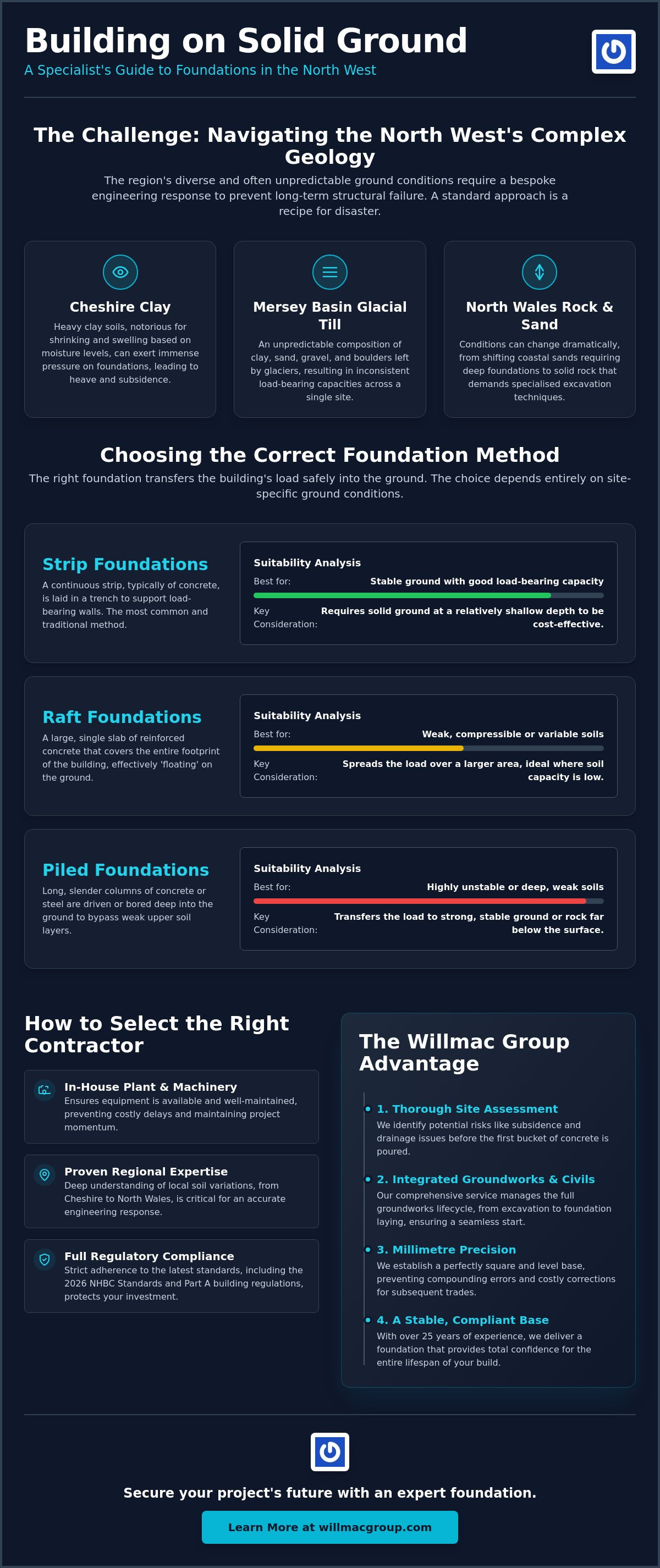
The geology of Cheshire is predominantly composed of Triassic sandstones and mudstones, often covered by a thick layer of glacial till. This clay-heavy soil is notorious for its tendency to shrink and swell based on moisture levels. When building in these areas, foundations must often be dug deeper to reach stable ground that isn’t affected by seasonal volume changes. Conversely, coastal projects in North Wales might deal with shifting sandy soils or, in some cases, solid rock that requires specialised excavation techniques. Working with experienced groundworks contractors North Wales who understand these specific terrain challenges is essential, and it’s for this reason that site preparation contractors Cheshire must prioritise soil testing to determine exactly which structural solution is fit for purpose.
Adhering to Part A of the UK Building Regulations is a legal necessity for any residential or commercial development. These regulations mandate that foundations must be adequate for the ground conditions, with a typical minimum depth of one metre, though this often increases in the presence of clay or nearby trees. As of January 2026, all NHBC-registered homes must also comply with the updated NHBC Standards 2026, which place a heavy emphasis on verifying ground conditions before work begins. Specialist contractors manage the relationship with building control, ensuring that every stage of the pour is inspected and approved. If you’re planning a new build or extension, our team can provide the civils and groundworks expertise needed to ensure your project begins on firm ground whilst remaining fully compliant with the latest standards.
Selecting a foundation method is a balance between engineering necessity and project economics. Every site in our region presents different challenges; what works for a suburban driveway won’t support a double-storey extension on Cheshire clay. Experienced foundation laying contractors North West avoid “one size fits all” solutions because they often lead to either expensive over-engineering or, worse, structural failure. Instead, the choice between strip, raft, or piled foundations depends on the load-bearing requirements of the structure and the physical access available on-site.
For many house extensions Chester homeowners undertake, the cost-benefit ratio often favours traditional methods if the ground is stable. However, as sites become more constrained or ground conditions more complex, the engineering response must adapt to ensure long-term integrity. A disciplined contractor evaluates these factors during the initial site visit to recommend a solution that balances durability with your budget.
Traditional strip foundations are the most common choice for residential extensions in the North West. They involve a relatively narrow strip of concrete that supports the load-bearing walls. When ground conditions are stable, trench fill foundations offer an even more efficient alternative. By filling almost the entire excavated trench with concrete, we reduce the need for extensive brickwork below ground level. This method is particularly effective on narrow sites where space for traditional masonry work is limited. It speeds up the project timeline whilst maintaining a high standard of structural accuracy.
In areas where the ground is poor or unpredictable, a raft foundation provides a more suitable alternative. This method involves a reinforced concrete slab that covers the entire footprint of the building, essentially allowing it to “float” on the soil. It’s an ideal solution for commercial units or residential projects situated on ground with low load-bearing capacity. By distributing the weight over a larger area, it reduces the risk of differential settlement.
When the soil is exceptionally unstable or consists of reclaimed land, piled foundations become a necessity. This involves driving or boring deep columns into the earth until they reach a more secure strata. These piles are then connected by reinforced concrete ground beams, which provide a level and stable platform for the build. This approach is the only way to guarantee stability amongst the more challenging terrains found across the North West. Choosing the right method ensures your build is both safe and cost-effective from day one.
Choosing between foundation laying contractors North West involves more than comparing bottom-line figures on a quote. Because the foundation is the single most important structural element of your build, the contractor’s technical competence and operational reliability are paramount. A specialist who possesses deep local knowledge of North West planning departments and building control officers can often navigate the approval process more efficiently than a firm from outside the region. This familiarity ensures that inspections are scheduled at the right intervals, preventing costly delays to your construction programme.
Operational capacity is another critical factor. Contractors who maintain their own in-house plant machinery and skilled labour force offer a level of schedule certainty that firms relying on subcontractors simply cannot match. When a company manages groundworks and civils North West as a single, integrated package, it eliminates the friction often found between different trades. This joined-up approach ensures that the transition from excavation to the first course of brickwork is seamless and professionally managed.
A reputable contractor should be transparent about their credentials and safety protocols. You should verify that they hold comprehensive public and employer liability insurance, alongside relevant industry accreditations. In-house Health & Safety management is a sign of a mature business that prioritises the wellbeing of its staff and the public. Modern plant fleets aren’t just about speed; they represent a commitment to site safety and environmental efficiency. Ask to see recent risk assessments and method statements to gauge their level of thoroughness.
A professional groundworks quote should be detailed and easy to understand. It ought to clearly outline the scope of work, including excavation depths, waste removal, and material specifications. To avoid “hidden extras” later in the project, ensure your contractor has reviewed a comprehensive site investigation report before finalising their price. For a clearer understanding of what to expect, you can refer to our guide on groundworks costs North West for realistic budgeting in the current market. If you are ready to begin your development with a partner you can trust, our team at Willmac Group provides the expert civils and groundworks support required for a stable start.
Willmac Group provides a comprehensive solution by bridging the gap between initial excavation and the finished structure. Many developers find that using separate firms for groundworks and the subsequent build creates communication gaps and logistical friction. As experienced foundation laying contractors North West, we eliminate these issues by managing the full project lifecycle. This integrated approach ensures that the structural integrity established in the trenches is maintained throughout the brickwork and finishing phases.
Choosing a single-contractor approach for new builds and extensions offers significant advantages for project momentum. It allows for a more predictable timeline, as there is no waiting for one firm to vacate the site before another arrives. We take pride in our ability to deliver high-quality structural finishes that meet the exacting standards of modern developers across Chester and Cheshire. Our commitment to reliable project delivery means your build stays on track from the first bucket of earth to the final course of masonry.
One of the primary benefits of working with foundation specialists who also understand the requirements of the brickwork phase is the precision of the hand-over. We ensure that the foundation is not just structurally sound but also perfectly positioned for the first lift of masonry. This attention to detail prevents the need for adjustments later in the build, saving both time and material costs. Our 25 years of experience in the industry ensures a seamless build process that transitions smoothly from ground level to the rising walls.
We specialise in bespoke residential and commercial construction projects, tailoring our services to meet the specific demands of your site. Whether you are dealing with the challenging clay soils of the North West or require complex civils and groundworks for a large-scale development, we provide the authoritative guidance you need. We invite you to get in touch for a professional consultation and site assessment, where we can discuss the most effective foundation strategy for your project.
Contact Willmac Group today for expert foundation laying in the North West.
Every successful project in Cheshire or North Wales relies on an engineering response that respects the local soil. We’ve explored how identifying the correct foundation method, whether it’s a traditional trench fill or a complex piled solution, prevents the structural failures that can plague poorly planned developments. By prioritising precision during the groundworks phase, you ensure that every subsequent stage of construction proceeds on a stable and compliant base.
Choosing the right foundation laying contractors North West is about more than just equipment; it’s about partnering with experts who understand the nuances of the 2026 NHBC Standards and Part A building regulations. Our directors bring over 25 years of industry experience to every site, providing high-quality residential and commercial groundworks that are fully compliant and built to last. This seasoned expertise allows us to manage the full groundworks lifecycle with transparency and precision.
If you are planning a new build or extension, we are here to provide the technical expertise and reliable project delivery your development deserves. Contact Willmac Group for a Professional Foundation Quote and take the first step towards a secure, professionally managed build. We look forward to helping you establish a firm start for your project.
Foundations for house extensions in the North West typically require a minimum depth of 1 metre to comply with Building Regulations Part A. However, in areas with heavy Cheshire clay or near large trees, depths often increase to 1.5 metres or more to reach stable soil. The exact depth is determined by a structural engineer after a site inspection to ensure the base remains unaffected by seasonal moisture changes.
Whilst you can technically dig your own trenches, hiring specialist foundation laying contractors North West is strongly advised to ensure full regulatory compliance. Foundations are the most critical structural element; any error in line, level, or concrete mix can lead to catastrophic failure. Specialists also have the necessary plant machinery and insurance to manage the risks associated with deep excavations and heavy material handling safely.
The foundation laying process for a standard domestic extension usually takes between one and two weeks from initial excavation to the concrete pour. This timeline includes site clearance, trench digging, installing steel reinforcement, and the mandatory building control inspections. Larger new builds or sites requiring complex piled solutions will naturally take longer, depending on the ground conditions and weather.
If unexpected ground conditions are discovered, work stops immediately so a structural engineer can reassess the design. This might involve deepening the trenches or switching to a different foundation type to ensure stability. Experienced contractors handle these variations by coordinating with building control and providing a revised plan that maintains the building’s structural integrity without unnecessary delays.
Raft foundations are generally more expensive than standard strip foundations because they require significantly more steel reinforcement and a larger volume of concrete. However, they can be more cost-effective than deep piling if you’re building on ground with low load-bearing capacity. The choice is always dictated by the soil’s ability to support the structure’s weight rather than just the initial budget.
Most professional groundworks specialists handle both foundations and the essential drainage systems as part of an integrated civils package. This includes installing foul water pipes and surface water soakaways whilst the trenches are open. Managing these tasks together ensures that the drainage is correctly levelled and integrated into the structural base, reducing the risk of future blockages or leaks.
You’ll likely need piled foundations if a soil investigation reveals unstable ground, such as deep peat or loose fill, that cannot support traditional footings. Piling is also common when building near protected trees or on steep slopes where lateral stability is a concern. A structural engineer will use your site’s borehole data to confirm if piles are the only viable engineering response.
Foundations must comply with Part A of the UK Building Regulations, which focuses on structural safety and load distribution. Additionally, new builds starting in 2026 must adhere to the NHBC Standards 2026, which emphasise thorough ground investigations and design responsibility. These regulations ensure that every new home is built on a base that is fit for the specific geological conditions of the site.