
The difference between a construction project that finishes on time and one that descends into a costly legal dispute often comes down to a single appointment. If you are managing a new build or a complex extension, you are likely feeling the pressure of coordinating various trades whilst trying to keep pace with the 2026 Future Homes and Buildings Standards. It is common to feel overwhelmed by technicalities and the fear of budget overruns, particularly as the material price index for all work rose by 3.2 per cent as of April 2026. Many clients begin their journey by asking, what does a main contractor do to protect their investment?
We recognise that you need a partner who ensures your project remains legally compliant and structurally sound. This guide provides a clear understanding of the main contractor’s role in managing risk, quality, and timelines. You will learn how they handle legal liabilities under CDM 2015 and the Building Safety Act, including the requirements for the digital golden thread of information. We also provide a practical framework to evaluate contractor competence, giving you the peace of mind that your project is in capable, professional hands.
A main contractor is the primary organisation responsible for the day-to-day oversight of a construction site and the management of all trades involved in a project. They act as the central hub between the client, the design team, and the physical workforce. Whilst many people use the terms builder and contractor interchangeably, the role is far more complex than just laying bricks. When clients ask what does a main contractor do, they are often looking for the person who will take total ownership of the build phase. This role is often referred to globally as a General contractor, but in the UK, the position carries specific statutory duties that have become increasingly rigorous.
One of the most significant benefits of this arrangement is the concept of single point responsibility. Instead of the client managing separate contracts for groundworkers, bricklayers, and electricians, they hold one contract with the main contractor. This professional assumes the burden of coordination. If a delay occurs in the early stages of a new build, it’s the contractor’s job to re-sequence the works and manage the supply chain to keep the project on track. This model provides clarity and protection for the client, ensuring that accountability is never diluted amongst multiple parties.
The Health and Safety Executive (HSE) maintains strict expectations for how a construction site is controlled. Under the Construction (Design and Management) Regulations 2015, the main contractor has a legal duty to plan, manage, and monitor the construction phase effectively. This involves creating a robust construction phase plan and ensuring that every worker on site has the correct induction and training. A Principal Contractor is a formal legal appointment required for any project involving more than one trade, specifically tasked with coordinating health and safety across the entire site. The 2026 landscape has seen a further shift with the Building Regulation Part 2A updates, which mandate higher levels of documented competence for those leading construction work.
A main contractor acts as a buffer, absorbing project risks that would otherwise fall directly on the client’s shoulders. This includes managing the fluctuating costs of materials and the availability of skilled labour. In 2026, the material price index for all work rose by 3.2 per cent, making this financial oversight even more critical. They also provide essential protection through professional indemnity and public liability insurance, which are non-negotiable for high-quality projects. For those planning work in the region, our guide to professional builders in Chester explores how local expertise and proper insurance coverage combine to provide a secure foundation for your project. By transferring these liabilities to a seasoned professional, you ensure that your project remains compliant with the latest safety standards and building codes.
The operational reality of a construction site is a complex sequence of moving parts. When exploring what does a main contractor do on a daily basis, the focus shifts from legal definitions to practical execution. They are the engine room of the project, responsible for procurement and the rigorous vetting of every specialist subcontractor who steps onto the site. This ensures that only tradespeople with the correct skills and professional behaviours are engaged, protecting the integrity of the build from the outset.
Financial management is equally vital. The main contractor tracks the project budget with precision, managing stage payments to trades and ensuring the supply chain remains fluid. This oversight prevents the friction that often leads to site delays. Quality assurance sits at the heart of these efforts, particularly when overseeing critical early stages like groundworks and civils. Ensuring these foundational elements meet exact specifications is a non-negotiable part of the role that guarantees the longevity of the structure.
Before the first shovel hits the ground, a main contractor performs a deep dive into architectural drawings. They assess buildability and identify structural hurdles that could cause issues later. Site logistics are then established, which involves organising site access, installing welfare units, and setting up temporary services. This phase is governed by the requirement to establish a construction phase plan, which is a legal necessity to ensure the project begins on a safe and organised footing.
Once work begins, the contractor’s focus turns to the intricate sequencing of trades. They ensure that groundworks are completed and signed off before the brickwork team arrives, preventing costly bottlenecks. A key part of this involves fulfilling principal contractor duties, which include conducting site-specific inductions and monitoring safety standards across the workforce.
Every decision is weighed against the “Time, Cost, Quality” triangle. If a project begins to creep in one area, the contractor must adjust the others to maintain balance. This level of professional oversight is why many clients choose to partner with an established builder rather than managing individual trades themselves. By handling the minute details of site logistics, the contractor allows the client to focus on the broader vision of their new build or extension.
Choosing between a local tradesperson and a professional firm is a pivotal decision for any property owner. Whilst the terminology often overlaps, the strategic distinction between a Main contractor or general contractor and a sole-trader builder is significant. A general builder often operates as a “man-in-a-van”, focusing on physical execution and direct labour. In contrast, a main contractor provides a structured management layer. When considering what does a main contractor do that a standard builder might not, the answer lies in administrative depth and risk mitigation.
A professional firm delivers comprehensive health and safety files and Operation and Maintenance (O&M) manuals upon completion. These documents are not mere paperwork; they are essential for the future sale or insurance of a property. In the 2026 regulatory environment, these records prove that the build meets the stringent new safety and environmental standards. Whilst a solo builder may excel at the craft, they rarely have the back-office capacity to manage this level of compliance or provide the same depth of liability protection.
The decision to move beyond a local builder usually depends on the scale and structural complexity of the work. If your project involves more than three distinct trades or a contract value that requires formal financing, a management-led approach is necessary. For example, large-scale house extensions in Chester often involve complex steelwork and the integration of new utilities with existing systems. A main contractor navigates the nuances of North West planning and building control, ensuring that every phase is signed off correctly and on schedule.
A common objection is that main contractors are more expensive due to their management fees. However, this perspective overlooks the commercial advantages they bring. A professional firm uses its significant buying power with merchants to secure materials at rates a private individual simply cannot access. This often offsets a large portion of the management overhead. It’s a trade-off where you pay for professional oversight to avoid the far greater costs of project failure.
Managing trades directly yourself often leads to expensive errors, mis-sequencing, and prolonged site vacancies. A professional main contractor provides a fixed-price contract to protect the client from the financial volatility of the construction market. By absorbing the risk of material price fluctuations, which rose by 3.2 per cent in the year to April 2026, the contractor offers a level of budget certainty that direct labour management cannot match.
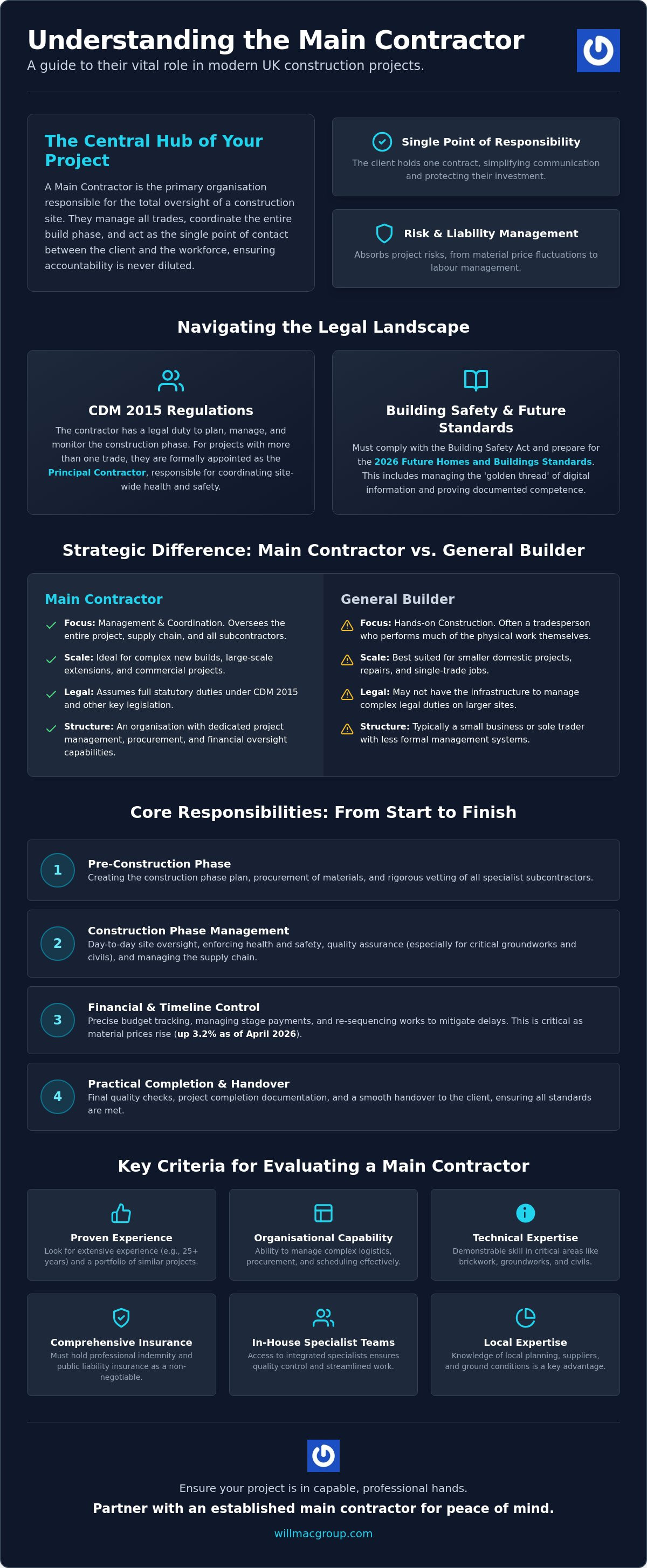
Technical expertise is the next non-negotiable factor. You should prioritise firms that demonstrate specialist knowledge in core areas such as brickwork and civils, as these form the structural heart of the building. Transparency regarding the latest building regulations is also a vital indicator of competence. In 2026, the requirements for energy efficiency and structural safety are more stringent than ever. A professional contractor will be able to explain exactly how they intend to meet these standards whilst maintaining a clean, safe, and well-organised site.
A strong portfolio should show more than just high-quality finishes; it should demonstrate structural integrity across varied environments. It’s essential to check recent references for projects completed within the last 12 months to ensure their current standards match their reputation. Local knowledge is particularly valuable in the North West. A contractor familiar with the specific coastal conditions of North Wales or the heavy clay soil types found in Cheshire will be better prepared for the groundworks phase than a firm from outside the region. This regional expertise prevents unforeseen delays and ensures the foundations are fit for purpose. For a deeper understanding of what separates lasting builds from those that fail prematurely, our reference guide to quality builders in the North West outlines the structural benchmarks and vetting criteria that define genuine construction excellence in the region.
When you reach the tendering stage, you must ensure all contractors are quoting against the exact same scope of work. If one quote is significantly lower than the others, it’s often a red flag. Unusually low prices or a lack of detail in the cost breakdown can suggest that the contractor has missed key elements of the build or intends to add “hidden extras” later. A professional main contractor provides a comprehensive, transparent breakdown that reflects the true cost of quality materials and skilled labour. For a step-by-step walkthrough of this process, our guide on how to find a reliable builder in Chester offers practical advice on vetting local firms.
If you are looking for a partner who combines technical precision with total transparency, get in touch with Willmac Group to discuss your upcoming project and experience our professional approach to construction management.
Willmac Group has spent over 25 years establishing itself as a pillar of the construction community in Chester and the wider North West. We recognise that clients aren’t just looking for a project manager. They need a partner who understands the physical reality of the build. Our local roots mean we’ve developed a deep understanding of regional planning nuances and the specific environmental conditions discussed earlier in this guide. This longevity in the industry is built on a foundation of stability and professional reliability.
When you ask what does a main contractor do to ensure a project’s success, the answer at Willmac Group is rooted in our direct involvement. We don’t just oversee a site from a distance. We manage the entire project lifecycle with a focus on structural excellence. This approach ensures that every extension or new build we undertake is built to last, meeting the high standards our clients expect. We take pride in our craftsmanship, ensuring that the technical requirements of 2026 are met with precision and transparency.
We maintain a unique advantage by keeping specialist brickwork and civils expertise in-house. Our background as specialist brickwork contractors means we bring a level of masonry precision to every project that standard management firms often lack. We understand the technical “dirty work” of groundworks just as well as the final aesthetic details. This integrated knowledge allows us to spot potential issues before they become expensive problems, providing a seamless transition between different phases of the build. It’s about more than just coordination; it’s about having a deep, practical understanding of every trade on site.
If you’re planning a new build or a significant extension, we invite you to discuss your vision with us. Our coverage area extends across Chester, Cheshire, North Wales, and the broader North West. We provide reliable, transparent construction solutions tailored to the specific needs of your project. Whether it’s a residential home or a commercial development, we bring the same level of thoroughness and care to every task. Willmac Group is ready to bring professional discipline and technical skill to your next project, ensuring it’s delivered on time and to the highest possible standard.
A successful construction project relies on more than physical labour; it requires a methodical approach to risk and compliance. By now, you should have a clear understanding of what does a main contractor do to protect your investment. They act as the vital link between your vision and structural reality, managing complex legal duties and the precise sequencing of specialist trades. Choosing a partner who offers single point responsibility ensures your project remains on schedule whilst meeting the highest standards of craftsmanship.
With over 25 years of industry experience, Willmac Group provides the stability and technical expertise necessary for complex new builds and extensions. Our in-house specialists in brickwork, civils, and groundworks ensure every structural element is executed with precision. We are proud to serve clients across Chester, the North West, and North Wales, delivering consistent results through transparent communication and professional reliability.
If you’re ready to move forward with a team that values quality and durability, we’re here to guide you. Discuss your construction project with Willmac Group today and take the first step towards a stress-free build. Your vision deserves a foundation of professional excellence.
The main contractor holds the primary legal agreement with the client and takes full responsibility for the entire project’s delivery. In contrast, a subcontractor is a specialist hired by the main contractor to perform specific tasks, such as plumbing or electrical work. Whilst the subcontractor focuses on their individual trade, the main contractor manages the overarching schedule, site safety, and the complex coordination between all parties on site.
Yes, the main contractor has a strict legal duty to manage health and safety during the construction phase. Under the CDM 2015 regulations, they must ensure the site is secure and that all work is carried out without risk to the workforce or the public. This involves creating a comprehensive construction phase plan, providing site inductions, and ensuring that welfare facilities meet the required standards from the very first day.
There is no law stating you must hire a main contractor, but you are legally required to appoint a Principal Contractor if your project involves more than one trade. If you choose to manage the project yourself, you effectively take on these legal liabilities and health and safety duties. Most homeowners find that delegating these risks to a professional provides essential peace of mind and ensures total compliance with building control.
Management fees are structured to cover the contractor’s overheads, full-time site supervision, and the complex administrative burden of the project. These fees reflect the value of transferring project risk from the client to the professional firm. When evaluating what does a main contractor do to earn this fee, consider the cost savings achieved through their merchant buying power and the avoidance of expensive structural errors or sequencing delays.
A professional contractor must maintain Public Liability Insurance and Employers’ Liability Insurance at a minimum. These policies protect against accidental damage to your property or injuries sustained on site. Many firms also carry Professional Indemnity Insurance to cover risks associated with technical advice. It is vital to check that these policies are current and provide adequate coverage for the specific scale and technical complexity of your new build or extension.
A main contractor can act as the principal designer if they possess the necessary skills, knowledge, and experience to manage the pre-construction phase. This is a common arrangement in design and build contracts. However, they must be able to demonstrate competence in both roles under the Building Safety Act 2022. This includes ensuring the design meets all safety requirements and environmental standards before physical work begins on the site.
If a contractor becomes insolvent, the project usually pauses until a replacement is appointed. You can mitigate this risk by ensuring your contract includes clear terms for termination and by making payments only for work that has been completed and signed off. Some clients also use performance bonds or insurance-backed guarantees to provide financial protection. Maintaining a clear digital record of all work helps a new contractor step in much more efficiently.
You should assess their ability to meet the higher competence requirements mandated by the Building Regulation Part 2A updates. When asking what does a main contractor do to prove their suitability, look for their experience in maintaining the “golden thread” of digital safety information. Verify their track record with the Building Safety Regulator and ask for evidence of their recent work involving low-carbon technologies and the 2026 Future Homes and Buildings Standards.