
The most expensive mistake you can make with a home extension isn’t choosing the wrong tiles; it’s assuming that planning permission is the only legal hurdle you need to clear. It’s a common misconception that can lead to significant structural issues or the refusal of your final completion certificate. Understanding the current building regulations for extensions UK is essential for any homeowner who wants to protect their investment and ensure their new space is safe, energy-efficient, and fully compliant with the latest 2026 standards.
It’s natural to feel anxious about the possibility of hidden costs or the prospect of a building control inspector rejecting finished masonry work. You deserve to move forward with your project feeling confident that every brick laid meets the highest standards of craftsmanship. This guide provides a comprehensive checklist designed to help you vet professional builders and navigate the technical requirements of the Building Safety Regulator. We’ll explore the difference between a vague estimate and a firm quote, whilst ensuring you have a clear path to a successful, high-quality build.
Selecting the right builder is a process of due diligence that protects both your home and your finances. A professional will welcome your questions because they have nothing to hide. Start by verifying memberships in recognised trade bodies like the Federation of Master Builders (FMB) or the National House Building Council (NHBC). These organisations provide a layer of accountability that is vital when managing the complex UK Building Regulations Framework. Membership suggests a builder is committed to industry-standard inspections and ethical business practices, ensuring your project remains on the right side of the law.
Stability is another key indicator of reliability. Confirm that the builder operates from a permanent office base rather than just a mobile phone. A local track record across the North West is invaluable. It shows they understand regional architecture and have a reputation to protect within the community. Ask for at least three references from extension projects completed within the last 24 months. Speaking to previous clients provides insight into how the team handles the daily realities of a construction site and whether they consistently meet the building regulations for extensions UK. For a broader framework on identifying quality builders North West homeowners can trust, it’s worth reviewing the structural benchmarks that define lasting construction excellence in the region.
The technical requirements for building regulations for extensions UK have evolved significantly, so your builder must demonstrate a proactive approach to compliance. Ask specifically how the team stays informed about the 2026 building regulation updates, particularly concerning energy efficiency and ventilation. Look for government-endorsed quality marks such as TrustMark registration. This indicates a firm has been thoroughly vetted for technical competence and customer service. On the ground, ensure that the specialists handling your brickwork or groundworks hold relevant CSCS cards. This proves they have the necessary training for on-site safety and technical skill.
Never overlook the specifics of a builder’s insurance policy. You should request proof of both Public Liability and Employer’s Liability insurance specifically tailored for structural extension work. For residential projects, a minimum of £2 million in Public Liability cover is standard. It’s also wise to ask about “Contract Works” insurance. This covers the extension itself whilst it’s under construction and most vulnerable to weather or accidental damage. Proper insurance protects your existing property investment during the high-risk excavation phase.
A successful extension is built on more than just a signed contract; it relies on the physical execution of complex structural details. Whilst many homeowners focus on the final interior finish, the true value of your investment lies in the masonry and groundworks that remain hidden. You should determine if a builder employs their own specialist trades or relies entirely on external sub-contractors for structural elements. Teams that work together consistently tend to have a better grasp of the building regulations for extensions UK, as they maintain a unified standard of quality control across every phase of the build.
This commitment to unified quality control is a hallmark of elite residential contractors worldwide, including specialist custom home builders Keller TX who focus on delivering structural excellence in every bespoke project.
Requesting to visit a current “live” site is the most effective way to judge a builder’s professional conduct. Pay close attention to the tidiness of the site and how the team manages materials. A well-organised site often reflects a methodical approach to construction, which is essential when matching new structures to existing homes. Observe the masonry quality first-hand; look for consistent mortar joints and clean brickwork, as these are the hallmarks of a craftsman who takes pride in their work. Partnering with an experienced specialist builder ensures these technical standards are met with precision.
Matching the aesthetic of an existing property requires more than just a similar brick colour. It involves understanding specific bond patterns and mortar mixes, particularly within the historic conservation areas of Chester. When you consult specialist brickwork contractors in Chester, you ensure that the new masonry is a seamless extension of your home’s original character. Ask your builder how they intend to achieve this blend to avoid a “tacked-on” appearance.
Foundations are the most critical element for structural compliance. In the North West, builders frequently encounter heavy Cheshire clay, which requires specific excavation depths and reinforcement to satisfy building control inspectors. Whilst many projects fall under Permitted Development Rights, every structure must adhere to the building regulations for extensions UK regarding ground stability. Professional groundworks and civils North West expertise ensures that drainage and utility lines are managed correctly from the start, preventing future subsidence or costly remedial work.
Financial stability on a project starts with a refusal to accept vague figures. Many homeowners fall into the trap of accepting a verbal ballpark figure, only to see costs spiral as the build progresses. You should always demand a detailed, written document that specifies the exact scope of work. This clarity is particularly important when considering the building regulations for extensions UK, as compliance often involves specific materials or structural methods that must be accounted for in the initial pricing. Professional transparency ensures that both parties understand the financial boundaries of the project from day one.
It is vital to understand that an estimate and a quote are not the same thing. One is a rough guide; the other is a commitment. Homeowners should always favour builders who provide a fixed price quote based on finalised architectural drawings and structural calculations.
| Feature | Estimate | Quote |
|---|---|---|
| Nature | Rough guide or educated guess | Fixed price for a defined scope |
| Accuracy | Subject to significant change | Highly accurate and reliable |
| Legal Standing | Non-binding | Legally binding contract |
| Basis | Initial discussion or site visit | Finalised architectural drawings |
A professional quote is a legally binding document that protects both the builder and the client. It should explicitly state what is not included in the price. Common exclusions often include VAT, skip hire for waste removal, and internal plastering or decorating. Clarifying these details early prevents the hidden cost anxiety that often plagues residential projects.
Secure your project’s progress by establishing a clear payment schedule linked to tangible results. Ask your builder what deposit is required to secure the start date, but avoid any firm asking for more than 25% upfront. Deposits should be reasonable and used to procure initial materials or schedule labour. Subsequent payments must be linked to specific project milestones rather than dates on a calendar. For example, a stage payment might be due upon the completion of groundworks or when the structure is officially watertight.
Crucially, you should ensure that payments for structural phases are only released once the work has been inspected and approved by your local building control officer. This approach guarantees that the building regulations for extensions UK are met before you part with your money. It also provides a natural pause in the project to address any variations. If unexpected structural issues are discovered during excavation, such as old drainage or unstable soil, a reliable builder will document these changes and provide updated costs before the work continues. Understanding what does a main contractor do to manage these variations and protect your budget is essential knowledge before signing any construction agreement.
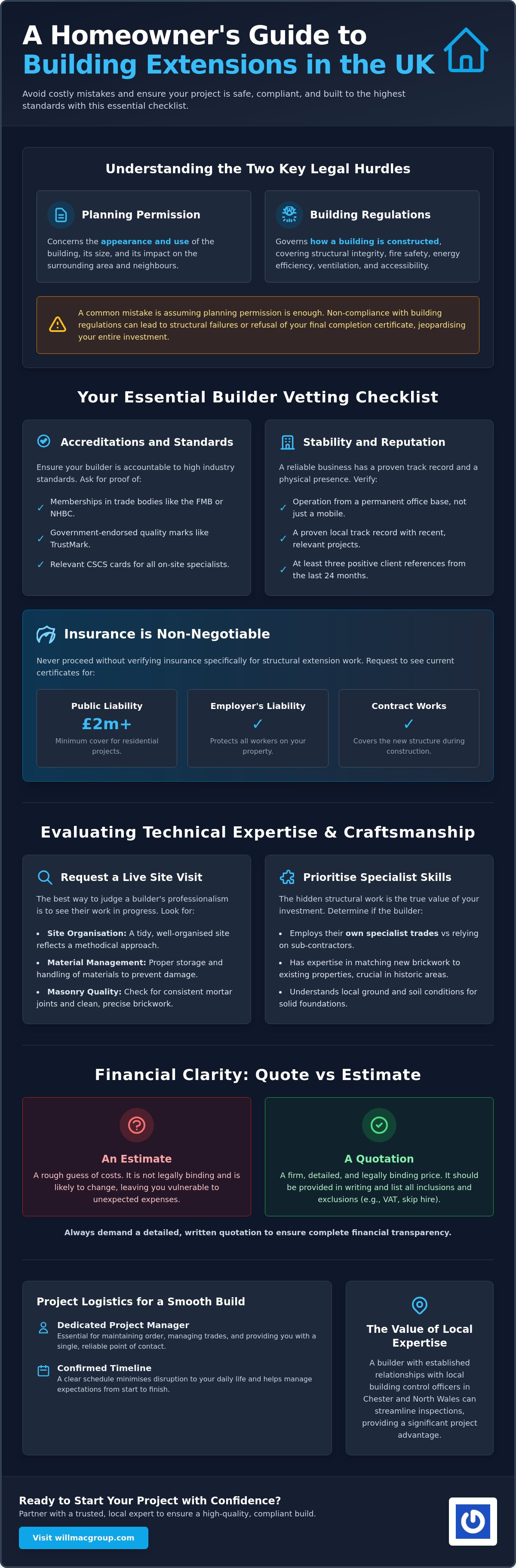
Effective project management is the bridge between a theoretical plan and a compliant structure. Whilst the technical details of building regulations for extensions UK are finalised during the design phase, their successful implementation depends on the logistical discipline of the site team. Homeowners often underestimate the complexity of coordinating multiple trades within a residential setting. You should clearly identify who’ll be your daily point of contact. Having a dedicated project manager ensures that structural standards are maintained without sacrificing the pace of the build.
Disruption is an inevitable part of construction, but a professional builder will have established protocols to mitigate it. Inquire about their site safety measures and how they intend to protect your existing property from dust, debris, and the elements. This is particularly vital when the extension involves breaking through existing external walls. Discuss daily working hours and the management of site deliveries and waste removal. A methodical approach to logistics prevents the site from becoming a source of stress for you and your neighbours. If you’re ready to begin your project with a team that prioritises order and excellence, consider discussing your plans with an experienced local builder.
A common pitfall in residential extensions is the lack of consistent supervision. You should ask: “Will there be a dedicated supervisor on-site every day to oversee the different trades?” A site manager’s primary responsibility is to coordinate bricklayers, joiners, and electricians, ensuring each phase is completed to the required standard before the next begins. This oversight is crucial for maintaining the critical path of the project. For more insights on vetting leadership on-site, refer to this step-by-step guide to finding a reliable builder.
Transparency regarding the project’s duration is essential for managing expectations. Request a written schedule of works that outlines the key phases of the build:
Ask how the team manages delays caused by the British weather whilst ensuring all work remains compliant with the building regulations for extensions UK. A professional firm will provide regular progress updates, perhaps through weekly meetings or digital reports, ensuring you remain fully informed of any adjustments to the projected completion window.
Local expertise is often the deciding factor between a project that stalls and one that proceeds with efficiency. In the North West and North Wales, building authorities have specific expectations regarding how the building regulations for extensions UK are applied to regional architecture. A builder who frequently operates within the Cheshire West and Chester council area, or across various North Wales councils, understands the nuances of local policy. This familiarity extends to the building control officers themselves. When a builder has an established reputation for quality, the inspection and sign-off process is typically more transparent and timely, as there is a baseline of trust in the contractor’s structural competence. For a deeper understanding of how construction oversight works at this level, it is worth exploring what does a main contractor do when coordinating compliance, trades, and local authority relationships on complex residential projects.
Sourcing the correct materials is equally vital for maintaining the aesthetic integrity of our region. Whether it’s the distinctive hue of Cheshire brick or specific slate requirements in North Wales, a local expert knows exactly where to procure high-quality materials that satisfy both building control and planning requirements. This regional insight ensures that your extension doesn’t just meet the technical building regulations for extensions UK, but also enhances the market value of your property by blending perfectly with the existing streetscape. Choosing a partner who understands these details protects you from the legal complications that arise when an extension fails to match the character of its surroundings. Our reference guide to quality builders North West property owners rely on explores how regional knowledge, material sourcing, and regulatory awareness combine to define true construction excellence.
You should ask your prospective builder how they handle the Building Control sign-off process in your specific council area. For those looking for builders in North Wales, it’s essential to discuss environmental factors such as coastal exposure and wind loading. These regional conditions require specific structural considerations that a non-local firm might overlook. Local knowledge ensures your extension is built to last, avoiding the legal and structural headaches that arise from non-compliance or poor weatherproofing.
Willmac Group brings over 25 years of industry experience and a deep-rooted heritage in specialist brickwork to every project. We understand the unique challenges of building in the North West, providing a comprehensive service that covers everything from initial groundworks to the final structural completion. For homeowners planning house extensions in Chester, our team offers a professional partnership focused on transparency and craftsmanship. We encourage you to contact us for a consultation that prioritises long-term quality over quick shortcuts, ensuring your home is extended with precision and care.
Navigating the technical and financial complexities of a home extension requires a methodical approach. By prioritising thorough builder vetting and demanding fixed-price quotations, you’ve already mitigated the most significant risks associated with modern construction. It’s essential to remember that achieving compliance with the building regulations for extensions UK isn’t just a legal necessity; it’s a commitment to the longevity and safety of your property. A structure built to these standards today will provide peace of mind for decades to come.
When you’re ready to transform your plans into a high-quality reality, choose a partner with a proven track record of excellence. Willmac Group brings over 25 years of construction and specialist brickwork experience to every project. Based in Chester and serving North Wales and the wider North West, we provide a comprehensive service from initial groundworks to structural completion. We’re fully insured and dedicated to maintaining the highest standards of craftsmanship throughout your build. Contact Willmac Group today for a professional extension consultation to ensure your project is handled with the expertise it deserves. Your dream space is within reach when you have the right team by your side.
A verbal estimate is generally not legally binding in the UK. It serves as an educated guess regarding the final cost and is subject to change as the project evolves. To protect your investment, you should always secure a written “Fixed Price Quote” which clearly defines the scope of work. This document acts as a legal contract and provides the financial certainty required for complex residential projects.
Your builder must hold Public Liability insurance with a minimum cover of £2 million to protect against property damage or injury. They should also carry Employer’s Liability insurance for their on-site team. For projects in Chester and the North West, it is advisable to confirm they have “Contract Works” insurance. This specific policy covers the extension structure whilst it’s under construction and vulnerable to environmental factors.
Reliability can be verified by checking memberships in trade bodies like the Federation of Master Builders (FMB). You should also request at least three references from extension projects completed within the last 24 months. Visiting a current “live” site allows you to observe their masonry quality and site organisation first-hand. These steps ensure the builder consistently adheres to the building regulations for extensions UK.
Paying a reasonable deposit is standard practice to secure a start date and procure initial materials. However, you should avoid any builder who requests more than 25% of the total cost upfront. A professional payment schedule should be linked to tangible milestones, such as the completion of groundworks or the structure becoming watertight. This ensures your capital is protected throughout the build duration.
The homeowner is ultimately legally responsible for ensuring the project complies with the building regulations for extensions UK. In practice, a professional builder or project manager will handle the day-to-day coordination with local building control officers. They’ll schedule the necessary inspections at key stages to ensure the work is approved. Always confirm that your builder will manage this process before construction begins.
A standard single-storey rear extension typically takes between 10 and 16 weeks to complete. This timeline covers the full lifecycle from initial excavation and groundworks to the final internal fit-out. Factors such as site access, weather conditions, and the complexity of the structural masonry can influence the duration. Your builder should provide a written schedule of works that outlines each phase and its projected completion window.
If unexpected issues like unstable soil or hidden utility lines are discovered, a professional builder will issue a “variation.” This is a formal document that outlines the necessary changes to the original scope and any associated costs. Reliable contractors in the North West are familiar with local ground conditions, such as Cheshire clay, and will discuss these structural solutions with you before proceeding with additional work.
It’s possible to remain in your property during most extension projects, though you should expect some level of disruption. Your builder will use dust screens and temporary partitions to protect your living areas from the construction zone. The most intrusive phase occurs when breaking through the existing external wall. A well-managed site will prioritise your safety and maintain essential services like water and electricity throughout the build.