
Did you know that residential land with planning permission in prime Cheshire locations can now reach values of up to £2 million per acre? If you are currently researching how to find land for a new build in Cheshire, you’ve likely discovered that the search involves much more than just browsing property portals. The reality of the 2026 market is that the most visible plots are often the most contested, whilst the best opportunities remain hidden from the public eye.
We understand the frustration of navigating strict Green Belt restrictions and the complexities of the latest local council updates. You need a site that is buildable, not just available. This guide will help you master the local strategies needed to identify, evaluate, and secure a plot that aligns with your specific goals. We’ll provide a clear roadmap for finding off-market land, explain how to use the updated local registers effectively, and give you a framework for assessing site viability before you make a financial commitment. By the end of this article, you’ll have the professional tools required to move your project from a vision to a reality.
Starting your journey on how to find land for a new build in Cheshire requires a solid understanding of the local regulatory framework. Before you begin scouting physical locations, it’s essential to understand what is self-build in the eyes of the local authorities. In the UK, and specifically across the North West, the “Right to Build” legislation requires councils to maintain a register of individuals interested in building their own homes. This isn’t just a list; it is a legal mechanism that forces local governments to ensure enough development permissions are granted to meet the demonstrated demand.
Cheshire is split into two primary administrative areas, each with its own register and fee structure. As of April 2026, joining the register in Cheshire East costs £32.00. In Cheshire West and Chester, the fee is £36.00 plus VAT. These registers are divided into Part 1 and Part 2. To join Part 1, you must prove a local connection. This usually involves demonstrating that you have lived or worked in the borough for a specific period, or have close family ties to the area. Achieving Part 1 status is vital because it places a duty on the council to find a serviced plot for you, whereas Part 2 only requires them to “have regard” for your interest when planning future land use.
Registering should be your first task even if you intend to find land independently. Councils use this data to allocate specific sites for self-build projects within their new Local Plans, such as those currently being updated for adoption in late 2028 and 2029. Under the current system, once you are on the register, the council has a three-year window to grant planning permission for enough serviced plots to meet that demand. This timeline is a critical component of your build programme. It provides a level of security that the local planning environment is actively working to facilitate new construction projects rather than just restricting them.
A serviced plot is defined as a parcel of land with highway access and pre-installed utility headers. Selecting a serviced plot significantly reduces the complexity of the initial phase of your project. In contrast, “raw” land in rural Cheshire may appear cheaper initially, but it often carries substantial hidden costs. Bringing water, electricity, and gas to a remote site can involve expensive Civils & Groundworks that quickly erode your budget. When assessing how to find land for a new build in Cheshire, always factor in the cost of infrastructure. If a plot lacks a direct connection to the mains or requires a new access road, the technical challenges can delay your start date by months.
Securing a plot in a high-demand county requires a departure from traditional property searches. Whilst portals like Rightmove are useful for established homes, they rarely showcase the best development opportunities. To master how to find land for a new build in Cheshire, you must adopt a multi-layered strategy that combines digital intelligence with local legwork. The Self-build and Custom Housebuilding Act 2015 provides the legal framework for local registers, but the most successful self-builders often secure their land before it ever reaches the public market. Specialist portals such as PlotBrowser, Plotfinder, and BuildStore are essential digital tools, as they aggregate land specifically intended for construction rather than agricultural use.
A “boots on the ground” approach remains one of the most effective methods in villages like Christleton or Tarporley. These areas are characterised by large, established gardens and irregular infill spaces. Identifying a gap between houses or a dilapidated outbuilding can often lead to a viable site. Use GIS mapping and Land Registry data to identify the boundaries and ownership of these “dead” spaces. This data-driven approach allows you to approach owners directly. Additionally, the Cheshire property auction circuit is a prime source for unloved land or “teardowns” where the value lies in the footprint of the existing structure rather than the building itself. In prime locations, residential land with planning permission can fetch between £1 million and £2 million per acre, making precision in your search vital.
Success in the off-market sector depends on professional communication. When writing to a landowner, keep your enquiry direct and respectful. Explain your intent to build a single family home rather than a large-scale development; this often eases concerns about local disruption. “Garden grab” opportunities are particularly prevalent in established Cheshire neighbourhoods where older properties sit on disproportionately large plots. Working with local planning consultants can also help you spot land that is likely to be allocated for housing in the upcoming Local Plan updates before the wider public becomes aware.
Don’t limit your professional network to residential estate agents. Commercial agents and dedicated land brokers often handle the sale of small parcels that don’t fit the standard residential model. Establishing a relationship with a reliable builder in Chester can also provide early leads, as they are often the first to hear about potential sites through their industry connections. Many landowners prefer a quiet, direct sale to avoid the complexities of the open market. By consulting with experienced construction professionals early in your search, you can gain a significant advantage in identifying land with genuine potential.
Securing a plot is a significant milestone, but the technical “buildability” of that land determines whether your project is a sound investment. When investigating how to find land for a new build in Cheshire, you’ve got to look beyond the surface. A plot located in the Cheshire plains might appear attractive and level, but these areas are often prone to poor natural drainage. Without a proper assessment, you may find yourself facing high costs for sophisticated sustainable drainage systems (SuDS) or attenuation tanks to satisfy planning requirements and protect your future home from waterlogging.
Before you exchange contracts, a topographical survey and professional soil analysis are non-negotiable. These reports reveal the true nature of the terrain and what lies beneath the topsoil, highlighting potential issues like peat pockets or high water tables. Understanding these technical limitations is just as important as knowing how to find land for a new build in Cheshire, as they represent the difference between a profitable build and a financial drain. You must also identify any Tree Preservation Orders (TPOs) or hidden utility easements that could severely restrict your buildable area. If the site access is too narrow for heavy plant machinery, your build costs will increase due to the need for smaller, more frequent transport runs.
Cheshire’s geology is diverse, typically consisting of heavy clay or areas of solid sandstone. These conditions directly dictate the depth and type of foundations required. It’s a technical reality that foundation costs for Cheshire clay can vary by up to 40% based on plasticity index. Utilising specialist groundworks and civils can often rescue a site that appears difficult. However, you must accurately calculate the “real” cost of site clearance and muck-away. In the North West, the disposal of surplus soil and subsoil is a major budgetary factor that requires careful management to avoid overspends.
Connecting a new home to the grid in rural Cheshire villages is rarely straightforward. If a mains sewer connection isn’t available nearby, you may need to install a private treatment plant, which requires its own set of environmental permits and ongoing maintenance schedules. Modern eco-friendly homes place higher demands on the local electrical grid. If you plan to install multiple air-source heat pumps or high-speed EV chargers, the existing electrical supply may need a costly upgrade from the Distribution Network Operator (DNO). Always secure firm quotes for these connections before committing to the purchase to ensure your budget remains intact.
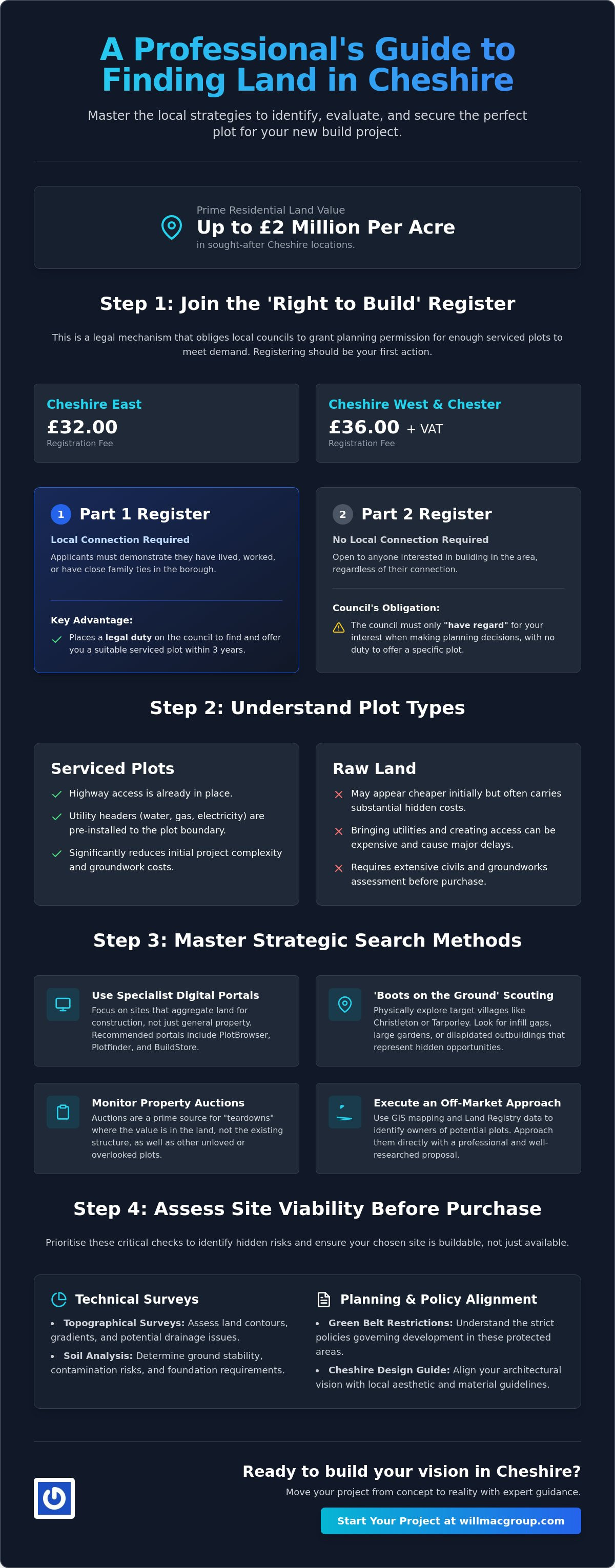
Securing a plot is only half the battle; obtaining the legal right to build on it is where many projects stall. When researching how to find land for a new build in Cheshire, you must distinguish between “infill” and “encroachment” within the Green Belt. Infill typically refers to the development of a small gap in an otherwise continuous built-up frontage. Encroachment, however, involves extending into the open countryside, which local planning authorities almost always resist. Understanding these nuances is vital for site selection, as the designation of your land will dictate the scale and style of the property you can realistically hope to build.
Local authorities, including Cheshire East and Cheshire West and Chester, use the Cheshire Design Guide to ensure new construction respects the regional character. If your plot lies in the north-eastern fringes of the county, you may also deal with the Peak District National Park planning authority, which enforces even more stringent aesthetic controls. Before you commit to a purchase, we recommend you consult a planning permission checklist to identify potential red flags. For a single new dwelling in Cheshire West and Chester, the pre-application advice fee is £331.00 as of April 2026. This is a worthwhile investment to gauge the council’s appetite for your project before submitting a full application.
Buying land with an “Option Agreement” carries more risk than purchasing a site with full permission. Outline permission only proves that the principle of development is acceptable; it does not guarantee that your specific design will be approved. A common strategy for those exploring how to find land for a new build in Cheshire is to look for “replacement dwelling” opportunities. This involves buying a site with an existing, often dilapidated, structure and applying to replace it with a modern custom build. Be aware of Section 106 agreements and the Community Infrastructure Levy (CIL), which are developer contributions that can add thousands of pounds to your total project cost.
Building in historic centres like Chester or Knutsford requires a specialised approach. Planning officers in these areas demand high-quality materials that match the existing streetscape. This often necessitates specialist brickwork to ensure the new structure blends seamlessly with heritage assets. In Roman Chester, you may also be required to fund an archaeological watching brief, where experts monitor groundworks for historical finds. If you are planning a project in a sensitive area, contact our construction team to discuss how we can help you meet these rigorous planning standards whilst maintaining your project timeline.
Transitioning from land acquisition to active construction requires a shift in focus from legalities to logistics. Whilst your initial research into how to find land for a new build in Cheshire provided the necessary foundation, the execution phase demands a rigorous management of resources and timelines. A robust budget is essential; it must clearly separate the land purchase price from the actual construction costs. We recommend maintaining a mandatory contingency fund of at least 10% to 15% to cover unforeseen ground conditions or material price fluctuations that can occur during the build programme.
Selecting your build route is the next critical decision. You have three primary options: self-managing the project, hiring a dedicated project manager, or appointing a main contractor. Self-management offers maximum control but requires a significant time commitment and deep technical knowledge. For many, the stability of a main contractor is the preferred choice. A main contractor takes full responsibility for the site, manages all sub-contractors, and ensures the project adheres to health and safety regulations and the agreed schedule. The first 100 days are particularly vital, as this period encompasses site setup, initial groundworks, and the completion of foundations. Before finalising your approach, it is worth understanding the key differences between residential new builds in the North West, particularly whether a bespoke or volume build route best suits your vision and budget.
Selecting a new build contractors Chester homeowners and developers trust is vital for navigating local supply chain challenges across Cheshire and North Wales. There is a distinct professional advantage in appointing a single partner to handle both the Civils & Groundworks and the main Construction. This continuity ensures that the team responsible for the foundations is the same one raising the walls. It reduces the risk of communication errors between different trades and ensures that the Brickwork and structural phases proceed without delay.
Before the first spade hits the ground, you must ensure structural warranties from providers like NHBC or LABC are in place. These warranties are essential for protecting your investment and are typically a requirement for any self-build mortgage provider. As the project nears completion, the focus shifts to quality control. Utilising a professional new build snagging list allows you to identify and rectify minor defects before the final handover. The project concludes officially once you receive Building Control sign-off, at which point you can begin the VAT reclaim process for your new build, potentially recovering a significant portion of your expenditure.
Mastering the search for a building plot involves a strategic combination of leveraging local registers and conducting rigorous technical site assessments. Success in this competitive market depends on your ability to look beyond the surface, ensuring that a potential site is not only available but also technically “buildable” from a groundworks perspective. Understanding the complexities of how to find land for a new build in Cheshire is the essential first phase of any successful construction journey, allowing you to navigate planning restrictions with confidence.
Ready to move from the search phase to active construction? Discuss your Cheshire new build project with Willmac Group. With over 25 years of industry experience in the North West, we are specialists in Civils & Groundworks and high-end Brickwork. Our team has a proven track record of delivering complex New Builds across Cheshire and North Wales, providing the technical expertise required to turn a challenging plot into a high-quality home. Building a custom home is a significant undertaking, but with the right local knowledge and a dependable construction partner, your vision for a perfect residence is well within reach.
Residential land with planning permission in prime Cheshire locations typically fetches between £1 million and £2 million per acre. Prices fluctuate based on the specific borough and the level of infrastructure already in place. Historical data indicates that land values in the Chester area are often significantly higher than those found in Cheshire East, reflecting the intense demand for plots in and around the historic city centre.
Building on Green Belt land is possible but remains subject to very strict planning controls. You’ll generally be limited to “infill” development, which involves building on a small gap within an existing developed frontage. Planning authorities almost always refuse projects that represent “encroachment” into the open countryside. It’s essential to prove your project meets the “very special circumstances” defined in the National Planning Policy Framework.
The Cheshire East Self-Build Register is a tool the council uses to measure local demand for custom housebuilding. As of April 2026, joining this register costs £32.00. Whilst the council has a duty to grant enough development permissions to meet the demand shown on the register, being on the list doesn’t guarantee you’ll be offered a specific plot. It’s primarily a planning mechanism to inform future land allocation.
You can confirm utility access by obtaining asset maps from regional providers like United Utilities or SP Energy Networks. A serviced plot is defined by having highway access and pre-installed utility headers already at the boundary. If you’re looking at unserviced land, you must secure formal quotes for connections early. In rural Cheshire, the cost of bringing power or water to a remote site can be a major budgetary hurdle.
Neither borough is “easy” due to high competition, but Cheshire East often has slightly lower land values per hectare than the Chester area. Your success in how to find land for a new build in Cheshire depends more on your search strategy than the specific council area. Proactive methods, like contacting landowners directly or attending local auctions, are usually more effective than waiting for plots to appear on public portals.
The most frequent technical challenges include heavy clay soil and high water tables, particularly in the Cheshire plains. Foundation costs for Cheshire clay can vary by up to 40% depending on the soil’s plasticity index, which dictates how much it shrinks or swells. You might also encounter solid sandstone in certain areas, which requires specialist excavation equipment and increases the initial groundworks budget.
A standard planning application for a single dwelling usually takes between 8 and 13 weeks for a decision. However, complex sites or those in conservation areas can take much longer if additional surveys are required. In Cheshire West and Chester, paying the £331.00 fee for pre-application advice can help identify potential issues early. This often speeds up the formal application process by ensuring your design meets local standards from the start.
Yes, an established builder often hears about off-market opportunities through their network of developers and land agents. Contractors who specialise in Civils & Groundworks are frequently the first to know when a larger plot is being subdivided. Engaging a builder early in your search for how to find land for a new build in Cheshire is beneficial because they can provide an immediate technical assessment of a site’s buildability before you buy. If you are still weighing up your options, our guide to bespoke versus volume residential new builds in the North West can help you clarify the type of home you want to build before committing to a plot.