
Will your next home be a lasting asset or a catalogue of compromises? For many looking at residential new builds North West, the appeal of a fresh start is often dampened by the reality of thin walls and endless snagging lists. You likely want a property that reflects the character of our region, whether that’s the historic streets of Chester or the rugged terrains of the Pennines, without the stress of unforeseen ground issues or planning delays. It’s a common concern that mass-produced houses prioritising speed over soul might not hold their value in a market that increasingly rewards quality.
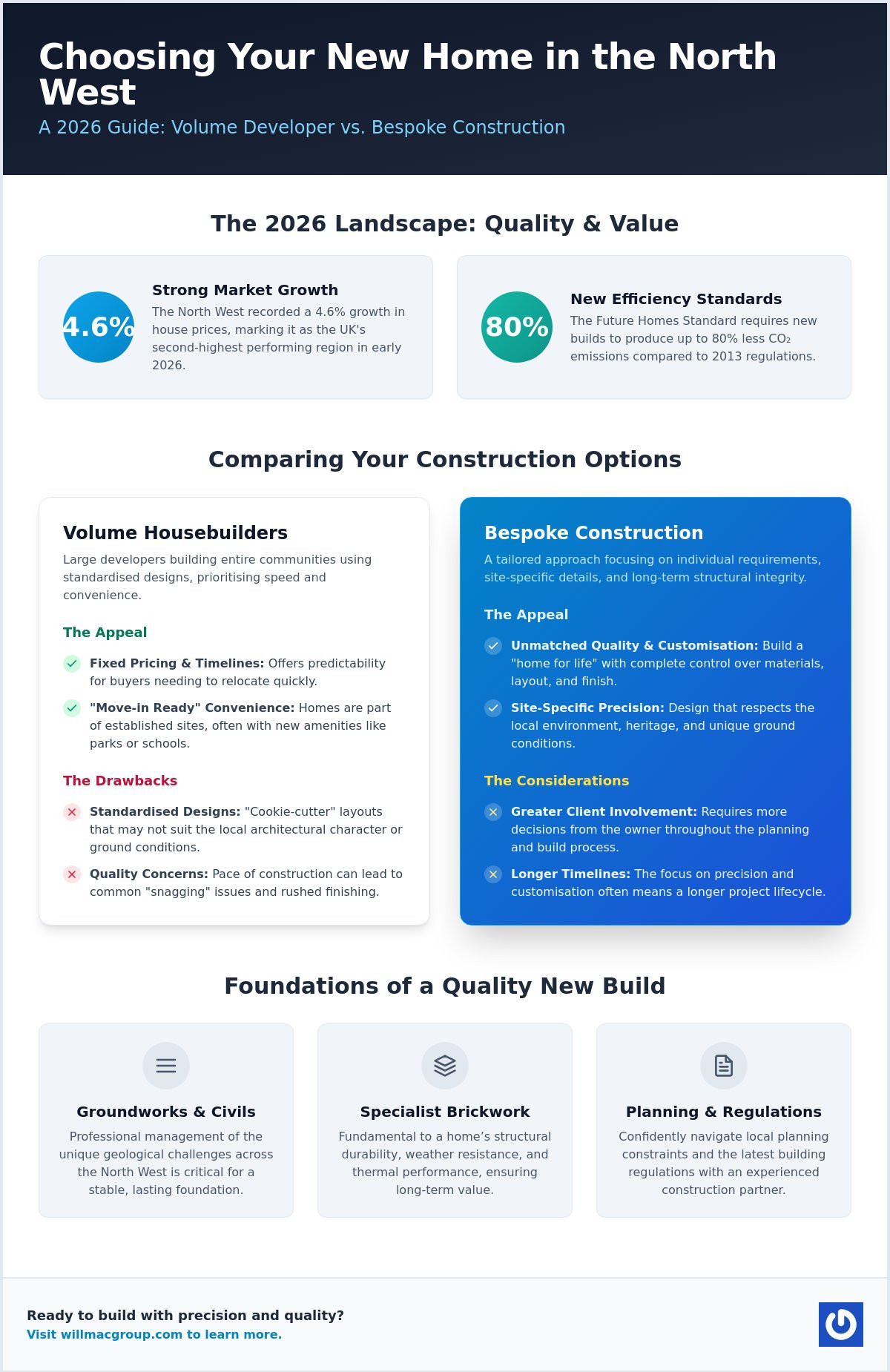
This guide helps you decide between the convenience of volume developments and the precision of bespoke construction for your 2026 project. You’ll learn how to ensure your home meets the rigorous new Future Homes Standards, which aim to reduce carbon emissions by up to 80% compared to previous regulations. We examine the critical construction stages, from managing complex groundworks to navigating local planning constraints, so you can find a partner who understands the specific demands of building in the North West. By the end, you’ll have the clarity needed to commission a home that delivers both structural integrity and long-term value.
The property market across the North West in 2026 presents a study in contrasts. From the high-density urban developments of Greater Manchester to the protected vistas of the Cheshire Green Belt, the options for new housing are broader than ever before. Whilst some UK regions have seen stagnation, the North West recorded a 4.6% growth in house prices in early 2026, marking it as the second-highest performing region in the country. This resilience continues to attract families and investors who recognise the long-term stability of the local market.
However, the term “new build” can be deceptive. It covers everything from thousands of identical units on a former industrial site to a single, architect-designed home on a private plot. In historic areas like Chester or the coastal towns of North Wales, the importance of local character cannot be overstated. A successful project must respect the existing architectural vernacular, often requiring a level of craftsmanship that mass-market developers struggle to provide. Choosing the right approach for residential new builds North West starts with understanding these regional nuances.
The “Chester-Wrexham corridor” has emerged as a primary focus for those seeking a balance between professional opportunities and rural living. Infrastructure improvements have made these border areas highly accessible, driving a surge in interest for high-quality family homes. Similarly, North Wales is seeing a move towards sustainable, high-specification residential builds. The appeal lies in the ability to combine modern living with the natural beauty of the coastline, provided the construction can withstand the specific weather conditions of the Irish Sea.
In the current market, quality is defined by more than just a modern floorplan. The implementation of the Future Homes and Buildings Standards has shifted the focus toward energy efficiency and material longevity. New homes are now expected to produce 75-80% less CO2 emissions than those built under 2013 regulations. This environmental focus has encouraged many to explore the self-build route, allowing for greater control over the materials used.
This shift represents a move towards creating “homes for life” rather than temporary starter properties. Achieving these high standards requires the expertise of specialist contractors who understand the full lifecycle of a project. From the initial groundworks to the final brickwork, every stage must be executed with precision to ensure the building remains a valuable asset for decades to come. Whether you are looking for a developer-led project or a bespoke commission, the choice of builder will ultimately define the success of your investment.
Deciding on a new home involves a choice between two distinct paths: purchasing from a volume developer or commissioning a bespoke build. Volume developers, often large PLC companies, create entire communities using standardised blueprints. This model prioritises efficiency and “move-in ready” convenience. In contrast, bespoke construction focuses on individual requirements, allowing for a level of site-specific detail that mass-produced homes cannot replicate. Understanding which approach fits your lifestyle depends on whether you value immediate availability or long-term structural integrity for residential new builds North West.
Large developments offer several benefits, including fixed pricing and established site amenities like parks or new schools. These homes are designed for speed, which helps buyers who need to relocate quickly. However, this pace often leads to common “snagging” issues, where finishing touches are rushed to meet quarterly targets. In many cases, these developments use “cookie-cutter” designs that don’t fully account for the unique ground conditions or architectural heritage of the region. Whilst they serve a clear purpose, they rarely offer the specialist masonry or detailed civils work found in higher-end commissions.
For those seeking a more personal investment, the bespoke path offers unparalleled transparency. Legislation like the Self-build and Custom Housebuilding Act 2015 has made it easier for individuals to find opportunities to create tailored homes. This route often begins with finding land for a new build in Cheshire or other desirable pockets of the region. Working with a dedicated construction group ensures that every material, from the foundation concrete to the facing bricks, is selected for its longevity rather than its cost-efficiency on a mass scale.
Choosing a bespoke approach allows you to have a single point of contact for the entire lifecycle of the project, including groundworks, brickwork, and the final construction. This integration reduces the risk of communication breakdowns and ensures that the structural quality remains consistent throughout. If you’re planning a project that requires this level of specialised care, consulting with an experienced builder can provide the necessary technical guidance to ensure your investment holds its value for years to come. Ultimately, the choice between volume and bespoke comes down to a trade-off between the ease of a pre-packaged home and the enduring quality of a project built to your exact standards.
Groundworks represent the most critical yet invisible phase of residential new builds North West. Whilst many homeowners prioritise the aesthetic finish of their property, the longevity of any structure depends entirely on what lies beneath the surface. Our region is geologically diverse, featuring everything from the heavy, shrinkable clay of the Cheshire plains to the rocky outcrops and high water tables of coastal North Wales. Without precise civils and groundworks, even the most well-designed home remains at risk of structural movement, subsidence, or chronic drainage failure over time.
Specialist contractors mitigate these risks by conducting thorough site investigations before construction begins. These assessments identify soil composition and potential contaminants, allowing for a tailored foundation strategy. This proactive approach is particularly important in the North West, where varied terrain requires a deep understanding of local conditions to ensure a building remains stable for decades.
Clay-heavy soils, common across Cheshire, present a specific engineering challenge because they expand and contract significantly with moisture levels. This movement requires deep-trench foundations or engineered rafts to maintain structural integrity. In contrast, coastal builds in North Wales must account for fluctuating water tables and high salt content, which can degrade standard materials if not properly managed. Willmac Group prioritises a “solid start” on every project, employing expert foundation laying techniques that often exceed the minimum requirements of UK building regulations to guarantee stability.
Preparing a site for a new residential project involves more than simply removing surface debris. Whether you’re developing a greenfield plot or a complex brownfield site, professional site clearance is essential for managing environmental risks and soil stability. Thorough preparation at this stage significantly reduces the likelihood of future new build snagging issues, such as uneven flooring or damp caused by poor drainage.
Environmental considerations are also paramount. In the North West, where high rainfall is a frequent factor, managing water runoff during the initial stages of a build is vital. Proper site preparation ensures that the soil remains stable and that drainage systems are correctly integrated from day one. By investing in professional site clearance and groundworks, you protect your home from the significant costs and stress associated with remedial structural work in the future.
Whilst the groundworks provide an invisible foundation, the brickwork is the defining feature of any residential project. It serves as the primary barrier against the elements and the visible face of the home’s character. In the context of residential new builds North West, the quality of the masonry is what separates a standard property from a premium investment. Specialist brickwork goes beyond simple aesthetics; it involves a technical understanding of thermal mass, moisture management, and structural load distribution that mass-market “brick-up” methods often overlook.
A well-executed facade acts as a thermal store, helping the building maintain a consistent internal temperature. This is particularly relevant for 2026 projects aiming to meet the Future Homes Standards. High-quality masonry ensures that the building envelope is airtight and weatherproof, protecting the internal structure from the driving rain common across the North West. Choosing a contractor with a focus on specialist masonry is essential for ensuring the longevity of the build.
The North West possesses a distinct architectural heritage, characterised by the red sandstone of Chester and the varied textures of Cheshire brick. For many bespoke residential new builds North West, reflecting this local character is a requirement of the planning process rather than a choice. Using traditional brickwork styles helps a new home sit comfortably amongst historic neighbours whilst providing the benefits of modern construction techniques. Those seeking new build contractors Chester residents can rely on will find that this combination of heritage craftsmanship and modern standards is central to delivering a high-specification home in the city.
Selecting a brickwork contractor requires an assessment of their technical knowledge and past portfolio. The choice of mortar and the style of pointing are not merely decorative; they affect how the wall breathes and sheds water. Incorrect mortar mixes can lead to damp issues or premature crumbling, especially in the exposed coastal areas of North Wales. A professional builder will understand the chemical compatibility between different brick types and mortar strengths.
Willmac Group integrates 25 years of masonry expertise into every project we undertake. We prioritise structural integrity and traditional craftsmanship to ensure that every home we build stands as a testament to quality. If you are looking for a partner to deliver a high-specification finish, our team provides the expert brickwork services required for a truly bespoke residential project. By focusing on the fine details of the masonry, we create homes that are as durable as they are beautiful.
Executing a successful residential project requires more than technical skill; it demands a methodical approach to the entire building lifecycle. The roadmap for residential new builds North West often begins months before the first spade enters the ground. Whilst the previous sections of this guide focused on the physical components of groundworks and brickwork, the final success of a home depends on how these stages are managed. A well-coordinated project ensures that the transition from a vacant plot to a finished dwelling is transparent, predictable, and compliant with the latest standards.
Choosing a building contractor that understands this full lifecycle is vital. A partner capable of managing everything from initial civils to the final masonry work reduces the friction often found when multiple subcontractors are involved. This integrated approach is the most reliable way to ensure that the structural integrity discussed earlier is maintained through to the handover of the keys.
Navigating the planning permission process in Cheshire and North Wales requires a deep understanding of local council expectations. In 2026, this involves more than just architectural approval. New developments must now account for the Building Safety Levy, which applies to all new dwellings as of October 1, 2026. Local knowledge is a favourite tool of successful developers because it allows them to anticipate specific constraints in historic areas like Chester, where material choices are often strictly dictated to preserve the regional vernacular.
Compliance with the Future Homes Standards is another critical hurdle. These regulations mandate higher energy efficiency through improved insulation and low-carbon technologies. A professional builder will ensure that every stage of construction, from the foundation depth to the specific mortar mix, meets these statutory requirements. This prevents costly delays or remedial work during the final building control inspections.
A bespoke build typically follows a more deliberate schedule than a volume development. Whilst mass-produced homes prioritise speed, a high-quality residential project allows time for critical phases like ground stabilisation and masonry curing. Project management plays a central role here, ensuring that the civils and groundworks teams complete their tasks before the bricklayers arrive on site. This prevents the overlapping of trades that often leads to mistakes or safety risks.
The final phase of any project is the snagging period. As discussed in our earlier analysis of site preparation, a professional eye is required to identify minor defects before possession. In a bespoke build, this process is usually more thorough, as the homeowner has been involved in material selection from the start. Once the final inspections are passed and the as-built EPC is verified, the project moves to handover. By following this structured roadmap, you ensure your new home is not just a modern structure, but a durable asset built to the highest professional standards.
Choosing between a volume development and a bespoke commission is a decision that shapes your lifestyle and financial security for decades. The true value of residential new builds North West lies in the structural details that often go unseen. Prioritising professional civils and groundworks ensures a stable foundation, whilst investing in specialist brickwork guarantees a home that ages gracefully against the regional climate. By navigating the planning process with local expertise, you can create a property that respects its surroundings and meets the highest modern standards.
Willmac Group brings over 25 years of industry experience to every project. Our specialist expertise in brickwork and civils has built a proven track record across Chester, Cheshire, and North Wales. We understand that a home is more than just a project; it’s a commitment to quality and craftsmanship that stands the test of time. We take pride in being a dependable partner for those who refuse to compromise on the integrity of their build.
Discuss your residential new build project with Willmac Group today to ensure your 2026 vision is built on a foundation of reliability and skill. We look forward to helping you create a home that delivers lasting quality.
Bespoke builds offer complete control over the design, layout, and material quality of your home. Unlike volume developments, these projects allow you to prioritise structural integrity and local architectural character, ensuring the property is a unique asset. This approach results in a higher-specification finish that is tailored to your specific lifestyle and long-term requirements.
Yes, you will almost always require formal planning permission to construct a new dwelling in Cheshire. The process involves submitting detailed plans to the local authority to ensure the project complies with regional development policies and building regulations. It’s advisable to work with a builder who understands the specific constraints often found in the Cheshire Green Belt or historic areas like Chester.
A bespoke residential project typically takes between 10 and 18 months to complete from the initial site clearance. The timeline depends on the complexity of the design and the specific ground conditions of the plot. Efficient project management is essential to ensure that the transition from groundworks to the structural brickwork phase remains on schedule despite the variable North West weather.
You should look for a contractor with a proven track record in both civil engineering and specialist masonry. For residential new builds North West, it’s vital to choose a team that demonstrates a deep understanding of local soil types and planning nuances. Transparency in their communication and a portfolio of high-quality, durable projects are the most reliable indicators of professional competence.
Modern homes built in 2026 are significantly more energy efficient, as they must comply with the Future Homes Standards. These regulations mandate that new builds produce 75-80% less carbon emissions than those built under previous rules. This is achieved through advanced insulation techniques, high-performance glazing, and the integration of low-carbon heating technologies like heat pumps.
Snagging is the final inspection process where minor defects or “snags” are identified and corrected before the homeowner takes possession. It is a critical quality-control stage that ensures the finish of the property meets professional standards. A thorough snagging list covers everything from the precision of the brickwork pointing to the functionality of the internal plumbing and electrical systems.
Ground conditions are a primary factor in determining the cost of your foundations and drainage systems. The heavy clay soils common in Cheshire or the rocky terrain of North Wales may require specialised engineering solutions to ensure structural stability. Identifying these requirements through early site investigations allows for more accurate budgeting and prevents costly remedial work during the construction phase.
Yes, Willmac Group provides an integrated service that covers the full construction lifecycle, including civils and groundworks and specialist brickwork. We manage residential new builds North West from the first foundation trench to the final decorative masonry. This comprehensive approach ensures structural consistency and reduces the risk of delays that often occur when coordinating multiple independent subcontractors.