
What if the most critical factor in your home’s long-term value isn’t the interior layout or the kitchen finish, but the specific texture of the clay you select today? Choosing the right brick for your new build in Cheshire is a complex task that requires a careful balance between personal taste and the strict architectural heritage of the North West. It’s common to feel overwhelmed by the vast array of colours available, especially when a single mistake could lead to a costly planning rejection in one of our many local conservation areas.
We believe that your home should look as though it has always belonged to the Cheshire landscape whilst providing the structural integrity of a modern build. This guide will help you master the art of brick selection to ensure your project blends heritage aesthetics with modern durability. We’ll examine the materials that suit our local environment, how to satisfy the latest planning regulations under the 2025 Act, and why finding a specialist brickwork contractor is essential for a high-quality finish that stands the test of time.
When you embark on a construction project, many decisions feel reversible. You can update a kitchen suite, replace flooring, or repaint a bedroom with relative ease as trends shift. However, the facade of your property is a permanent commitment. Your choice of masonry defines the character of the building for its entire lifespan, making the process of choosing the right brick for your new build in Cheshire one of the most significant investments you’ll make. A well-considered selection doesn’t just provide a shell; it anchors the property within the unique geological and architectural context of the North West.
Cheshire’s regional aesthetic is deeply rooted in its natural landscape, particularly the historic use of Triassic red sandstone. This stone has influenced local building styles for centuries, from medieval churches to Victorian manor houses. Modern developments that ignore this heritage often look out of place, appearing as “anywhere” houses that lack a sense of belonging. Beyond aesthetics, the right brick choice directly impacts long-term property valuation. In premium North West postcodes, buyers look for authenticity and durability. Selecting a high-quality material that matures gracefully ensures the structure retains its premium appeal and market value for decades to come.
Navigating these complexities requires more than just a trip to a local merchant. Professional specialist brickwork contractors North West play a vital role in this early stage. They provide practical advice on material suitability, ensuring that the bricks you admire in a showroom will actually perform under the specific environmental conditions of your site. Understanding the history and types of brick is fundamental to identifying which manufacturing methods best replicate the traditional textures found across the county.
Planning authorities, such as Cheshire West and Chester or Cheshire East, maintain strict standards to preserve the county’s character. If your site is located within a designated Conservation Area, you’ll likely face requirements for specific “reclamation” or “handmade” aesthetics to ensure the new build doesn’t clash with protected neighbours. This is even more critical when building extensions for existing Cheshire properties. Successful brick matching is a technical skill; it requires finding a product that mirrors the size, colour, and weathering of the original masonry to create a seamless transition between the old and the new.
A brick must do more than look attractive on a sunny afternoon; it’s your primary defence against the North West climate. Our region experiences high levels of rainfall and fluctuating temperatures, meaning the material must be frost-resistant and have low porosity to prevent damp. Achieving high “kerb appeal” in Cheshire’s most sought-after areas involves finding a material that balances this technical resilience with a classic look. The “Cheshire Red” palette is a specific blend of rustic oranges, deep reds, and weathered purples that reflects the traditional clay tones of the region.
The manufacturing process is the primary factor that determines a brick’s final appearance and its structural performance. When you’re choosing the right brick for your new build in Cheshire, understanding these differences helps you match the material to the architectural style of your home. Wirecut bricks are created by extruding clay through a die and cutting it with wires, resulting in uniform sizes and smooth finishes. In contrast, handmade bricks are individually thrown into moulds, creating a unique character for every unit. This choice dictates whether your home looks like a contemporary masterpiece or a traditional farmhouse.
Stock bricks offer a practical middle ground for many North West projects. These are machine-made but designed to mimic the softer edges and varied textures of traditional masonry. According to the Brick Development Association, selecting the correct durability designation is just as vital as the aesthetic. For the damp, cold winters typical of the North West, you should prioritise F2 rated bricks. These are fully frost-resistant and capable of withstanding the freeze-thaw cycles that can cause inferior materials to crumble or “spall” over time. If you’re unsure which material suits your site’s specific exposure, consulting with an experienced builder can provide clarity on long-term performance.
The visual impact of these choices is significant. Smooth, wirecut options provide a crisp, modern feel, while textured handmade bricks offer a timeless, weathered look. Your selection should reflect the surrounding environment; a sleek, wirecut brick might look striking in an urban setting but could feel out of place in a rural village. Balancing these functional requirements with your desired aesthetic is the key to a successful build.
Handmade bricks are defined by their “creased” or “folded” face, a result of the clay being pressed into a sanded mould. This texture is particularly effective in rural Cheshire, where buildings need to feel integrated with the natural landscape. Waterstruck bricks are similar but use water instead of sand to release the clay from the mould, producing a smoother, more liquid-like texture. These premium materials, often costing between £1,500 and £2,500 per 1,000 units, help a new build look established and high-end from the day the scaffolding comes down.
For contemporary designs that require sharp lines and precise geometry, wirecut bricks are the superior choice. Their consistent dimensions allow for thin mortar joints and intricate bonding patterns that characterise modern architecture. They’re also highly efficient for large-scale construction, with standard machine-made bricks typically priced between £500 and £750 per 1,000. These materials are frequently utilised by commercial builders Chester to deliver projects that require both structural precision and cost-effectiveness.
Technical excellence ensures that choosing the right brick for your new build in Cheshire results in a structure that is both compliant and enduring. Every brick used in UK construction must meet the BS EN 771-1 certification. This standard governs the compressive strength, dimensional tolerances, and water absorption of the clay units. Beyond this baseline, you should look for an “S2” soluble salt rating. This classification indicates the lowest possible level of active soluble salts. It’s the most effective way to prevent efflorescence, that unsightly white staining that occurs when salts are drawn to the surface. This issue is particularly common in the humid conditions of the North West.
Size is another critical factor where technicality meets tradition. Whilst modern bricks are typically metric (215 x 102.5 x 65mm), many heritage projects in Cheshire require imperial dimensions. If you’re building in a sensitive area, you might need 73mm or 80mm bricks to align with neighbouring properties. This choice affects the entire build process. Modern lintels and windows are often designed for metric heights. Selecting the wrong size can lead to complex adjustments on-site, increasing both time and labour costs.
To ensure your project moves forward without delay, follow this planning compliance checklist:
The North West’s high rainfall and frequent freeze-thaw cycles make the “F2” durability rating non-negotiable. An F2 brick is classified as frost-resistant in “severe” exposure conditions. This means it won’t crumble when water inside the clay freezes. Quality manufacturers often add barium carbonate to the clay mix. This compound reacts with soluble sulphates to neutralise them, which significantly improves weather resistance. External protection is only half the battle. Robust groundworks and civils North West are essential to prevent rising damp from compromising the lower courses of your masonry.
Planning officers in Cheshire often demand “Brick Match” services to maintain regional character. This involves comparing new samples against existing local structures to ensure a harmonious blend. Always insist on building a sample panel on-site before the full delivery arrives. Bricks can look remarkably different under the specific light of your site compared to a showroom floor. For large-scale projects, the guidance of a commercial construction company Cheshire can be invaluable. Their experience in planning negotiations ensures that material selections meet both aesthetic desires and local policy requirements.
Selecting a palette for a Cheshire home requires an eye for the regional landscape. Whilst the county is famous for its red sandstone heritage, the actual spectrum of clay tones available is surprisingly broad. When choosing the right brick for your new build in Cheshire, it’s vital to view your samples outdoors. The flat, grey light of a North West winter will make a brick look significantly darker than it appears under bright showroom spotlights or on a digital screen. We recommend examining samples in both wet and dry conditions to understand how the material’s appearance shifts with the weather.
Texture plays a secondary but equally vital role in the building’s character. A smooth, wirecut brick creates a sharp, uniform surface that reflects light evenly, lending itself to contemporary designs. Conversely, a sandfaced or rustic texture scatters light, creating a softer, more weathered appearance that feels established. This choice affects how the building matures; more textured bricks tend to hide minor imperfections and environmental weathering better than their smoother counterparts. Balancing these visual elements ensures the structure feels grounded in its environment.
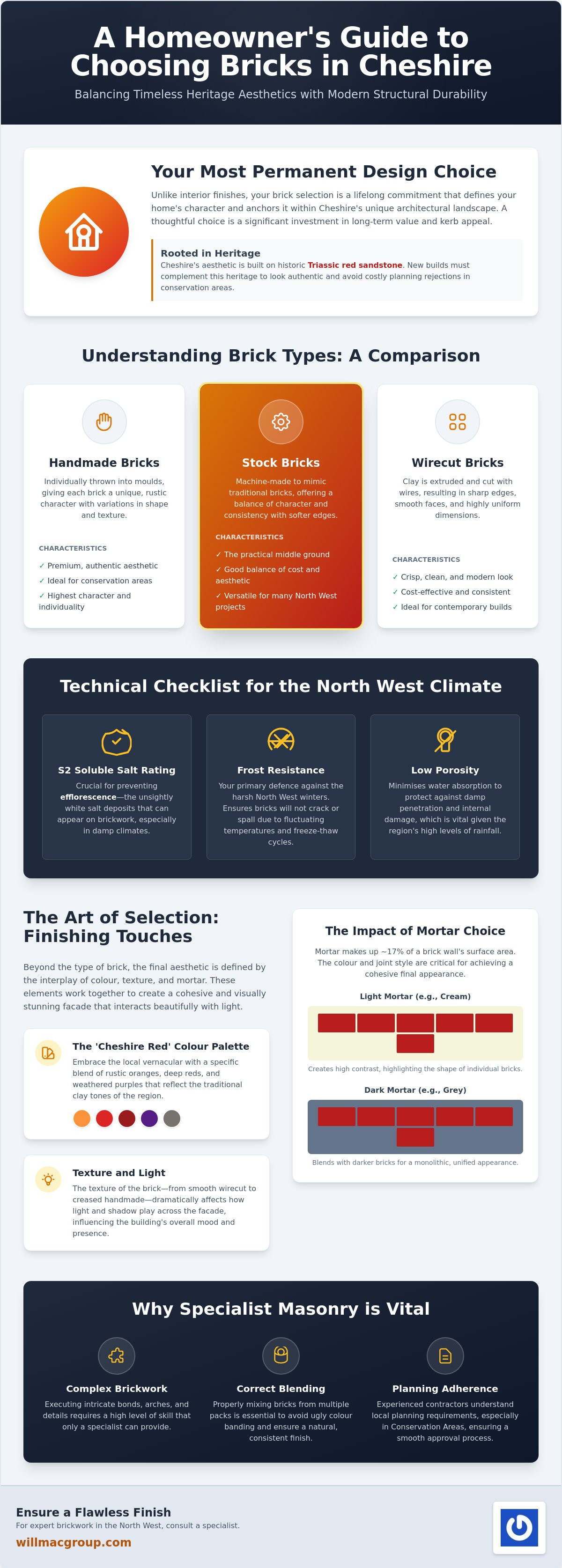
Many homeowners overlook the “15% rule” during the design phase. Mortar typically accounts for 15% to 20% of the total visible surface area of a brick wall. A dark brick paired with a light mortar will look completely different to the same brick paired with a matching dark mortar. Before committing to a full delivery, always build a small test wall on-site with your chosen mortar to see the final effect in situ. This simple step prevents a costly aesthetic mismatch once the project is underway.
The choice of mortar colour can either unify the masonry or make each individual brick stand out. Natural mortar is a safe, traditional choice, whilst white or lime-based mortars provide a striking contrast that can brighten the overall facade. The joint profile is also a functional consideration. A bucket handle joint is the most common in the North West because its curved shape sheds water effectively. Weather struck joints offer a premium, tailored look, whereas a recessed joint can highlight brick texture but may be less weather-resistant in exposed North West sites.
A successful build considers the relationship between the masonry and other external elements. Stone sills, lintels, and roof tiles should all complement the primary brick colour. Architectural interest can be introduced through feature bands or soldier courses, where bricks are laid vertically to create visual breaks. This level of detail is particularly important for house extensions Chester, where the goal is to ensure the new structure integrates seamlessly with the existing property. If you require expert guidance on material selection for your project, contact our specialist builders to discuss your requirements.
Even the most premium materials fail to deliver value if the execution is subpar. Choosing the right brick for your new build in Cheshire is only the first half of the journey; the second half is finding a team capable of translating those materials into a flawless facade. High-quality masonry requires more than just a steady hand. It demands an understanding of how clay units interact with mortar, moisture, and structural loads. When an unskilled labourer handles premium handmade bricks, the result often lacks the refined finish that justifies the initial investment.
One of the most common errors in masonry is “colour banding.” Because clay is a natural material, shades vary slightly between different kiln firings and packs. Specialist contractors prevent this by “blending” bricks from at least three different packs simultaneously. This technique ensures a balanced, natural distribution of tones across the entire wall, avoiding unsightly stripes or patches of a single shade. As established commercial brickwork contractors North West, we prioritise these small but vital details to protect the visual harmony of your project.
Our commitment to quality control is grounded in 25 years of industry experience across the North West and North Wales. We don’t just lay bricks; we manage the entire masonry lifecycle to ensure every site meets BS standards. This involves rigorous coordination with site managers to ensure that deliveries are timed correctly and that execution remains on schedule. Our team operates with a sense of quiet confidence, providing a reliable partnership for developers who value stability and high craftsmanship over aggressive sales tactics. For projects that extend beyond the county border, our brickwork contractors North Wales expertise ensures the same exacting standards are applied across the region’s most demanding coastal and upland environments.
Structural masonry involves complex technical requirements that go far beyond aesthetics. Correct wall tie spacing is essential for the stability of the cavity wall, whilst the precise placement of weep holes ensures adequate ventilation and drainage. These elements are often overlooked by general builders but are second nature to specialised teams. Specialist contractors are better equipped to handle the demands of large-scale residential and commercial builds, where precision matters most. We ensure that every course of brickwork contributes to a durable, high-value structure that will stand for generations. Contact Willmac Group for an expert brickwork consultation to discuss how we can support your next project.
Choosing the right brick for your new build in Cheshire is a decision that defines your property’s character and structural longevity for decades. We have explored how identifying the correct regional palette and ensuring technical compliance with F2 frost ratings protects your investment against the North West climate. As we have discussed, high-quality materials only succeed when they are paired with expert blending and precise masonry techniques that prevent common issues like colour banding or efflorescence.
With over 25 years of specialist masonry experience, Willmac Group is a trusted partner for high-quality residential and commercial brickwork. We are experts in navigating North West planning and heritage requirements, ensuring your project meets every regulatory standard whilst maintaining premium aesthetic appeal. Our team brings a sense of quiet confidence to every site, prioritising transparency and craftsmanship above all else. Discuss your new build project with Willmac Group to ensure your vision is executed with professional care and technical excellence. Your new home deserves a facade that stands as a lasting testament to quality construction.
Look for bricks that mirror the Triassic red sandstone characteristically found across the region. Many successful projects involve observing the masonry in local villages like Tarporley or Knutsford to identify specific blends of orange and deep red. Choosing the right brick for your new build in Cheshire often requires selecting a material with a rustic or sandfaced texture to avoid a flat, modern appearance that might clash with historic neighbours.
Metric bricks are the modern standard, measuring 215mm x 102.5mm x 65mm, whilst imperial bricks are typically taller and were used in older properties. Metric is generally more cost-effective and aligns with standard window and door frame dimensions. However, imperial sizes are frequently required for extensions or builds in conservation areas to ensure the new coursing heights match the original architecture perfectly.
Yes, most planning approvals in the North West include a condition that requires the local authority to approve your external materials before construction starts. You’ll typically need to submit physical samples or build a sample panel on-site for inspection. Planning officers look for consistency with the local development plan to ensure the new structure doesn’t negatively impact the aesthetic character of the street scene.
An F2 rating indicates that a brick is fully frost-resistant under severe exposure conditions, which is essential for the North West climate. This classification ensures the clay can withstand repeated freeze-thaw cycles without the face of the brick crumbling or spalling. Using a brick with a lower rating, such as F1, in an exposed external wall can lead to significant structural and aesthetic damage within just a few years.
Mortar colour has a substantial impact because it accounts for roughly 15% to 20% of the wall’s visible surface area. A light mortar creates a distinct grid-like effect that highlights the shape of each individual brick, whilst a darker mortar tends to blend the masonry together for a more subtle look. It is a reliable practice to test at least three different mortar shades on a sample panel to see how they interact with your chosen brick.
You can use reclaimed bricks, but it is often more practical to select new “reclamation style” bricks that offer guaranteed performance. Genuine reclaimed units can suffer from inconsistent durability and high wastage rates, often exceeding 20% due to breakages. Modern reclamation bricks provide the desired weathered aesthetic whilst ensuring the F2 frost resistance and structural integrity required for a new build project.
Specialist contractors possess the specific skills required for precise masonry tasks, such as correctly blending packs to prevent unsightly colour banding. Whilst a general builder manages multiple trades, a specialist focuses on the technical nuances of structural integrity and complex bonding patterns. This level of expertise is particularly important when choosing the right brick for your new build in Cheshire to ensure the final result reflects a high standard of craftsmanship.
The standard requirement is 60 bricks per square metre for a single-skin wall. It’s professional practice to add a 5% allowance to your total order to cover wastage and breakages that occur during transit or on-site cutting. For a typical three-bedroom detached house, this usually results in an order of approximately 10,000 to 12,000 bricks, though this varies based on the specific number of window and door openings in your architectural design.