
Did you know that 93.7% of new build buyers reported defects to their builder after moving in, according to the 2025 National New Homes Customer Satisfaction Survey? While the keys to a fresh property represent an exciting new chapter, these figures suggest that perfection is rarely the standard on handover day. Creating a comprehensive new build snagging list UK is no longer just a helpful suggestion; it’s a vital technical audit required to protect your investment and ensure your home meets the high standards of craftsmanship you’ve paid for.
It’s completely normal to feel a sense of anxiety when inspecting your new property, especially if you’re worried about overlooking a critical structural flaw or feel unsure about what qualifies as a “reasonable” defect. We understand that confronting developers can feel daunting without a clear plan. This guide provides you with a professional framework to master the snagging process, covering everything from minor cosmetic finishes to essential structural integrity. We will walk you through the latest 2026 regulations and the New Homes Quality Code, giving you the confidence to report issues clearly and ensure your home remains a stable, high-quality environment for years to come.
A new build snagging list UK is a formal document that records every defect, omission, and instance of poor craftsmanship found in a newly constructed property. In the construction industry, this process is often compared to creating a “punch list” to ensure the final product matches the agreed specifications. For a detailed overview of the terminology, you can read more about What is a Snagging List. This audit isn’t merely about finding small paint splashes; it’s a vital step in ensuring your home is structurally sound and finished to a high standard.
Legally, most UK new build contracts include a “defects liability period,” which typically lasts for the first two years of ownership. During this time, the developer is contractually obliged to rectify any issues that arise due to failure to meet building standards. Identifying these problems early is essential for protecting the resale value of your property. Unresolved issues can become expensive headaches when you eventually decide to sell, as future buyers’ surveyors will undoubtedly flag them. Beyond the financial implications, a thorough list ensures the safety and longevity of the building’s infrastructure.
While many homeowners choose to create a DIY list, there’s a significant difference between a casual walkthrough and a professional snagging survey. A professional inspector uses specialised equipment, such as thermal imaging cameras and moisture meters, to detect hidden problems like thermal bridging or slow leaks that aren’t visible to the naked eye. Relying on a professional new build snagging list UK provides a level of technical detail that holds developers accountable to specific industry regulations.
The timing of your inspection is critical. Under the New Homes Quality Code, buyers now have the right to a Pre-Completion Inspection (PCI). This allows you or a professional to inspect the property before you officially move in. Conducting the audit whilst the house is empty is far more effective, as every corner is visible and there’s no risk of furniture obscuring defects. If you’ve already moved in, don’t worry. You generally have a two-year window to report most snags under standard warranties, though it’s always best to raise issues as soon as they’re spotted to avoid disputes over whether damage was caused by daily living.
Reputable builders in Chester view the snagging process as a standard part of their quality control programme. A professional builder will have a clear system for receiving reports and scheduling rectification works. You should expect a written response outlining the timescales for repairs, which typically range from a few days for minor cosmetic fixes to several weeks for more complex tasks. Maintaining clear, written communication is the most effective way to manage this relationship. By providing a structured list, you help the site manager coordinate the necessary trades efficiently, ensuring your home is brought up to the expected standard without unnecessary delays.
While most homeowners focus on the interior finishes, the external “envelope” of your property is what ensures long-term stability and protection against the British weather. A robust new build snagging list UK must prioritise the structural integrity of the masonry and roofline. It’s about looking beyond the surface to verify that the building is weather-tight and correctly assembled. Poorly executed external work can lead to significant damp and thermal issues that may not become apparent until the first heavy winter storm.
A primary area of concern is the quality of the masonry. Experienced specialist brickwork contractors look for strict consistency in mortar joints and coursing. Uneven mortar beds or “snots” (excess mortar) left in the cavity can create bridges for moisture to enter the home. You should also evaluate the roofline. Fascias and soffits must be securely fixed and guttering must have a slight, consistent fall towards the downpipes to prevent water pooling. According to the New Homes Quality Code, developers are expected to deliver homes that meet high technical standards, and the external finish is a clear indicator of the care taken throughout the project.
When walking the perimeter, pay close attention to the details that manage moisture. Weep holes are essential for cavity ventilation; ensure they are clear of debris and spaced correctly, usually every three bricks above lintels. You might notice “efflorescence,” which is a white salt staining common on new bricks. While often harmless, it should be monitored to ensure it isn’t masking a more serious water ingress issue. Don’t forget to inspect movement joints, which allow the building to flex without cracking, and check that lead flashings around chimneys and valleys are neatly chased into the mortar.
The ground surrounding your home plays a vital role in its health. Driveways and patios must have a “fall” to direct rainwater away from the foundations. If water pools against the walls, you risk future damp problems. Check that air bricks, which provide vital sub-floor ventilation, are not obstructed by soil or landscaping. Finally, verify the stability of fencing and external walls. In exposed locations, such as North Wales or the Cheshire plains, boundaries must be sturdy enough to withstand high winds. If you’re planning future additions to your property, consulting a professional builder can help you understand how these external factors impact your plans.
Once the external shell is verified, the focus shifts to the intricate details of the interior. A systematic approach is essential. We recommend starting at the top floor and working your way down, room by room. This ensures no space is overlooked. When compiling your new build snagging list UK, pay close attention to the joinery. Check that skirting boards and architraves are flush with the walls and that internal doors hang straight without swinging open or shut on their own. Every window in the property must be tested. They should open, close, and lock smoothly without catching on the frame. Also check for any draughts that might suggest a failed seal.
Don’t forget to look underfoot. Uneven floor levels or “hollow” sounding floor tiles often indicate poor subfloor preparation or insufficient adhesive. This isn’t just a cosmetic issue; it can lead to cracked tiles or tripping hazards later. Use a spirit level in various spots to ensure the finish is consistent across the entire room. Using a professional new build snagging list UK ensures you don’t miss these subtle defects that can be costly to fix later.
Testing the core infrastructure is vital for long-term comfort. Run every tap to check for consistent flow and efficient drainage. Look inside vanity units and under sinks for any signs of slow leaks. Your central heating system should be balanced correctly, meaning all radiators reach a similar temperature at the same time. For homeowners in West Sussex, professional specialists like WellPlumbed can provide expert insights into what constitutes a high-quality heating installation. In the consumer unit, ensure every circuit is clearly and accurately labelled. Check that all sockets and switches are level and securely fixed to the walls. Any flickering lights or non-functional sockets should be flagged immediately.
These rooms are high-moisture areas where precision is paramount. Inspect the sealant and grout around baths, showers, and worktops for any gaps. Even a tiny opening can lead to water ingress and subsequent rot. Check the alignment of kitchen cabinet doors and drawers to ensure they are level. Integrated appliances should be tested for basic operation. Finally, use a high-powered torch, such as those available from New Local Tools, to look for scratches on sanitaryware, glass, or worktops. These defects are often missed in natural light but can be wooden difficult to rectify once you’ve officially moved in and the developer claims the damage occurred after handover.
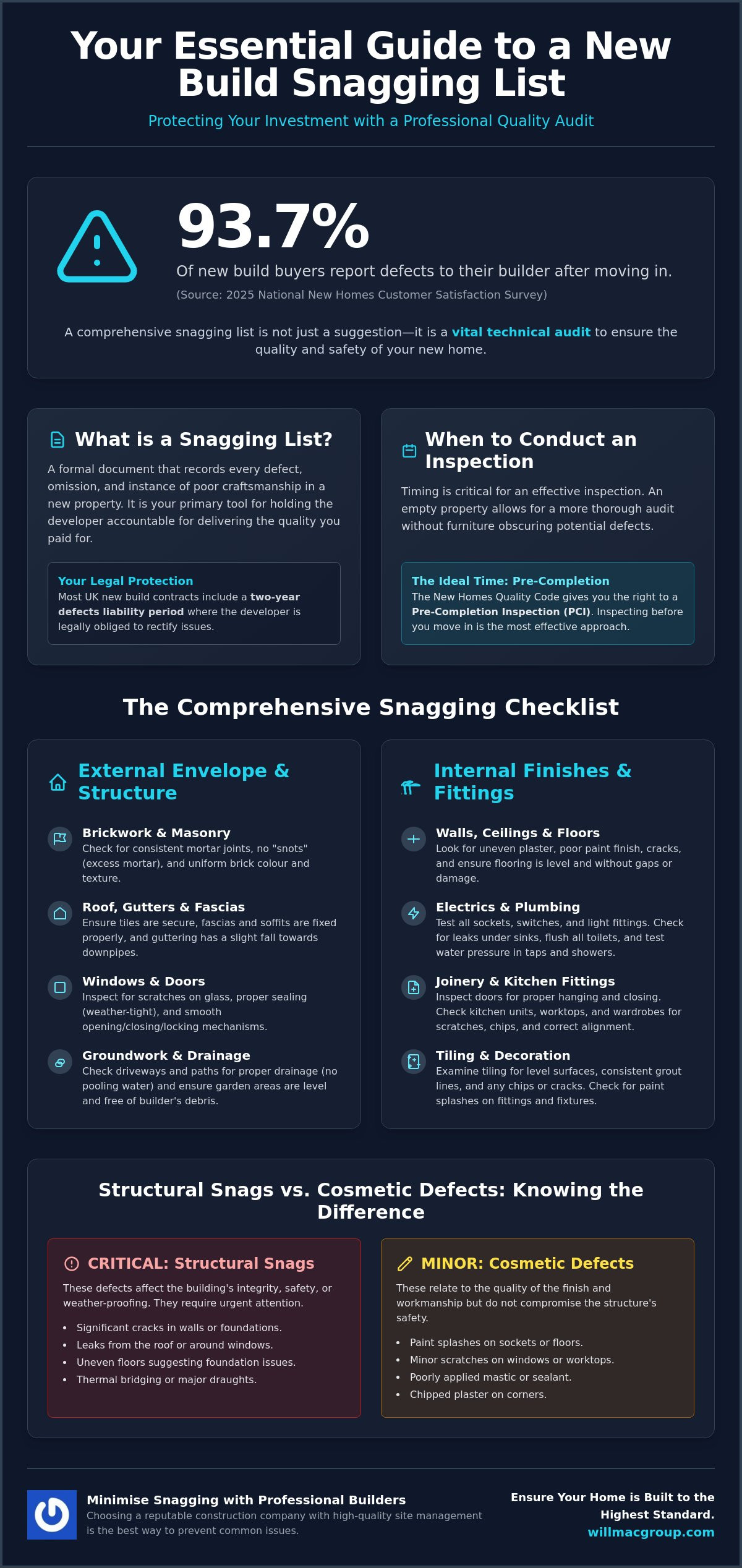
Differentiating between a minor paint scuff and a serious structural failure is a vital skill when compiling your new build snagging list UK. Not all defects carry the same weight. While a scratched kitchen worktop is frustrating, it doesn’t threaten the building’s longevity. Categorising your findings helps you prioritise what needs urgent attention from the site manager. Structural issues, such as failing lintels or significant masonry movement, require immediate specialist intervention, whereas cosmetic snags are often grouped together for a decorator to address in one visit.
Understanding the stages of new build construction provides valuable context for why certain issues appear. Many snags are the result of how different materials interact as the building settles into its foundations. For example, if the groundworks weren’t perfectly compacted, you might see evidence of movement in the brickwork months after completion. Being able to spot these “red flags” early, such as diagonal cracks that are wider than a 50p piece, can save you from significant stress later. If you are planning your own project and want to ensure structural excellence from day one, contact an experienced builder today.
Settlement is a physical reality for almost every new home. As the hundreds of litres of water used during the plastering and bricklaying phases begin to evaporate, the materials naturally contract. This often results in fine, hairline cracks in the plaster, particularly around door frames and where walls meet ceilings. You can minimise this timber movement by managing humidity levels; don’t turn the heating up to maximum immediately after moving in. You may also notice “nail pops,” which occur when the timber studs dry out and push the plasterboard nails slightly forward. These are standard maintenance items and are typically fixed during the end-of-year defect review.
Some problems aren’t immediately visible on handover day. Latent defects are faults caused by poor design, materials, or workmanship that may only manifest years later. This is why structural warranties, such as those provided by the NHBC or similar providers, are essential. These policies usually cover major structural failures for up to 10 years. You should be alert for serious warning signs like persistent damp that suggests a failed DPC (Damp Proof Course) or windows that suddenly become difficult to close due to a sagging lintel. If you suspect a significant fault that goes beyond simple settlement, involving a structural engineer is a prudent step to protect your investment.
The goal for any homeowner is to receive a property where the new build snagging list UK is exceptionally short, focusing only on the most minor of cosmetic adjustments. Achieving this result isn’t a matter of luck; it’s the direct outcome of proactive site management and a commitment to high standards from the first day of the project. When you choose an established construction company in Chester, you’re investing in a team that prioritises quality control at every milestone, rather than rushing to a finish line. If you are still in the early stages of your project, understanding how to find land for a new build in Cheshire is an equally important first step before construction quality even becomes a consideration.
Structural excellence begins beneath the surface. Rigorous groundworks and civils are essential for setting a stable foundation. If the site preparation is flawed, even the most expensive interior finishes won’t prevent settlement issues or drainage failures later. At Willmac Group, we employ a “clerk of works” style approach to our own builds. This involves constant, methodical inspections of the superstructure as it rises, ensuring that every brick, lintel, and joist is installed according to the technical drawings. By identifying potential issues during the build phase, we eliminate the structural red flags that often cause anxiety for homeowners during their final walkthrough.
Preventing snags requires a combination of high-quality materials and consistent craftsmanship. We don’t rely on transient subcontractors; instead, we utilise skilled tradespeople who understand our expectations for longevity and finish. Using premium materials prevents the premature wear or failure of components like door seals or plumbing fixtures. Before a client ever steps foot in the property for their inspection, we conduct our own internal “pre-snagging” audit. This allows us to rectify minor paint blemishes or joinery adjustments whilst the site is still under our full control, ensuring the property is presented in its best possible light.
A professional handover is the final step in minimising future disputes. We provide a comprehensive homeowner manual that goes beyond basic warranty details, explaining exactly how to maintain the property during the crucial drying-out period. It’s vital that you understand the operation of your home’s mechanical and electrical systems, from the heat pump settings to the consumer unit layout. We also establish a clear, direct point of contact for the defects liability period. This transparency ensures that if any minor issues do arise after you’ve moved in, they are handled with the same precision and care that went into the construction of the home itself.
Mastering your new build snagging list UK is the final, essential step in transitioning from a construction site to a permanent home. By distinguishing between minor cosmetic shrinkage and significant structural red flags, you can navigate the handover process with technical clarity and confidence. Protecting your property’s value requires a methodical approach that prioritises the building’s envelope and core infrastructure just as much as the interior fit and finish.
Quality construction is built on a foundation of transparency and rigorous site management. With over 25 years of industry experience, the Willmac Group team specialises in structural brickwork and groundworks, ensuring that every project meets the highest standards of stability. Our proven track record across Chester and North Wales is built on delivering homes that stand the test of time, minimising the stress of the defects period through precision and care from the outset.
If you are planning a construction project and want to ensure excellence from the first brick to the final handover, we are here to guide you. Discuss your new build project with the Willmac Group team today and take the first step towards a defect-free future. We look forward to helping you build something exceptional.
Builders are typically responsible for rectifying defects during the first two years of ownership, known as the defects liability period. Under the New Homes Quality Code, developers must respond to snagging reports within clear, set timeframes. After this initial two year window, your protection usually shifts to the remaining eight years of a structural warranty, which only covers major structural failures.
A developer may refuse to fix an item if they believe the finish meets industry “tolerances” set by warranty providers like the NHBC. If you disagree with their assessment, you can escalate the matter to the New Homes Ombudsman Service. This independent body can order builders to carry out repairs or even pay compensation of up to £25,000 if they find in your favour.
Investing in a professional survey is generally considered a prudent move for most homeowners. The average cost for a professional inspection is approximately £394, which is a small fraction of the property’s total value. Inspectors use technical equipment like thermal cameras to find hidden defects, such as missing insulation or slow leaks, that a DIY check would likely miss.
The most frequent issues reported include poorly fitted windows, plumbing leaks under sinks, and incomplete loft insulation. According to the March 2025 Home Builders Federation survey, 93.7% of buyers reported problems to their builder after moving in. Using a comprehensive new build snagging list UK ensures these common faults, along with more technical masonry issues, are formally recorded.
Yes, a professional list should cover both cosmetic defects and critical structural integrity. While many people associate snagging with paint scuffs, a technical audit looks for failing lintels, incorrect wall tie spacing, and problems with the damp proof course. Identifying these structural concerns early is vital for the long term stability of your home.
You can report snags at any point during the first two years of your warranty. However, it’s highly beneficial to conduct a Pre-Completion Inspection (PCI) before you move your furniture in. This prevents the builder from claiming that certain damages, such as scratches on flooring or chips in worktops, were caused by your removal team rather than the tradespeople.
A snag is a defect that is visible or detectable during the initial inspection or the first two years of occupation. A latent defect is a hidden fault, such as a foundation failure or a major roofing flaw, that may not manifest for several years. Latent defects are typically covered by your 10 year structural warranty rather than the builder’s initial snagging period.
In the UK, most new build contracts don’t allow buyers to withhold a “retention” sum from the final purchase price. Legal completion usually requires you to pay the full balance regardless of minor snags. Instead, you should rely on the protections offered by the New Homes Quality Code and your structural warranty to ensure the developer fulfils their obligation to rectify any recorded issues.