
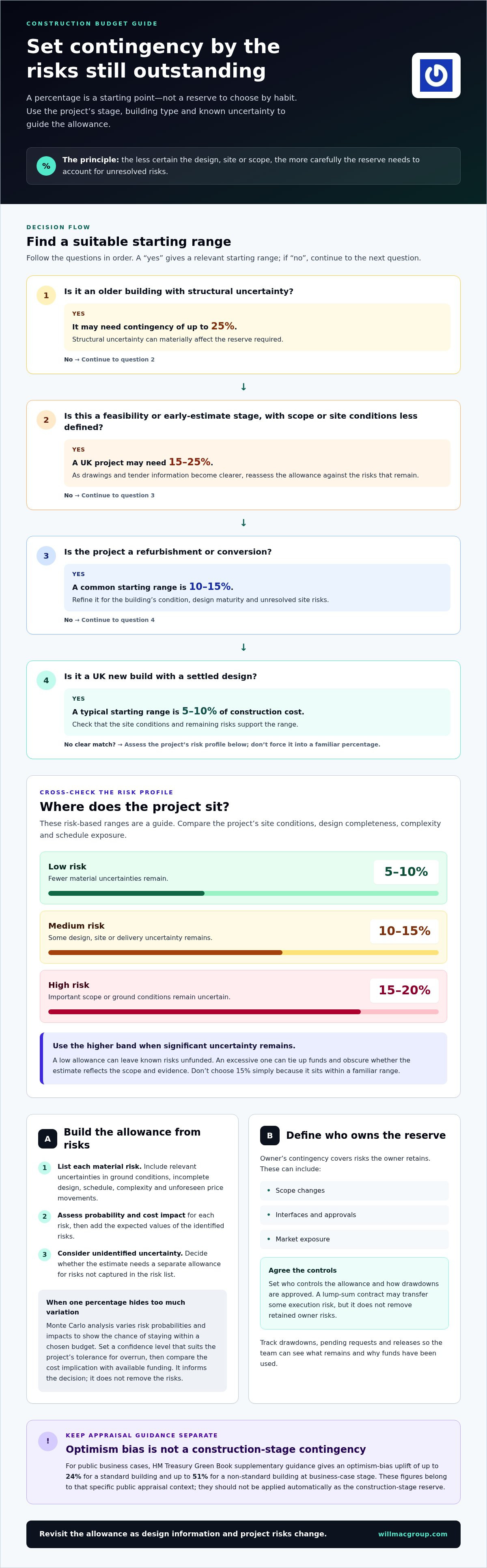
A larger reserve isn’t automatically a safer one: a construction project contingency budget should reflect the design’s maturity and the risks still outstanding. For a UK new build with a settled design, a typical allowance is 5% to 10% of construction cost; a refurbishment or conversion commonly calls for 10% to 15%, while an older building with structural uncertainty may need up to 25%.
Choosing a percentage is only the starting point. It’s understandable to want a clear buffer for unexpected costs, but contingency works best when it’s linked to specific risks and reviewed as the project develops, not treated as spare money.
This guide explains how to choose an appropriate allowance, what it should cover and which costs belong elsewhere. It also shows how surveys and design development can clarify risks, and how project controls track drawdowns, pending requests and remaining funds to keep the budget visible throughout construction.
Choose a percentage by assessing design maturity, site uncertainty and the risks that remain, not by treating every build alike. For an early estimate, 5-15% can be a rule of thumb; the risk profile should determine where your project sits within that range.
An allowance that’s too low can leave known risks unfunded and put pressure on the project budget if they occur. One that’s too high can tie up funds unnecessarily and obscure whether the estimate reflects the project scope and available evidence.
Classify the project’s risks before selecting a percentage. A low-risk construction project may use 5-10%, a medium-risk project 10-15%, and a high-risk project 15-20%. Compare site conditions, design completeness, complexity and schedule exposure; use the higher band when important scope or ground conditions remain uncertain. Don’t choose 15% simply because it appears within a familiar range.
List each material risk, estimate its probability and assess its cost impact. Add the expected values of identified risks, then consider whether the estimate also needs a separate allowance for uncertainty that risk identification hasn’t captured.
Define the owner’s contingency for risks the owner retains, such as scope changes, interfaces, approvals or market exposure. A lump-sum contract may transfer some execution risk, but it doesn’t remove those retained risks. Agree who controls the allowance and how drawdowns are approved. A low reserve can force difficult funding decisions; an excessive one may leave funds unused or conceal an immature estimate.
Separate contingency from planned costs in your estimate, then set a reserve for risks whose timing or scale remains uncertain. Project type, design stage, site information and the treatment of price changes all affect what belongs in the reserve.
For inflation, price changes and VAT, show forecast escalation and VAT treatment clearly in the estimate rather than hiding them in contingency. Keep the budget consistently VAT-inclusive or VAT-exclusive, based on the project’s VAT treatment, and reserve contingency for unforeseen cost movements or other identified risks.
Choose a starting range that reflects the work and the estimate’s maturity. A UK new build with a settled design commonly uses 5-10% contingency, while a refurbishment or conversion commonly uses 10-15%. An older building with structural uncertainty may need up to 25%. At feasibility or early-estimate stage, a UK project may need 15-25%, as scope and site conditions are less defined.
As drawings and tender information become clearer, reassess the allowance against the risks that remain. Public works projects are commonly allocated 5-10%; don’t apply that range mechanically to a complex refurbishment or use an early-stage reserve after uncertainty has reduced.
List factors that could change costs, such as difficult ground conditions, incomplete design information, schedule uncertainty, and material or labour price movements that could not have been foreseen at tender. Link each identified risk to its possible effect on the estimate. This makes contingency a planned reserve for uncertainty, not spare money for routine costs.
Use contingency for unforeseen conditions or omissions that emerge during construction, not regular project costs or minor scope adjustments. A delay, for example, may affect indirect costs and contractor commitments, so assess schedule exposure alongside physical site risks.
Separate uncertain risks from planned items with costs still to be finalised. Under RICS New Rules of Measurement (NRM1), contingency is a risk allowance added to the base cost estimate for items that cannot be precisely predicted. An allowance, by contrast, sets aside budget for a known item whose final cost remains variable.
Record each allowance against its item and state whether it covers materials, installation labour or both. For example, an unfinished selection may need an allowance; an unidentified site condition belongs in the risk register and may justify contingency. This distinction helps prevent mistakes and improves confidence in the estimate.
Show anticipated inflation or price escalation as a forecast cost in the estimate, with its timing and basis visible. Use contingency for unexpected price movements that could not reasonably be anticipated at tender, not as a substitute for planned escalation. Review material and labour exposure against procurement timing and the project programme.
For VAT, keep the cost plan consistent and show whether figures include or exclude it, reflecting the project’s VAT treatment. Don’t count recoverable VAT as a project cost or omit VAT that the budget must fund. Clear separation makes the reserve easier to assess. For a defined construction project scope, this distinction supports more useful cost planning.
A UK project team can reduce contingency by investigating site conditions, developing the design and updating its risk assessment. Remove or revise allowances only when evidence shows that the related uncertainty has reduced or passed.
For design contingency management, the suggested allocation is approximately 20% during design, 30% during design development and 50% or less during the construction-document phase. Use these stages to plan approval and spending, then review each allocation as information develops.
During delivery, assess the reserve against current risks and forecast project cost, not just the original percentage. Use each review to prepare a clear balance of approved spending, pending changes and remaining exposure.
Connect contingency to the cost forecast, risk register and programme to keep its purpose visible. Project management controls turn uncertainty into a current figure that stakeholders can review and act on.
Clear cost and programme reporting helps keep construction decisions grounded in current information. Discuss your construction project and the practical considerations behind its delivery.
Willmac Group delivers extensions, new builds and construction, including brickwork, through a comprehensive, integrated, one-roof service. If you’re moving from budget planning towards a defined building project in Chester, the North West or North Wales, consider how the proposed scope, site conditions and design decisions shape the work and its risks. Clear cost planning helps separate agreed requirements from contingency reserved for uncertainty, making it easier to discuss priorities before construction begins.
For an extension or new build, Willmac Group can help deliver the construction work as the project moves from plans into building. A useful next step is to outline the intended scope and the key decisions already made, so the conversation can focus on the work involved and how it will be managed.
To discuss your project, contact Willmac Group.
A well-managed construction project contingency budget is more than a reserve on a spreadsheet. It gives you a clearer basis for decisions as the scope, evidence and delivery plan develop. Before moving forward, bring together the current estimate, key assumptions and unresolved decisions. This creates a practical starting point for discussing priorities and the work needed to turn your plans into a build.
Willmac Group undertakes extensions, new builds and construction, giving you a route from project plans to building work. Share the outline of your project and the decisions you’ve already made to begin a focused conversation about its next stage.
Contact Willmac Group to discuss your project and take the next step with a clearer plan.
A contingency budget is a reserved part of a project’s funding for costs that cannot be fully predicted at the outset. It sits alongside the base estimate rather than replacing it. For example, a project team can record a potential site issue as a risk, then draw on the reserve if it occurs. Planned purchases with prices still being finalised belong in separate allowances.
In construction, contingency is a controlled reserve for eligible costs arising from uncertainty during delivery. It can help address an unexpected condition that affects the work, such as a concealed structural issue discovered during refurbishment. It isn’t a general fund for upgrades or additions requested after work starts. Recording the cause and approval for each use helps distinguish genuine risk events from changes to the agreed scope.
Contract terms determine who controls contingency and what happens to unused funds. Under a lump-sum contract, the contractor usually retains unused contingency; under a GMP contract, it’s typically shared between the owner and contractor. Before work begins, identify the relevant clauses covering control, permitted use and final reconciliation. This helps all parties understand how contingency decisions affect their responsibilities and the project’s financial closeout.
Start with a percentage that reflects the project’s estimate maturity and risk, then test it against identified exposures. For early screening or concept development, 5-15% can be a rule of thumb. A lower-risk project may sit nearer the lower end; incomplete scope or difficult site conditions support a higher allowance. Apply the percentage to the base estimate, and keep planned variable-cost items separate.
Use a documented approval process before committing reserve funds. The request should identify the risk event or change order, explain why contingency is appropriate, and set out the forecast cost and effect on the remaining balance. The authorised decision-maker can then approve or reject it against the agreed rules. Record the decision and update the cost forecast so stakeholders can trace its use from request to reported expenditure.
Reduce or release funds when the related risk has been resolved, ruled out or become irrelevant to the remaining work. For example, once an investigation removes a specific ground-condition uncertainty, review the associated reserve against the findings. Don’t release funds just because construction has progressed or time has passed. At closeout, reconcile approved expenditure, outstanding commitments and active risks before releasing any remaining balance.
A construction project contingency budget is the project’s planned reserve for cost effects that are uncertain when the estimate is prepared. It gives the owner a way to address eligible risks without confusing them with the agreed base scope. For instance, a risk register can connect a possible event to a potential cost and a decision process. Keep the reserve visible in forecasts, rather than letting it disappear into general project spending.
For a UK new build with a settled design, a typical construction contingency is 5-10% of construction cost. A refurbishment or conversion commonly uses 10-15%, while an older building with structural uncertainty may need up to 25%. Treat these as project-type guides, then adjust for design maturity, site knowledge and remaining risks. A public business case has a separate optimism-bias assessment, not simply a construction reserve.