
A single misplaced course of bricks can compromise the structural integrity of an entire home, regardless of how impressive the architectural drawings look. You’re likely concerned about finding tradespeople who actually understand the rigorous 2026 amendments to the Building Regulations, especially with the Future Homes and Buildings Standards now influencing every site. It’s a common worry that poor masonry or a lack of coordination between groundworks and brickwork will lead to costly delays. When searching for reliable bricklaying contractors Wirral, you need a partner who treats British standards as the floor, not the ceiling.
It’s vital to feel confident that your investment is protected by high-calibre craftsmanship and a deep understanding of the Building Safety Act 2022. This article will help you select the finest masonry experts to ensure your project is built to last. We’ll examine the specific technical requirements for 2026, the benefits of coordinating brickwork with early-phase construction, and how to achieve a finish that satisfies both local planning officers and your own high expectations for quality.
Hiring a general labourer might seem cost-effective for minor repairs, but for extensions and new builds, the expertise of specialist bricklaying contractors Wirral is indispensable. A professional contractor doesn’t just lay bricks; they manage the entire masonry phase of a construction project. This includes coordinating with suppliers, managing onsite safety, and ensuring that the brickwork aligns perfectly with the civils and groundworks already in place. For a large-scale build, this level of oversight prevents the common errors that lead to structural failure or aesthetic inconsistency.
The impact on your property’s valuation cannot be overstated. High-quality masonry is a permanent record of a building’s standard of construction. Prospective buyers and surveyors look for crisp lines, consistent mortar joints, and a lack of efflorescence or cracking. In the coastal environment of the Wirral peninsula, where buildings face high winds and salt-heavy air, professional contractors select materials and techniques specifically designed to withstand these conditions. This foresight protects the structural safety of the building for decades, rather than just years.
The character of Wirral homes is often defined by their masonry. Using various brickwork techniques and terminology allows a contractor to match new extensions to existing period properties or create striking modern finishes. Whether it’s a traditional Flemish bond or a contemporary stack bond, the precision must be absolute. Structurally, the brickwork serves as the primary load-bearing component. Professional quality control ensures that wall ties are correctly spaced and cavities remain free of debris, which is essential for preventing damp and ensuring the home remains thermally efficient in the North West’s damp climate.
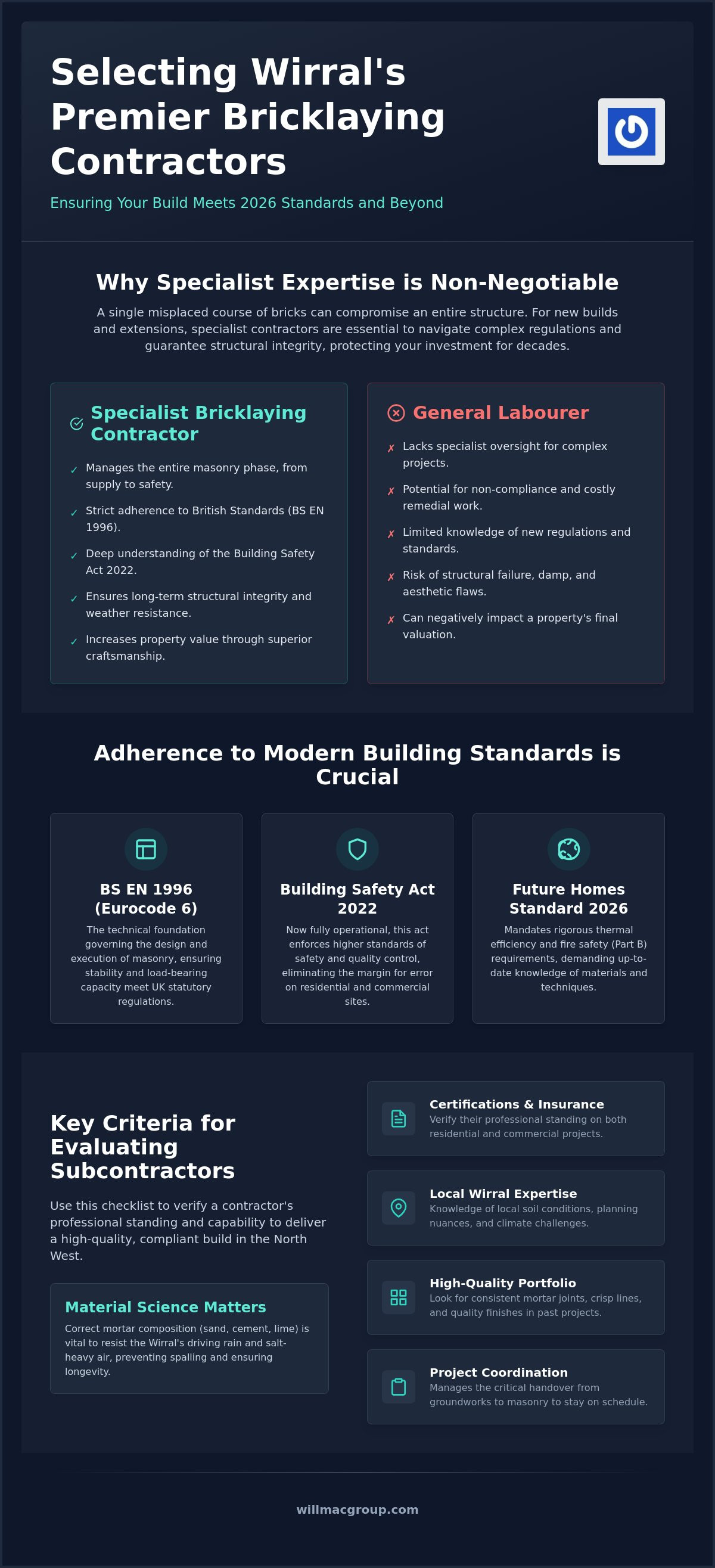
Compliance is a moving target in 2026. With the Building Safety Act 2022 now fully operational and the latest amendments to Part B (Fire Safety) taking effect as of September 2026, the margin for error has disappeared. Experienced contractors maintain strong relationships with building control officers in Birkenhead, Wallasey, and across the Wirral. They understand the specific thermal requirements mandated by the Future Homes Standard, ensuring your new build or extension passes inspections without costly remedial work. Choosing a contractor with local roots means they’re already familiar with the soil conditions and planning nuances specific to our region.
Specialist Brickwork is the disciplined application of masonry units to create a load-bearing or decorative structure according to British Standards. Achieving this level of precision requires bricklaying contractors Wirral to strictly adhere to BS EN 1996, also known as Eurocode 6. This technical standard governs the design and execution of masonry structures, ensuring every wall possesses the necessary stability and load-bearing capacity to meet statutory building regulations. Without this technical foundation, even the most attractive brickwork can fail under the stresses of time and weather.
Material selection is equally vital to the longevity of a build. Engineering bricks, typically Class A or B, are utilised for their high compressive strength and low porosity, making them ideal for foundations or areas prone to high moisture levels. In contrast, facing bricks are chosen for their aesthetic qualities, though they must still meet rigorous durability ratings for frost resistance. Identifying the correct brick for the specific application is a hallmark of a professional masonry team. When evaluating bricklaying contractors Wirral, it’s essential to ask about their quality control procedures for maintaining bond consistency across different elevations.
The Irish Sea winds across the Wirral peninsula demand a specific approach to mortar. The mix proportions of sand, cement, and lime must be carefully adjusted to ensure the joints are flexible enough to accommodate thermal movement whilst remaining resistant to driving rain. Incorrect ratios often lead to spalling, where the brick face breaks away due to moisture ingress. Professional contractors also focus on the technical process of repointing. This isn’t merely a cosmetic fix; it’s a vital maintenance task that protects the structural core of the wall. By managing material handling on site, we can prevent efflorescence, the white salt staining that often occurs when bricks aren’t kept dry before being laid.
The choice of bond significantly affects both the strength and appearance of a building. Stretcher bond is common in modern cavity walls, but for many Wirral projects, Flemish or English bonds are preferred to provide a traditional aesthetic. Ensuring absolute verticality and horizontal alignment is achieved through consistent site surveying and the use of laser levels. Large masonry walls also require modern movement joints. These discreet gaps, filled with flexible sealant, allow the brickwork to expand and contract without causing structural cracks. Consulting an experienced specialist brickwork team early in your project helps ensure these technical details are planned for from the outset.
Selection of a subcontractor should be based on more than just a cursory glance at recent feedback. Whilst user-led rating systems offer some insight, they often lack the technical depth required to judge structural masonry. Professional bricklaying contractors Wirral should be evaluated through a lens of technical certification and proven history. This methodical approach ensures that your project is handled by individuals who respect the complexity of modern building standards and possess the logistical capacity to deliver results on time.
Insurance is a non-negotiable prerequisite for any construction project. Public Liability and Employer’s Liability insurance are essential to shield you from financial risk should an accident occur on your property. Beyond these legal safeguards, look for evidence of professional bricklaying qualifications amongst the workforce. CSCS cards are the industry standard for verifying that bricklayers possess the necessary competence and safety training to work on modern sites. Membership in trade bodies further indicates a commitment to staying updated with evolving masonry techniques and the latest building regulations.
When reviewing a portfolio, look beyond the initial visual appeal. Examine the consistency of the mortar joints and the precision of the detailing around windows, arches, and corners. A high-quality contractor won’t mind you asking to see a project completed five or more years ago. This allows you to see how their work stands up to the elements and whether the structural integrity remains uncompromised by issues like settlement or poor mortar selection. For further advice on managing your selection process, our guide on how to choose a building contractor provides additional vetting strategies for residential and commercial builds.
Health and safety compliance is a major factor in professional project management. Accreditations like CHAS (Contractors Health and Safety Assessment Scheme) or SMAS (Safety Management Advisory Services) provide peace of mind that the contractor operates under a recognised safety framework. This is vital when coordinating with other trades on site, such as those handling groundworks or roofing. You must also assess their capacity to scale. A contractor who can deploy additional skilled labour when required will keep your build on track, preventing the frustrating delays that often plague smaller operations when they face unexpected logistical challenges. This ability to manage resources effectively is what separates a specialist contractor from a simple labour-only service.
Successful masonry depends on the preparation that occurs before the first trowel of mortar is mixed. The transition from groundworks and civils to the bricklaying phase is a critical juncture in any construction timeline. If the site preparation or foundation work is imprecise, bricklaying contractors Wirral will face immediate challenges with vertical alignment and structural stability. A seamless handover ensures that the masonry team can begin work on a stable, level base, which is essential for maintaining the pace of the build.
Establishing a realistic timeline requires a pragmatic approach to the British climate. Whilst a skilled bricklayer can typically lay between 400 and 600 bricks per day, this productivity rate is subject to architectural complexity and shifting weather conditions. Rain or frost can halt work to protect the integrity of the mortar curing process. Professional contractors use staged scaffolding and strategic site logistics to maintain momentum. By ensuring materials are stored correctly and access is clear, the team can maximise productive windows and keep the project moving safely.
Foundations must be perfectly level and fully cured before the first course is laid. The installation of the Damp Proof Course (DPC) is a vital step that requires absolute precision. In the Wirral’s damp coastal environment, the DPC acts as the primary defence against rising damp. Accurate site preparation at this stage prevents costly structural adjustments later in the build. It’s much simpler to verify levels at the footer than to attempt to correct a leaning wall several metres up.
Brickwork doesn’t exist in isolation. It must interface seamlessly with several other trades to ensure a functional building envelope. This includes coordinating with joiners for the placement of lintels and window frames, as well as preparing for the arrival of the roofing team. Services such as plumbing and electrical conduits must be correctly sleeved through the masonry walls during construction to avoid the need for retrospective drilling. The oversight provided by a full build contractor is invaluable here, as they manage these complex transitions and ensure no phase of the build is compromised by poor communication.
The project concludes with a rigorous final inspection and “snagging” process. This ensures that every joint is struck correctly, weep holes are clear, and the finish meets the high aesthetic standards expected of premium masonry. By managing these stages with precision, professional bricklaying contractors Wirral ensure the longevity of your build. If you’re planning a new build or extension, contact Willmac Group to discuss how our integrated approach to construction can streamline your project from the ground up.
Willmac Group stands out amongst bricklaying contractors Wirral by blending a quarter-century of traditional masonry experience with sophisticated modern construction management. We don’t just see ourselves as subcontractors; we act as a strategic partner for both residential and commercial developers. Our commitment to delivering specialist brickwork in Chester and across the Wirral peninsula is built on a foundation of transparency and technical precision. This long-standing presence in the region has allowed us to refine our processes to meet the highest British standards of craftsmanship.
Our integrated approach is what truly sets our builds apart. By managing the full lifecycle of the masonry phase, including the critical transitions from civils and groundworks, we eliminate the friction that typically occurs between separate trades. This holistic oversight ensures that the structural integrity of your project is maintained from the first excavation to the final course of bricks. We organise our teams to meet the demanding schedules of 2026 construction programmes, ensuring that high-calibre results are delivered within the agreed timelines and budgets.
Every project in Wirral requires a nuanced approach to match the distinct architectural character of our local communities. Whether we’re working on premium extensions in Heswall and West Kirby or creating striking modern homes in Caldy, we tailor our masonry to the specific aesthetic requirements of the site. Our expertise in new build construction allows us to support private clients and commercial firms with equal proficiency. We prioritise the use of high-quality materials that are proven to stand the test of time in the North West’s unique coastal climate.
Beginning a construction project requires clear communication and accurate forecasting. We provide comprehensive, transparent quotes that reflect the true scope of your brickwork requirements, ensuring there are no hidden surprises as the build progresses. Our process begins with a detailed site visit and technical consultation across the Wirral and Cheshire area. This methodical start allows us to identify potential challenges early and provide a realistic roadmap for your project. As reputable bricklaying contractors Wirral, we’re ready to bring structural excellence and refined craftsmanship to your next build. Contact our team today to discuss your requirements and discover how we can help you achieve a flawless finish.
Building a property in 2026 requires more than just manual skill; it demands a deep understanding of evolving statutory regulations and technical masonry standards. The integration of groundworks and masonry provides the necessary stability for any build, whilst strict adherence to BS EN 1996 ensures long-term structural safety. Selecting established bricklaying contractors Wirral means your project is protected from the common pitfalls of poor coordination and substandard finishes. Quality masonry is an investment in your property’s longevity and value.
Willmac Group brings over 25 years of industry experience to every site, specialising in high-quality residential and commercial masonry. We provide a comprehensive service that manages the entire process from initial civils to the final structural finish. Our team focuses on transparent communication and rigorous quality control to deliver results that meet the highest British standards. Discuss your Wirral brickwork project with Willmac Group today to ensure your next build is defined by durability and superior craftsmanship. We look forward to helping you turn your architectural vision into a solid, lasting reality.
National averages for a skilled bricklayer in 2026 typically range between £180 and £300 per day. If the contractor provides a labourer as part of the team, the combined daily rate usually falls between £250 and £400. These figures can fluctuate based on the specific technical requirements of the site and the complexity of the masonry bonds required.
Yes, employing a specialist is the most reliable way to ensure your extension meets the 2026 amendments to the Building Regulations. Specialist contractors manage the critical interface between the new masonry and your existing home. They ensure structural loads are distributed correctly and that the damp proof course is integrated seamlessly to prevent future moisture issues.
The brickwork phase for a standard detached home typically requires two to four weeks of active labour. This estimate depends on the total brick count and the architectural complexity of the design. A proficient team can generally lay between 400 and 600 bricks per day, though this pace may be adjusted to maintain precision during intricate detailing work.
A bricklayer is an individual tradesperson focused on the manual task of laying units, whilst a brickwork contractor provides a comprehensive management service. Contractors handle site logistics, health and safety compliance, and the coordination of materials. When you hire bricklaying contractors Wirral, you’re investing in professional oversight that links the masonry phase with groundworks and other construction stages.
Bricklaying can proceed during winter provided the ambient temperature is at least 3°C and rising. Mortar will not cure correctly if it freezes before setting, which compromises the strength of the wall. Professional teams use protective covers and specific additives to maintain progress, but work must stop if temperatures fall below the safe threshold for structural integrity.
Facing bricks and engineering bricks are the standard choices for most residential builds in Cheshire and the Wirral. Facing bricks are selected for their aesthetic finish and frost resistance, whilst Class B engineering bricks are utilised below ground level due to their low porosity. Using the correct combination ensures the building remains durable against the damp, salt-heavy air of the Irish Sea.
Visible gaps in mortar joints or “spalling,” where the brick face begins to crumble, are clear signs that repointing is necessary. Structural repair is usually required if you notice large diagonal cracks or bowing in the wall surface. Repointing is a vital maintenance task that prevents water ingress from reaching the inner cavity and causing damp or timber decay.
Structural brickwork for extensions, new builds, and significant alterations always requires a building regulations inspection. These site visits ensure the work complies with the Building Safety Act 2022 and current fire safety standards. Professional contractors coordinate these inspections at key stages, such as the DPC level and wall plate, to ensure the project is fully certified upon completion.