
A single agreed sum does not always mean the price can never change. A fixed price building contract sets the price in advance and usually does not fluctuate when material or labour costs change. A lump sum contract also starts with one agreed price, but may allow adjustments in specified circumstances, such as variations or provisional sums. With cost plus, the client pays project expenses and an agreed profit, so the final amount can change as costs change.
It is understandable to favour a clear figure when setting a building budget. The detail behind that figure matters just as much: the scope, exclusions, markups and rules for allowable costs determine where the financial risk sits.
This article explains how fixed price, lump sum and cost plus arrangements work, where their risks differ, and what the contract documents should clarify. You’ll also see how allowances, variations and payment terms affect the amount payable, helping you compare options against your project’s scope and budget.
A fixed-price arrangement can help set a budget, while cost plus links payment to actual expenses and an agreed profit. To compare them, start with the project scope, how settled the plans are, and who carries the cost risks.
UK residential construction contracts use fixed-price, cost-plus and other payment structures, with terms set out in standard or bespoke documents. Nearly 70% of small builders in the UK primarily use fixed-price agreements. Common standard-form contracts are associated with the Joint Contracts Tribunal and the New Engineering Contract; projects may also use modified standard forms.
Other options allocate costs differently: target cost contracts can share overruns and savings, guaranteed maximum price contracts set a ceiling, and unit-price contracts pay agreed rates for measured work. Time-and-materials agreements charge for labour and materials as used, so the total may rise. Before choosing, prepare an accurate estimate based on the scope, drawings, materials, labour, subcontractor work, markups, taxes and fees.
Planning documents should identify the work, exclusions, programme assumptions and responsibility for Building Regulations coordination. State access constraints, such as restricted street access or limited delivery space, and the assumptions made about them. Clear documentation helps ensure the agreed price reflects the actual site and planned work.
For a UK construction contract to be legally binding, it must cover intention, capacity, agreement, certainty of terms and consideration. The builder must carry out the agreed work under its terms, while the homeowner must meet the agreed payment obligations. A fixed-price total is calculated from the scope and estimated labour, materials, subcontractor costs, markups, margins, taxes and other fees.
To assess a builder’s proposal, compare the estimate with the written scope, exclusions, programme and payment stages. Check that each item aligns with the plans and approved selections. If a dispute arises, follow the contract’s notice and dispute-resolution provisions, keep written records of decisions and costs, and document any agreed variation before work proceeds. That record helps distinguish included work from additional expenses.
These terms describe how a construction price is agreed and whether the contract allows it to change. Their precise wording matters because “fixed”, “firm” and “lump sum” can carry different terms.
The Chartered Institute of Building defines a fixed-price contract as one where the price is agreed and fixed before construction starts. A fixed price building contract combines materials, labour, markup, margins, taxes and other contractor fees into one amount payable by the homeowner.
UK government definitions distinguish fixed price from firm price. A firm price is an all-inclusive total that will not change; a fixed price covers the initial contract period but may change later under an agreed mechanism. This distinction affects flexibility: the contract wording determines whether specified events can adjust the price.
Under either model, the contractor generally carries the risk of costs exceeding the agreed price and should account for that risk when pricing. A clearly defined scope helps both parties understand what the amount covers. For residential work, check that the written terms describe the work, exclusions and any adjustment mechanism, rather than relying on the label alone.
A lump-sum construction contract sets one agreed price before work begins. It gives the homeowner a single total for the defined work, rather than a running bill of expenses plus profit.
“Lump sum” describes the payment structure, while “fixed price” describes how the price behaves. The terms can overlap, but a lump-sum contract may allow adjustments in specified circumstances, including variations, provisional sums, fluctuations, certain supplier payments, statutory fees, or opening-up and testing work.
For example, a contract may set a maximum total for its defined scope while allowing an approved variation to change the amount payable. Read the clauses together: the agreed sum, included work, exclusions and adjustment mechanisms establish the real commitment. A clearly defined scope for residential building work gives the agreed price a firmer basis.
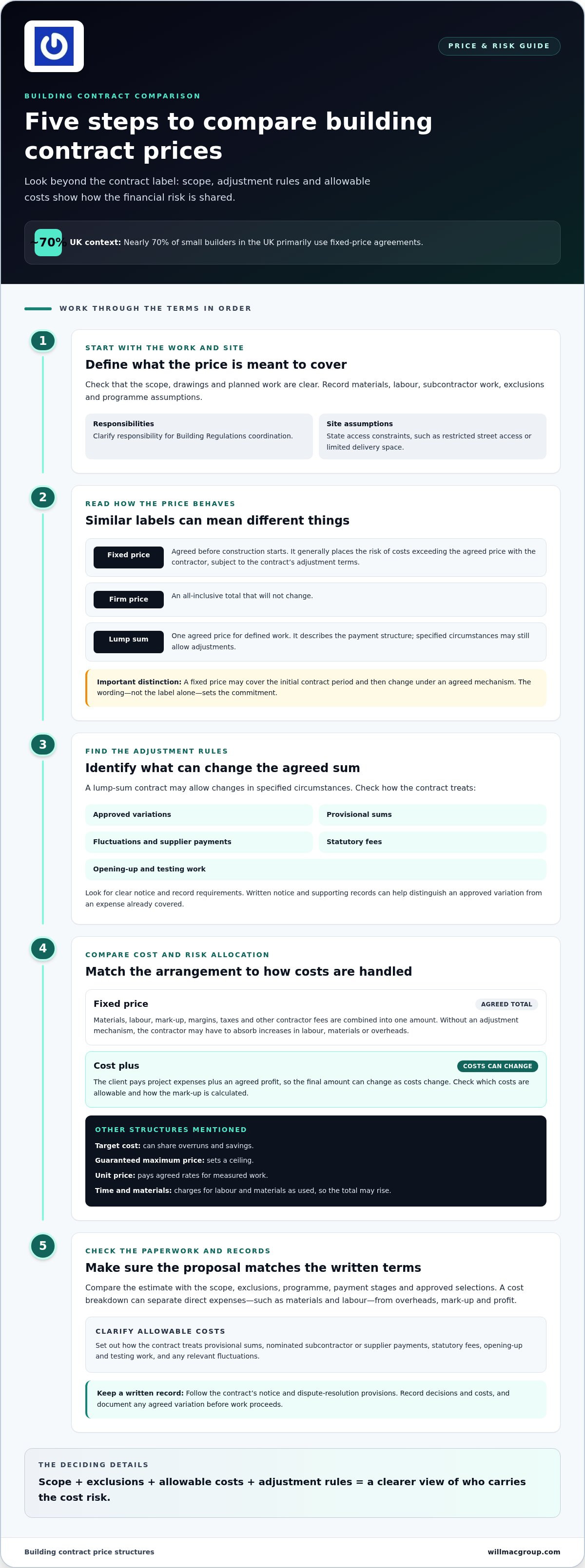
Homeowners risk paying more if exclusions, allowances or variations are unclear; builders risk losing profit when actual expenses exceed their estimate. In either case, the signed contract’s wording determines which costs are covered and how changes are handled.
A cost breakdown separates direct expenses, such as materials and labour, from indirect costs, such as overheads, then shows the contractor’s markup and profit. This matters because an unclear definition of allowable costs can lead to disagreement about what the agreed price includes.
Set out how the contract treats provisional sums, nominated subcontractor or supplier payments, statutory fees, and opening-up or testing work. It should also state relevant events, fluctuations, and notice and record requirements. For example, a clause requiring written notice and supporting records helps distinguish an approved variation from an expense already covered by the contract.
With a fixed price, a contractor may have to absorb increases in labour, materials or overheads if the contract provides no adjustment mechanism. Pricing uncertain risks into the original figure can protect the contractor, but may mean the homeowner pays for risks that never occur.
A guaranteed maximum price sets a ceiling for the client, with the contractor bearing costs above it. If actual costs fall below the maximum, savings may go to the client, contractor or be shared, depending on the agreement. The contract should explain how savings are allocated before work starts.
Documentation can create risk even when both parties intend clear terms. A spreadsheet or copy-and-paste error in a signed contract can become binding and reduce a builder’s margin. Before signing, review the completed document for consistent figures, scope, exclusions and payment terms.
Contract software may provide template libraries, secure document delivery, electronic signatures and payment processing. These features support record-keeping, but they do not replace accurate, project-specific terms. The contract still needs to identify allowable expenses and the evidence required for claims.
The practical difference is how the contract treats price changes. A fixed-price agreement generally prevents the price from fluctuating when labour or material costs change. A lump-sum contract sets one agreed total, but may allow adjustments under specified conditions. The labels can overlap, so the written terms determine the actual structure and certainty.
For a fixed-price arrangement, the contractor prices the defined work and carries much of the risk if delivery costs rise. That can make budgeting more predictable for the homeowner. However, the contractor may include a risk allowance for uncertain costs, affecting the initial figure even if those costs never arise.
A lump-sum agreement also gives the project one total price, rather than charging each expense separately. Its terms may permit changes for variations, provisional sums, fluctuations, certain subcontractor or supplier payments, statutory fees, and opening-up or testing work. These exceptions mean the total can change despite the agreed lump sum.
Consider a residential project with a specified scope. If timber prices rise after signing, a fixed-price contract would not usually adjust solely because of that increase. A lump-sum contract might allow a change only if its fluctuation clause applies. If the homeowner requests different materials, the variation process may affect either contract type.
Compare the clauses, not just the contract type. Look for the starting price, included work, exclusions, and each event that can change the amount. Then check who approves variations, what notice is required, and how savings or additional costs are treated. Detailed terms provide more useful certainty than a label alone.
For a building project with a defined scope, discuss your construction requirements and how the work can be planned.
Willmac Group undertakes extensions, new builds and construction work, including brickwork. If you’re planning a project, a clear scope connects the agreed contract structure with the work on site, from the main build through to specified brickwork.
For an extension or new build, define the work, exclusions, materials and process for approving changes in the contract documents. This gives both parties a shared reference when comparing a fixed-price arrangement with a lump sum, and helps clarify how variations affect the agreed scope. Willmac Group’s construction work is suited to homeowners ready to discuss a defined building project and its requirements.
Contact Willmac Group to discuss your building project.
Before signing a fixed price building contract, use the agreed scope as a practical reference for decisions throughout the project. Keep a record of selections, approvals and changes, so everyone can work from the same understanding as the job progresses.
Consider how decisions will be managed once work is under way. Agree who can approve changes, how those decisions are recorded and how updated documents are shared. This gives the project a clear working process and supports communication between the homeowner, builder and subcontractors without relying on informal conversations or assumptions.
For your next step, bring your priorities and project requirements together, then discuss the work with Willmac Group. A conversation can help you move from contract comparisons towards a defined building project and a considered plan for the work.
Contact Willmac Group to discuss your project and take the next step with confidence.
For an accurate construction quote in Chester, provide a clear scope, current drawings, material choices and site details. Include access limits, delivery arrangements and any known ground conditions, as these can affect how work is planned. Ask for the quote to distinguish included work from exclusions and allowances. This gives you a clearer basis for comparing the proposed work with your requirements across Chester, the North West or North Wales.
Set out a written process covering how changes are proposed, priced, approved and recorded before affected work proceeds. Define which events count as relevant events, how provisional sums are adjusted, and whether labour or material fluctuations can alter the price. For concealed conditions, specify how they are reported and assessed, including any opening-up or testing. Keep dated records of instructions and decisions so the agreed scope and revised amount remain traceable.
Main construction contract types include fixed-price or firm-price, lump-sum, cost-plus, target-cost, guaranteed maximum price, unit-price, and time-and-materials agreements. They differ in how the price is calculated, whether it can change, and who carries cost overruns or receives savings. For instance, unit-price terms pay agreed rates for measured work, while cost-plus terms reimburse expenses and an agreed profit. The project scope and uncertainty influence which structure fits best.
Start with the contract’s fluctuation or inflation clauses: these determine whether specified cost increases can change the amount payable and how adjustments are calculated. A fixed-price arrangement without such a mechanism can place rising costs on the contractor; cost-plus generally passes allowable expenses to the client. A target-cost agreement may share overruns under agreed terms. For a new agreement, define how any inflation adjustment applies to the project.
The best contract type depends on how settled the scope is, how much cost certainty the budget needs, and which party can manage each risk. A defined, straightforward project may suit a fixed or firm price. Evolving work with likely changes may suit cost plus, provided allowable expenses and markups are transparent. A target-cost arrangement can share savings and overruns. Compare the payment basis, adjustment clauses and risk allocation against the project’s actual requirements.
Payment terms should be agreed in the contract and matched to the project’s scope and programme. Set out any deposit, each payment stage, the work that triggers payment, and any evidence required. If retention applies, define the amount, its purpose and when it will be released. Linking payments to completed work gives both parties a clear record of progress and the sums due throughout the build.