
What makes a fair home extension payment schedule? Rather than relying on standard percentages, link payments to clearly described work and agreed triggers. It’s understandable to feel unsure about paying for progress you can’t yet see, or to find it difficult to compare a deposit-led proposal with calendar-based or milestone-based payments. Clear terms matter because payment expectations affect the working relationship throughout a build.
A well-planned schedule sets out when each payment is due, what work it relates to and how changes will be handled. This guide explains the usual parts of a payment plan, compares common approaches and shows how to agree milestones and keep the details in writing. The right arrangement depends on the extension and its agreed scope.
For a project involving Construction, Brickwork and Civils & Groundwork, coordination across the work can help keep responsibilities and progress clear. Willmac Group provides comprehensive, integrated, one-roof services, with a dedicated project manager and office support team for every project. Pricing is transparent, with no hidden costs. Any changes or additional expenses are discussed and agreed upon in writing before moving forward. A clear written plan helps both parties understand what’s due and when, from the first payment through to completion.
Payment timing can feel uncertain when a build has started but there’s little visible progress to show for it. Early work may involve preparation, ordering materials or tasks that aren’t immediately obvious from the house. Without agreed payment points, it can be difficult for the homeowner and builder to share the same understanding of what is due and why.
A home extension payment schedule gives both parties a reference for managing progress, invoices and records. It should sit alongside the written agreement, rather than being treated as a substitute for it. A Construction contract sets out the agreed terms for construction work, while the payment plan clarifies how financial stages relate to those terms.
A schedule is different from the extension budget, which sets out expected expenditure; the project timeline, which sets out the order and expected timing of activities; and the scope of work, which describes what the project includes. A schedule records when agreed payments fall due and which milestone each relates to. Keeping these documents distinct helps prevent a projected date or budget allowance from being mistaken for a payment trigger.
Set out each payment point, its amount or agreed calculation, and either its due date or the event that makes it payable. For stage payments, describe the work, milestone or documented project requirement each instalment relates to. If payment depends on approval or a particular record, name that requirement clearly.
Invoices, approvals and payment records create a straightforward audit trail. Keep them with the agreement and any written updates, so both parties can see what was claimed, what was approved and what has been paid. These records are particularly useful if there’s a question about whether a milestone has been reached or an invoice relates to the agreed work.
Extension projects differ in scope, sequence and procurement needs. Key structural milestones may occur in a different order, and materials or project requirements can affect when particular costs arise. A sample percentage split can help start a conversation, but it’s an example, not a universal standard or a substitute for matching payments to the project.
Instead, consider whether each payment point reflects identifiable progress and whether both parties can understand its trigger. The right arrangement is the one documented for the agreed work, not simply a template copied from another build. Planning the wider scope and sequence also puts payment discussions in context. The complete guide to house extensions in Chester covers broader planning and building considerations.
These terms describe different parts of a payment arrangement, so they shouldn’t be treated as interchangeable. Deposits, stage payments and retention are distinct terms that need separate written definitions. A clear home extension payment schedule explains how each applies to the agreed work, rather than relying on assumptions about what a particular payment usually means.
A deposit is an initial payment made before or at the start of the work. State its purpose and treatment in the agreement: for example, whether it will be credited towards the agreed total, what it is intended to cover and how it will be accounted for. This distinguishes the deposit from later instalments for completed stages.
Start with the reason given for the deposit, then compare it with the rest of the written payment terms. The agreement should explain what the initial payment covers and how it relates to later payments, so the same work isn’t counted twice. Assess the amount and timing against the individual project agreement, not a universal percentage. Extensions differ, and no single deposit figure suits every arrangement.
Stage payments are instalments linked to agreed progress points. Rather than falling due solely because a particular week has arrived, each payment can be tied to defined work, such as completion of an agreed groundwork or structural stage. The agreement should make the trigger clear enough for both parties to recognise when it has been met. Where useful, specify what record or approval confirms that progress.
Stage payments can make the relationship between work and payment easier to follow, particularly when each milestone is observable and clearly described. Retention is different: it’s an agreed portion of a payment held until a stated condition is met. It isn’t automatically required. If included, document the amount or calculation, the release condition and the agreed timing, so there’s no uncertainty about when it becomes payable.
Give the final payment the same clarity as earlier stages. State what completion means for payment purposes, whether any agreed retention remains outstanding, and how final items or adjustments will be recorded. Avoid relying on vague phrases such as “at the end” if the parties could interpret them differently. The written terms should show how the final amount is calculated and when it falls due.
Willmac Group delivers comprehensive, integrated, one-roof extension services across Construction, Brickwork and Civils & Groundwork. Every project has a dedicated project manager and office support team. Pricing is transparent, with no hidden costs, and any changes or additional expenses are discussed and agreed upon in writing before moving forward. This keeps the payment arrangement aligned with the agreed work. Find out more about Willmac Group’s extension work.
A payment trigger can be linked to work completed, a date in the programme, or a combination of the two. The useful comparison is not which method is always fairest, but how clearly each fits the project and lets both parties identify when a payment is due.
| Point to compare | Milestone-based | Calendar-based |
|---|---|---|
| Payment trigger | An agreed work stage is completed, such as a defined section of brickwork. | A stated date or interval is reached, whether or not a particular work stage is named. |
| Clarity | Clear when the milestone describes observable work and how completion is recorded. | Clear when the date and any conditions are explicit; less clear if the work linked to it is unstated. |
| Flexibility | Can follow actual progress, though the sequence of stages may change. | Offers predictable dates, but may need written terms for delays or changes to the programme. |
| Confirming progress | Both parties can refer to the defined work and agreed evidence of completion. | The date is easy to identify; confirming what work or progress it represents may need extra detail. |
A hybrid arrangement can pair a planned date with a work-stage condition. For example, a payment might be scheduled around a target week but become due only when a named part of the agreed work is complete. The agreement should explain what happens if the date arrives before the stage is reached, or if sequencing changes. No approach is automatically fair or suitable for every extension.
Whatever model is chosen, align it with the written scope, work sequence and payment terms for that project. Avoid a vague label such as “progress payment” if the parties could understand progress differently. State the work the payment relates to and how completion will be recorded.
A milestone can make the reason for an instalment more tangible. It might be completion of agreed groundworks or a clearly defined brickwork stage, rather than a general reference to work being under way. Describe the boundary of the stage and the evidence used to confirm it, such as a recorded inspection or progress update. The groundworks and civils site-preparation guide explains how this early work fits into a build.
A date-only trigger can leave uncertainty if it arrives before the expected work stage or the sequence has changed. Written criteria can set out whether payment is due on the date, after specified work, or only when both conditions are met. Record how a revised programme affects the trigger, so neither party has to infer the payment position from a changed schedule.
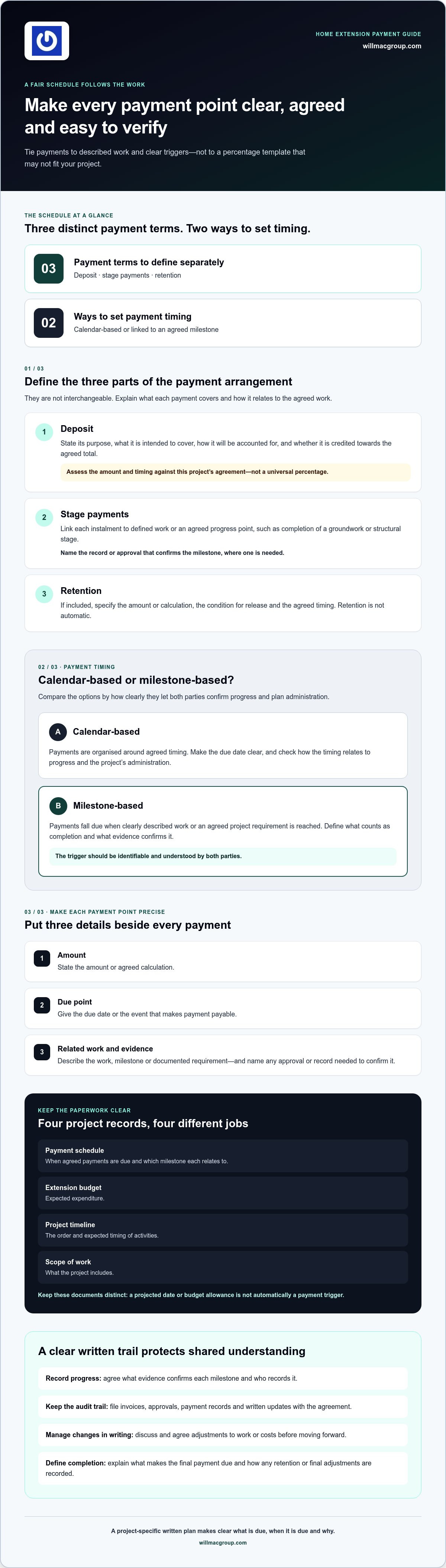
A clear agreement turns payment discussions into practical instructions both parties can follow. Before signing, check that the scope, work sequence and payment triggers fit together. This process helps you create a schedule that can be understood and administered throughout the extension project.
Write each trigger in observable terms that connect directly to the scope. For instance, distinguish completion of an agreed groundwork stage from work simply being under way, and describe the specific brickwork stage covered by an instalment. If materials or other project requirements affect when a payment is due, state how they are treated in the schedule. Clear descriptions help prevent different interpretations of the same milestone.
Projects can change, so agree how an adjustment will be documented before it affects the payment plan. Any changes or additional expenses should be discussed and agreed upon in writing before moving forward. If a milestone or date needs updating, record the revised trigger, any changed amount or timing, and the parties’ agreement in a written amendment. Keep the update with the original schedule and related invoices.
A dedicated project manager and office support team help keep communication and documentation clear across an extension project. To discuss your extension plans and agreed work with Willmac Group, view the company’s project contact details.
A clear payment arrangement depends on more than setting out instalments. The work being delivered, the people coordinating it and the way changes are recorded all need to remain aligned as the extension progresses. Willmac Group takes a comprehensive, integrated, one-roof approach across Construction, Brickwork and Civils & Groundwork, coordinating connected parts of a project.
Every project has a dedicated project manager and office support team. This provides a clear point of coordination and helps keep communication organised as work moves between stages. For homeowners, that structure helps explain how progress relates to agreed work and payment terms, rather than treating each invoice as a separate conversation.
The project manager is the dedicated point of coordination, helping keep the agreed scope, sequence and progress in view. The office support team provides additional communication support, so project information can be handled in an organised way. Together, these roles help maintain a shared understanding of what has been agreed and where the work stands.
Clarity matters if requirements change. Any changes or additional expenses are discussed and agreed upon in writing before moving forward. Recording the decision in writing keeps the project’s agreed work and payment expectations aligned. It also gives both parties a clear reference if a change affects a stage, its timing or the associated payment arrangement.
Willmac Group’s pricing is transparent, with no hidden costs. The homeowner and project team have a clear basis for discussing the work and its costs, with any agreed changes documented before moving forward. A written record gives everyone the same information to refer to as the project develops.
For homeowners in Chester, the first step is to outline the extension scope and project requirements. This helps establish what the work involves and what needs to be agreed before the project moves forward. Willmac Group follows a three-step process: Contact, Agree Work, Project Completed. The payment arrangements form part of agreeing the work, so expectations can be set out alongside the project requirements.
Once the work is agreed, the dedicated project manager and office support team help maintain communication during delivery. If a change becomes necessary, it is discussed and agreed upon in writing before moving forward, keeping the record current. This process provides a clear route from an initial conversation through to completion, while allowing the agreed plan to reflect the individual extension.
For more information about Willmac Group’s extension services in Chester, see the company website.
Before work begins, make the agreed payment plan part of the way you organise the project, not a document that gets filed away. Keep a copy of the signed terms accessible, note when invoices or agreed milestones are due, and save confirmations as payments are made. This gives you a practical record to refer to as the build moves forward and keeps financial decisions connected to the work you agreed.
A home extension payment schedule should also remain useful if your plans evolve. If a change affects the scope, sequence or payment terms, record what’s changing and agree the update in writing before moving forward. That creates a shared reference for the next decision, rather than relying on memory or informal conversations.
With the arrangements set out clearly, you can approach the project with greater confidence and focus on the home you’re planning to create. Read about Willmac Group’s extension services.
A written payment schedule may form part of the agreement between a homeowner and builder, but whether it’s legally binding depends on the contract and the circumstances in which the terms were agreed. Read the schedule alongside the full agreement, including any later written changes. If you’re dealing with a specific dispute or uncertainty about your rights, seek guidance from a qualified solicitor rather than relying on a general explanation.
Where VAT applies, the written quotation and invoices should make clear whether the stated sums include or exclude it. Don’t assume a particular rate or that every builder has the same VAT treatment. Check how the figures are presented before agreeing the home extension payment schedule, and seek qualified tax guidance if your property or project raises a specific VAT question.
Keep the agreed schedule, any written amendments, invoices, payment confirmations and records identifying the work linked to each stage. For example, file a dated progress note or approval alongside the invoice it relates to. An organised record helps you follow the sequence if a figure is queried later and gives both parties a shared payment history. You can choose a filing method that suits you; no particular system is required.
Paying a supplier directly can affect who places the order, arranges delivery, handles the invoice and records the cost against the project. It may also change how the agreed balance is calculated. If the parties agree to direct payment, document the amount, responsibilities and effect on the project account and payment schedule before making the payment.
Compare the work you can observe with the milestone wording in the agreement, including any stated evidence of completion. Raise the specific difference promptly through the agreed project contact, and keep relevant correspondence and dated records together. Ask for the position to be clarified in writing so there’s a shared account of the discussion. If the disagreement concerns your rights under the contract, seek advice based on your specific agreement.
Yes, a payment date or milestone can be changed if the parties agree a revised arrangement. Record the new trigger, date, affected amount and when the change takes effect, then keep the update with the original terms so the current position is clear. At Willmac Group, any changes or additional expenses are discussed and agreed upon in writing before moving forward. A written amendment distinguishes the agreed change from an informal conversation.
Planning an extension in Chester? Contact Willmac Group to discuss your project.