
Large construction projects can run up to 80% over budget, according to McKinsey. A construction cost overrun is the amount by which a project’s actual costs exceed its original budget. Knowing how to avoid construction cost overruns starts with clear planning and close cost tracking, but even a well-managed project can face unexpected changes.
It’s understandable to worry when spending starts to outpace the budget, especially if the cause isn’t clear. This article explains what construction cost overruns are, how to respond when a project goes over budget, and how contingency funds and cash flow management can support informed decisions. It also covers common causes of rising costs, practical ways to monitor progress and the figures that show why budget management matters.
A construction cost overrun occurs when a project’s actual spending exceeds its approved budget. Common causes include rising material prices, additional labour, delays or work missing from the original plans. For example, a late delivery of roof tiles can leave a crew waiting and push later trades and equipment hire out of schedule.
A clear scope helps contractors price the same work and reduces the risk of scope creep. Before construction begins, record the required materials, finishes, site preparation and work stages. If a specification says “brick exterior” without defining its extent or finish, quotes may rely on different assumptions. Agreeing the details early gives the project team a consistent basis for decisions.
Material prices and availability can change between estimating and ordering. A supplier may face a shortage, propose a substitute with a different specification or revise a delivery date. Each change can affect costs and the sequence of work. Compare any substitute with the project requirements, then document its cost, suitability and effect on the schedule before approving it.
Site conditions can reveal unexpected work. Groundworks might uncover poor soil or a hidden service that requires a revised approach. Heavy rain can delay excavation or prevent materials from reaching the work area. Changes to approval requirements can also affect the specified work or timing. Record the issue, its likely impact and the decision needed, then update the project records.
Use a formal change order whenever work differs from the agreed plans. It should describe the added, removed or revised work, its cost and its effect on the programme. For example, adding a window after construction starts may require changes to brickwork, materials and labour. Review the full impact before approving it instead of treating the request as a minor adjustment.
Good change control is central to how to avoid construction cost overruns: compare each proposed change with the agreed scope, budget and schedule. Keep dated approvals, revised drawings and supplier information together so everyone works from the same instructions. Changes may arise during a project, but recording the reason and agreed response makes their financial impact visible.
Compare contractor quotes by checking that their scopes, drawings, specifications, exclusions and assumptions match. Confirm that each estimate covers labour, materials, suppliers, fees, waste-bin rental, equipment and relevant trades, such as concrete and electrical work. A lower total may exclude work or assume a different scope, so compare the details line by line before choosing.
Set a budget baseline from the agreed scope and itemised estimates, then record it alongside the programme. Include the building work and other project components, rather than treating the main construction figure as the full project cost. For example, a £500,000 approved budget and a £550,000 final spend produce a £50,000 overrun, equal to 10% of the budget.
Use current pricing and cost information, historical project data and expert input to improve estimates. Common causes of overruns include underestimating materials or labour, overlooking work, unexpected complexity, delays and equipment downtime. When a cost changes, update the affected budget line and forecast the likely final spend instead of relying on the original total.
If spending exceeds the baseline, identify the cause before deciding how to respond. Compare actual costs, outstanding commitments and estimated costs to complete against the approved budget. Review pending changes, pause discretionary spending where appropriate and consider whether resources can be reassigned. Record each decision and its effect on scope, cost and timing.
Project management software or a cost-tracking spreadsheet can show planned and actual costs alongside tasks and milestones. Update figures as invoices, orders and progress information arrive. Regular site visits and project meetings can help explain variances. If a subcontract package’s latest forecast exceeds its approved amount, investigate the difference early and revise the overall forecast.
Clear cost controls can make construction project planning easier to follow. Keep the baseline, revised estimates and approvals together, so the team can see what changed, why it changed and how the decision affects the remaining budget.
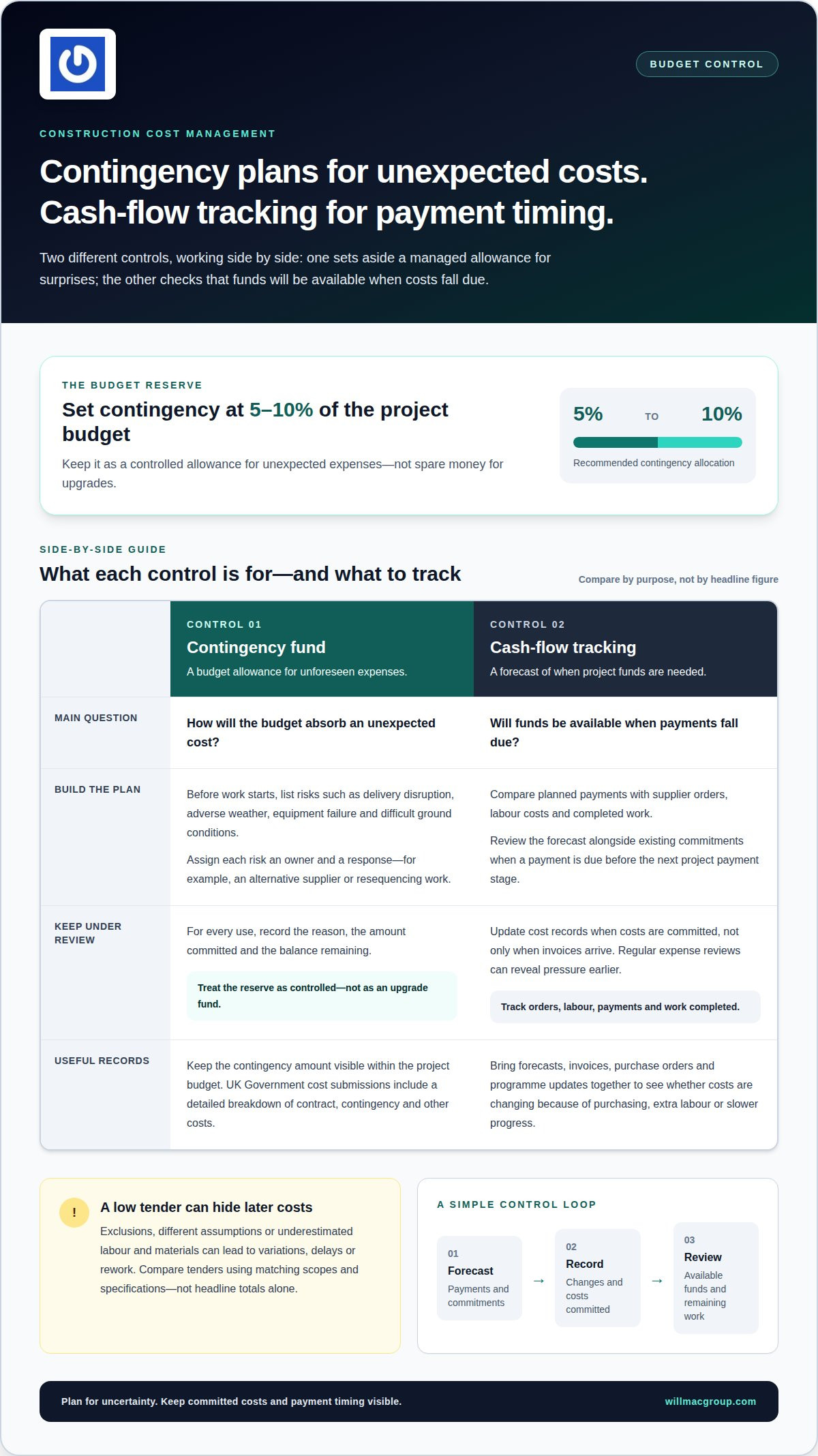
Set aside a contingency fund within the project budget for unexpected expenses. Construction project budgets should reserve 5-10 percent of the budget for contingency. Treat this as a controlled allowance, not spare money for upgrades. Record the reason whenever contingency is used, the amount committed and the remaining balance.
Create a risk plan before work starts. List risks such as delivery disruption, adverse weather, equipment failure and difficult ground conditions. Assign each risk an owner and a response, such as identifying an alternative supplier or resequencing work. UK Government cost submissions include a detailed breakdown of contract, contingency and other costs, helping stakeholders understand how the total is composed.
Cash flow tracking shows whether funds will be available when invoices fall due. Compare planned payments with supplier orders, labour costs and completed work. For example, if a material delivery is due before the next payment stage, review the cash forecast alongside existing commitments. Regular expense reviews can reveal pressure earlier than comparing only the initial budget with final costs.
The lowest construction tender can carry risks if it excludes work, uses different assumptions or underestimates labour and materials. Gaps may lead to later variations, delays or rework. Compare tenders using matching scopes and specifications, not headline totals alone.
Construction cost management software can bring forecasts, invoices, purchase orders and programme updates into one view. Update records when costs are committed, not only when invoices arrive. This helps identify whether a cost increase comes from purchasing, extra labour or slower progress, so the project team can respond using specific information.
Manage each variation through a documented approval process. Record the proposed change and its effect on scope, cost and timing, then update the forecast before work proceeds. Review purchasing plans against the schedule, combine orders where practical and align labour with upcoming tasks. These controls help manage cash flow while keeping project requirements in view.
Construction cost statistics show why a final total alone gives an incomplete picture. In KPMG’s 2015 global construction survey, 31% of respondents’ projects came within 10% of their budgets. That means budget performance should be judged against the approved figure and the actual result, not simply whether work reached completion. Define the comparison before work starts, then use it consistently.
McKinsey reported that large construction projects typically take 20% longer to finish. Longer programmes can affect labour hours, equipment hire and the timing of supplier payments. The statistic is not a forecast for an individual building project, but it highlights why schedule performance belongs beside cost performance. Track both, so delays are visible before they distort the final cost picture.
25% of construction firms report that they are just 2-3 inaccurate estimates away from being out of business. For a project owner, the practical lesson is to examine estimates and assumptions rather than treating a tender total as certainty. Check that each major work package is included, and record which prices, quantities or delivery assumptions could change.
Translate variance into pounds and a percentage. A project with a £200,000 approved budget that finishes at £220,000 has a £20,000 overrun, equal to 10%. Compare actual spending with the baseline at each milestone; then identify whether the gap comes from scope, purchasing, labour or delays. This makes the next decision more specific than simply cutting costs.
Use the figures as prompts for project controls, not as targets to accept. Set a baseline, allocate responsibility for tracking each cost area and review forecasts as work progresses. If a variance appears, document its cause and likely effect on the remaining programme before approving a response. Planning a building project? Discuss your construction project and how its scope can be managed from the outset.
Willmac Group undertakes extensions, new builds and construction work for residential and commercial projects. If you’re planning an extension or new build, a clear scope and agreed requirements provide a sound starting point. Willmac Group also carries out brickwork, helping turn building plans into a finished structure.
Speak with Willmac Group when you’re defining a project’s scope or planning construction work. Share the intended work and key requirements to establish what the project involves before decisions are made. This is a practical next step for owners planning building work in Chester, the North West or North Wales.
Contact Willmac Group to discuss your project.
The strongest approach to how to avoid construction cost overruns is to make cost control an active project responsibility, not a final review. Before work proceeds, assign responsibility for recording decisions, tracking their effects and sharing changes with the people who need to act on them. This turns budget information into a practical tool for managing the work.
If your project is still being planned, use the next conversation to clarify what needs to be built, what matters most and how decisions will be handled as work progresses. A clear starting point helps everyone understand the intended scope and gives future discussions a firm reference.
Willmac Group can discuss your building project and the work you’re planning. Contact Willmac Group to take the next step, and approach your project with a clear plan and informed decisions.
A cost overrun is the amount by which a project’s actual spending exceeds its approved budget. To understand the position, separate money already spent from committed costs and the forecast for unfinished work. An approved variation may explain part of the increase, but it should still appear in the revised forecast. This helps show whether the remaining budget can cover the planned work.
First, identify which budget line has changed and why. Match invoices, orders and site progress to the latest forecast, then separate approved changes from unexplained variances. If a particular work package is over budget, review its remaining scope and commitments before making wider cuts. Record the decision and update the forecast so stakeholders can see the current position and next steps.
Common causes include incomplete requirements, unexpected site conditions, material price changes, supply disruption, labour overruns and delays. These factors can interact: a late delivery may interrupt the sequence of trades, while a ground issue can require extra work before construction proceeds. For projects in Chester, the North West or North Wales, record each cause against the affected work package to distinguish a one-off issue from a wider trend.
Start with a defined scope and coordinated project information, then divide the work into packages such as groundwork, structure, services and finishes. Ask contractors to price the same specifications, and compare inclusions, exclusions and assumptions. Include supplier, trade and other project expenses in the estimate. As work progresses, compare actual and committed spending with the forecast, updating affected lines when scope or timing changes.
Figures vary by calculation basis: one recommendation is 5-10 percent of the budget, while another is five to 15 percent of the project’s estimated total cost. The right allowance depends on project risks, scope definition and the amount of uncertainty in site conditions and pricing. List the risks behind the contingency and record each drawdown, so the remaining allowance stays visible and purposeful.
Material price changes affect the amount needed to buy specified products, while supply disruption can alter delivery timing or require a suitable alternative. Labour costs depend on the hours and skills needed to complete the work; delays or rework can add to those hours. Track orders, delivery updates and labour against the programme, then revise forecasts when assumptions change. This helps show whether budget pressure comes from price, availability or productivity.