
What if the most valuable asset in your search for a building plot isn’t a high budget, but a builder’s eye for technical detail? Many people assume that learning how to find land for a new build UK starts and ends with scrolling through property portals, yet the most successful projects often begin with a more strategic, methodical approach. It is natural to feel the pressure of a competitive market, perhaps worried about the complexities of Green Belt restrictions or the prospect of discovering hidden ground issues after you’ve already committed your capital.
We understand that the fear of buying a ‘lemon’ plot can be a significant barrier to starting your project. This guide will provide you with a clear roadmap of where to source genuine opportunities and how to evaluate their feasibility from a construction perspective. You’ll learn how to identify the best search locations, how to spot potential structural red flags, and why involving a builder during the pre-purchase phase is essential for assessing groundworks. With the average UK land price sitting at £11,932 per acre as of July 2026, we’ll ensure you have the professional knowledge to invest your money wisely and move from searching to breaking ground with total confidence.
The 2026 land market is currently in a state of transition. Whilst prices for prime agricultural land have seen a slight decline, the competition for viable residential plots remains high. Understanding how to find land for a new build UK requires more than just a search engine; it demands a clear grasp of what makes a site technically buildable. Demand continues to outstrip supply because many parcels of land lack the necessary infrastructure or planning status to support a residential dwelling. You aren’t just looking for a space. You’re looking for a legal and technical opportunity that can support a solid foundation.
A common mistake amongst first-time buyers is confusing amenity land with a building plot. Amenity land is typically used for non-residential purposes, such as grazing or leisure, and rarely carries the right to develop. A building plot, by contrast, is a parcel of land that either already has planning permission or sits within a designated development boundary. Before you commit your capital, it’s useful to understand the wider context of What is Self-Build? and how the UK legal framework separates land ownership from the right to construct on it.
In the North West, Green Belt protections are particularly stringent to prevent urban sprawl around hubs like Chester. It’s a common misconception that ‘Greenfield’ land, which is land that hasn’t been built on before, is the same as ‘Green Belt’. Greenfield sites are often found on the edges of towns and can sometimes be developed if they meet local housing needs. However, Green Belt land is protected by much tougher national policies, making planning permission exceptionally rare. The sequential test is a planning mechanism that requires local authorities to prioritise development on sites with the lowest environmental or flood risk before considering more sensitive alternatives. Successfully identifying how to find land for a new build UK often involves looking for ‘Brownfield’ sites, which are previously developed areas that the government actively encourages for redevelopment.
Every local authority in England is required to maintain a ‘Right to Build’ register. This is a list of people and groups who want to build their own homes in the area. Signing up for the register at Cheshire West and Chester Council, for example, is a vital starting point. This data is used by the council to gauge demand and must be taken into account when they allocate land for self-build projects. Being on this register gives you a head start in 2026 because it ensures you’re visible to the local authority when new serviced plots or development opportunities are released to the market. It’s a simple, free step that helps align your search with local planning strategies.
Sourcing a viable plot requires a move from passive observation to active investigation. Whilst many begin their journey on mainstream property portals, the most successful self-builders use a combination of digital tools and boots-on-the-ground networking. Identifying how to find land for a new build UK often involves looking where others aren’t, particularly in areas with high demand like Chester and the surrounding North West. Beyond the property listings, you must also consider the official government guidance regarding custom housebuilding, which outlines the legal frameworks that local councils must follow when supporting new developments.
Local estate agents and specialist land agents remain invaluable. In Chester, building relationships with agents who specialise in land can grant you access to “pocket listings” before they reach the open market. Property auctions are another high-speed route, though they carry significant risk. If you choose the auction route, the ‘legal pack’ is your most important document. It contains searches, title deeds, and planning history. Missing a detail in this pack can lead to a binding contract on a plot that is structurally unbuildable or legally encumbered.
Mainstream sites like Rightmove and Zoopla are useful if you use the ‘land’ filters correctly, but specialist portals like PlotBrowser and BuildStore are designed specifically for this purpose. These platforms often categorise plots by their planning status, which saves hours of manual filtering. For a more proactive approach, use Google Earth to scan for urban gaps or large gardens in established residential areas. In historic cities like Chester, these ‘infill’ sites are often hidden from street view but offer excellent potential for a single new dwelling.
Some of the best opportunities never reach an agent’s window. If you spot a derelict building or a neglected parcel of land whilst driving through your target area, don’t wait for a ‘For Sale’ sign. You can use Land Registry data to identify the owner for a small fee. Writing a professional, polite letter to the landowner expressing your interest can sometimes trigger a sale. This direct approach bypasses competition and can lead to a more transparent negotiation. If you find a potential site, consulting a reputable building contractor early can help you avoid costly mistakes during the initial assessment. They can provide a quick reality check on whether the site is accessible for heavy machinery or if the topography will require complex civil engineering.
Once you’ve identified potential sources, the next step in learning how to find land for a new build UK is categorising the plot type. Each category carries distinct structural and legal implications that will dictate your construction budget. Urban infill, often referred to as ‘garden grabbing’, involves building on land situated between existing properties. Whilst these plots often benefit from established utility connections, they present unique logistical hurdles. Access for heavy plant machinery can be restricted, particularly in the historic, narrow streets of Chester. You must also consider the impact on neighbouring foundations when excavating close to existing boundaries.
Brownfield sites offer a different set of challenges. These are previously developed areas that may have an industrial or commercial legacy. Whilst the government encourages their use to protect the countryside, the hidden costs of clearing contaminated soil or removing old concrete slabs can be substantial. It’s often helpful to consult resources provided by the National Custom & Self Build Association (NaCSBA) via their Right to Build registers to see how local authorities prioritise these sites within their wider development plans. A thorough site investigation is essential here to ensure you don’t inherit a liability.
Building in an urban centre like Chester requires meticulous planning regarding site logistics. Narrow access points may dictate the size of delivery vehicles or the type of crane required for timber frame kits. Conversely, rural plots in North Wales often present the opposite problem. Whilst access might be easier for large vehicles, the cost of connecting to the mains water, electricity, or sewerage systems can be prohibitive if the plot is remote. Planning success rates also vary; urban developments are often looked upon more favourably by councils seeking to meet housing targets within existing settlement boundaries.
Purchasing a site with an existing, derelict house is often considered the safest route for a self-builder. Because a dwelling already exists, the ‘principle of development’ is already established, which simplifies the planning process significantly. There are also financial benefits to consider. New builds are typically zero-rated for VAT, whereas renovations are not. By demolishing a structure and starting fresh, you can often achieve a higher standard of energy efficiency whilst managing your budget more effectively. At Willmac Group, we manage the entire transition from demolition to the final site preparation, ensuring the ground is structurally sound before the first brick is laid.
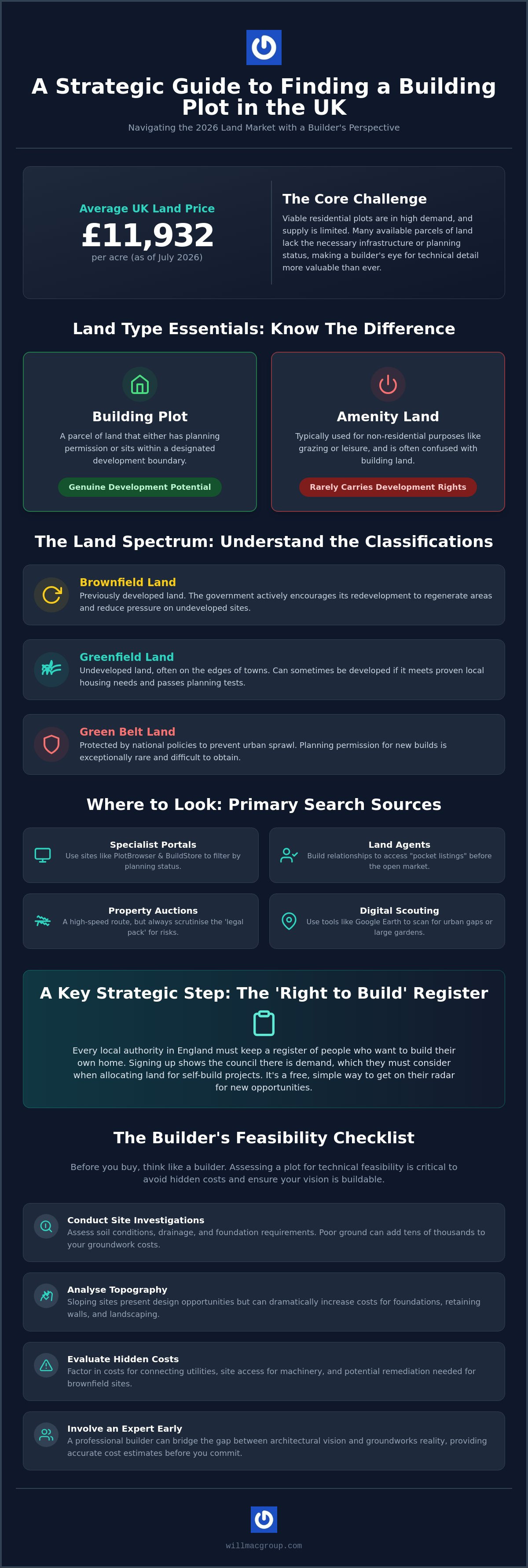
Identifying a promising site is a significant milestone, but the transition from finding land to actually breaking ground requires a rigorous technical assessment. Many prospective self-builders focus on the purchase price and the view, yet the most critical factors often lie beneath the surface. Knowing how to find land for a new build UK that is actually viable involves looking at the plot through the eyes of a contractor. A site that appears to be a bargain on a property portal can quickly become a financial burden if the topography or soil conditions require extensive engineering solutions.
Topography is one of the most common “hidden” costs. Whilst a sloping plot might offer stunning views of the North Wales landscape, it often necessitates complex stepped foundations or substantial retaining walls. These elements add significant expense to a project before the ground floor is even poured. Similarly, you must evaluate access and logistics. If a standard brick lorry or a 20-tonne excavator cannot safely reach the site due to narrow lanes or weight-restricted bridges, your haulage costs will escalate as materials must be double-handled or delivered in smaller, more frequent loads.
Soil conditions dictate the design and depth of your foundations. In many parts of the North West, foundation depths vary wildly due to the presence of heavy clay or sandstone layers. You must also be wary of ‘made ground’, which refers to land that has been previously filled with unconsolidated material. Professional groundworks and civils are the most critical part of your budget because they establish the structural integrity of the entire build before any visible progress is made. Without a professional site investigation, you risk encountering contamination or drainage issues that require specialist remediation. If you are concerned about the structural potential of a specific plot, our team can provide a professional assessment of the civils and groundworks requirements before you commit to the purchase.
Technical feasibility is only half of the checklist; legal restrictions can be just as restrictive. Restrictive covenants might prevent certain types of construction or specify the use of particular materials that don’t align with your vision. You should also check for easements and wayleaves, which are legal rights that allow third parties, such as utility companies, to access or run services through your land. Engaging with the local council through a ‘Pre-App’ (Pre-application advice) is a sensible step. This formal process provides an early indication of whether your proposal is likely to be accepted, allowing you to address potential planning hurdles before submitting a full application.
Securing a plot is a significant achievement, but it’s merely the first phase of a complex lifecycle. Whilst the initial search for how to find land for a new build UK is often driven by location and aesthetics, the transition to planning requires a focus on structural reality. Consulting a reputable building contractor before you finalise the purchase can prevent a dream project from becoming a financial burden. A builder brings a practical perspective that complements the architect’s vision, ensuring that what looks good on paper is actually achievable on the ground.
Cost certainty is the most valuable asset any self-builder can have. By involving a construction partner early, you can move away from vague estimates towards concrete data. At Willmac Group, we support clients through every stage of the build, from the initial site clearance and specialist groundworks to the final, high-quality brickwork. This end-to-end involvement allows us to manage the technical risks associated with a new build, providing a stable foundation for your project. Building a team where the architect and builder communicate from the outset ensures that design choices are grounded in technical feasibility.
A builder can spot physical constraints that might be overlooked during a standard viewing. When you are researching how to find land for a new build UK, the focus is often on the land’s location, but the proximity of protected trees or the specific requirements for heavy machinery access can drastically alter your initial budget. Getting a ballpark figure for the civils and groundworks phase allows you to make a land bid that accounts for the true cost of development. This early collaboration ensures your design is buildable within your financial parameters and prevents costly redesigns later in the process.
Finalising your new build construction plans with a team that possesses local knowledge of Chester and North Wales is essential. Planning nuances and ground conditions vary by postcode; having a partner with over 25 years of industry experience ensures these variables are managed with precision. We understand the specific soil types and drainage requirements of the region, allowing us to execute your project with transparency and skill. If you have identified a potential plot and want to understand its true potential, contact Willmac Group for a professional feasibility discussion. We are here to ensure your project starts with the technical integrity it deserves.
Securing a plot is a significant milestone, but the success of your project depends on moving beyond the initial search. Whilst understanding how to find land for a new build UK is the first step, the technical feasibility of that land determines your long-term success. From navigating the complexities of the Right to Build register to conducting thorough site investigations into soil conditions and topography, every decision should be grounded in professional insight. A site that looks perfect on a digital map requires a builder’s eye to ensure it can support the foundations of a lasting home.
Willmac Group provides the technical assurance required for successful projects across Chester, the North West, and North Wales. Our specialist groundworks and civils expertise ensures your build begins with a stable, professional foundation. We take pride in being a reliable partner for assessing site feasibility, guiding you through the transition from a vacant plot to a completed home. Start your new build journey with Chester’s leading construction experts. Your project deserves a foundation built on transparency, skill, and established local knowledge.
The average price of land in the UK is currently £11,932 per acre, though this figure fluctuates significantly based on regional demand. In Scotland, prices average around £5,038, whilst in London, they can reach £95,601. For those looking at prime arable land with development potential, prices typically sit near £10,000 per acre as of July 2026. It is essential to remember that a plot with full planning permission will command a substantial premium over raw agricultural land.
Yes, you can secure financing through a specialist self-build mortgage, which releases funds in stages as construction progresses. As of July 2026, the average 2-year fixed mortgage rate is 5.46%, whilst 5-year fixed deals average 5.48%. Lenders have recently become more competitive, with several major institutions cutting rates to attract self-builders. You will typically need a larger deposit for land than for a standard residential purchase, often between 25% and 50% of the plot’s value.
You can verify the planning status of any site by visiting the local authority’s planning portal, such as the Cheshire West and Chester Council website. Each listing will state whether the plot has Outline Planning Permission, which establishes the principle of development, or Full Planning Permission, which includes approved designs. It is also wise to check the Planning Portal for any recent applications or service charges, which currently stand at £70 for submissions.
The ‘Right to Build’ register is a list maintained by local councils that helps them gauge the demand for self-build and custom housebuilding in their area. Joining this register is a vital step in learning how to find land for a new build UK, as it requires the council to grant enough planning permissions to meet the demand on the list. You can sign up via your local council’s website, provided you meet the eligibility criteria regarding age, nationality, and financial capability.
Finding land in the North West is competitive, particularly due to the strict Green Belt protections surrounding historic centres like Chester. However, the market is currently in a state of transition. Recent inheritance tax reforms and changes to estate assets are expected to increase market liquidity throughout 2026. This shift may lead to more parcels of land becoming available, though buyers must remain selective to secure plots with genuine structural potential.
Buying land without planning permission is a significant risk, as the value of the site will remain at its ‘amenity’ or agricultural rate if development is refused. To mitigate this, many buyers use a legal “option” agreement. This contract, prepared by a solicitor, requires the vendor to sell the land to you only once planning permission has been granted. This ensures you aren’t left with a parcel of land that cannot be built upon.
A solicitor is essential for handling the legal transfer of land and ensuring there are no hidden encumbrances. They will perform vital searches to identify restrictive covenants, easements, or wayleaves that could prevent you from building. Solicitors also manage the payment of Stamp Duty Land Tax. For a main residence, SDLT starts at 2% for properties above £125,000, though first-time buyers currently enjoy relief on purchases up to £300,000.
Groundworks costs are highly variable and depend entirely on the soil conditions and topography of the site. A sloping plot or one with ‘made ground’ will require more complex civil engineering and deeper foundations, which increases the initial spend. Identifying how to find land for a new build UK that is cost-effective requires a professional site investigation. This assessment identifies the specific foundation requirements before you commit to a build, preventing unexpected budget increases during the early construction phases.