
Choosing the cheapest quote for your project often results in the highest long-term expenses when groundworks are overlooked or heritage brickwork fails to match. It’s natural to feel a sense of unease regarding the financial complexities of a build, especially with the intricate planning requirements and structural standards expected in 2026. You likely want more than just a rough estimate; you need a reliable framework to navigate your house extension cost Cheshire without the fear of hidden surprises.
This guide provides that clarity by breaking down the essential components of a successful project, from the £331 householder planning fee in Cheshire West to the investment required for professional structural calculations. We’ll explore the impact of the standard 20% VAT rate on your budget and the current fees for architect drawings that ensure a seamless build. By the end of this article, you’ll have the confidence to choose a contractor who prioritises structural longevity and specialist brickwork over temporary shortcuts.
Establishing a realistic house extension cost Cheshire requires a look at current market benchmarks for 2026. Understanding What is a House Extension? provides the foundation for evaluating these structural investments. In the North West, material costs have begun to stabilise after years of volatility, yet the demand for skilled labour remains consistently high. This creates a baseline where the final figure depends heavily on your choice of finish and the specific constraints of your postcode. It’s a balance between your vision for the space and the practicalities of local construction standards.
For a standard single-storey extension in 2026, homeowners should anticipate a starting range between £1,500 and £2,000 per square metre for a basic specification. This figure rises to between £2,000 and £3,000 for premium finishes involving high-end materials or complex structural alterations. It’s essential to remember that an “all-in” budget includes the standard 20% VAT rate and professional fees, which generally increase the total by a significant margin. Whilst basic builds focus on utility, mid-range and premium specifications introduce bespoke elements such as architectural glazing or specialist brickwork that reflects the local character. Specification levels typically break down as follows:
Logistics play a vital role in determining the house extension cost Cheshire residents can expect. In the historic centre of Chester, restricted site access and the proximity of neighbouring properties often extend the labour duration and complexity. Working within conservation areas requires specific materials like reclaimed bricks or lime mortar to satisfy planning regulations, which naturally increases procurement costs. Conversely, projects in the “Golden Triangle” or rural Cheshire West often face fewer access issues but may encounter higher costs for skip hire and transport due to the distance from major supply hubs. These regional nuances mean that a project in Wilmslow may require a different budgetary approach than a build in a Chester row house, particularly when local councils have specific aesthetic expectations.
The “Cheshire Premium” isn’t merely a myth; it reflects the high standards of local planning departments and the aesthetic expectations of the region. Whether you’re dealing with Cheshire East or Cheshire West and Chester, you’ll find that regulations regarding heritage matching and structural integrity are strictly enforced. This often necessitates the use of specialist contractors who understand how to blend new construction with existing period architecture. Investing in this level of quality protects the property’s long-term value, even if it requires a higher initial outlay. It doesn’t pay to cut corners when the goal is a seamless addition that enhances your home’s character.
The total house extension cost Cheshire homeowners face is heavily influenced by the chosen footprint and structural complexity. While extending outwards is the most common approach, building ‘up’ often provides a better economy of scale. For those living in older properties across the county, a wrap-around extension can transform a cramped layout, though it requires significant structural steelwork to support the existing house. These projects often involve ‘wet’ rooms like kitchens, where plumbing and high-performance glazing significantly drive the budget beyond the basic build costs discussed earlier.
Side-return extensions are popular in suburban streets, yet they introduce unique challenges. You’ll often need to manage complex drainage realignments and navigate ‘party wall’ agreements with neighbours. The choice of roof also impacts the final bill; a flat roof with a high-quality membrane is typically more affordable than a pitched roof using slate or tile. If your design includes large-scale bi-fold doors or lantern roof lights, expect the material costs to rise accordingly. Before committing to a layout, it is worth understanding the full scope of rear extension planning requirements that North West homeowners should know, particularly regarding Permitted Development boundaries and structural foundations. It’s vital to consult the official planning and building regulations to ensure your design meets current energy efficiency and safety standards.
It’s a common misconception that adding a second storey will double your budget. In reality, you’re already paying for the foundations and the roof for a single-storey build. Adding the middle section is often surprisingly cost-effective on a per-square-metre basis, helping to balance the overall house extension cost Cheshire residents must manage. You’ll need to budget for extensive scaffolding and potential ground-floor reinforcement to carry the extra weight, but the return on investment is often much higher. Adding a fourth bedroom or a master ensuite in high-value postcodes can significantly increase your property’s market value. If you’re unsure which route offers the best value for your specific plot, discussing your goals with a specialist builder can help clarify the most efficient path forward.
The ground beneath your home is often the most unpredictable factor in your total house extension cost Cheshire. Whilst many homeowners naturally prioritise the visible elements like bi-fold doors or kitchen islands, the foundations and civils represent the structural backbone of the investment. Cutting corners here isn’t just a safety risk; it’s a financial one. A poorly executed foundation can lead to subsidence or structural cracking that costs far more to rectify than it is to build correctly the first time. Precision in these early stages ensures that the rest of the build proceeds without costly delays.
Cheshire is known for its diverse soil profiles, particularly the heavy clay found across much of the North West. This type of soil expands and contracts with moisture levels, often requiring deeper foundations or specialist solutions to ensure stability. In some instances, standard trench-fill foundations aren’t sufficient. If you’re building near large trees or on unstable ground, you may require piling. This involves driving long columns into the earth to reach a more stable layer, which naturally impacts the initial budget. Site preparation also involves more than just digging; it requires a methodical approach to waste removal and logistics.
Before excavation begins, you must account for several critical factors:
Following the guidelines on the UK Government’s Planning Portal ensures that these “invisible” works meet strict safety standards before the first brick is even laid. Getting the civils right from day one is the most effective way to prevent budget creep later in the project.
Once the ground is secure, the focus shifts to the masonry. In a county with such a rich architectural heritage, “brick matching” is essential for maintaining your property’s market value. A mismatched extension looks like an afterthought and can actually detract from your home’s appeal. Using hand-made or reclaimed bricks often costs more than standard facing bricks, but the visual continuity is worth the investment for the long-term ROI. Structural brickwork integrity is the foundation of a safe extension.
Precision in brickwork is where a project’s budget is truly protected. Willmac Group specialises in this level of detail, ensuring that every course is level and every joint is consistent. Intricate detailing, such as arches or dentil courses, requires additional labour time but provides the character that Cheshire homes are known for. By employing a builder who understands the nuances of local masonry, you avoid the costly mistakes that come from poor craftsmanship or inaccurate material selection. This level of skill ensures that your house extension cost Cheshire delivers a result that looks as though it has always been part of the original property.
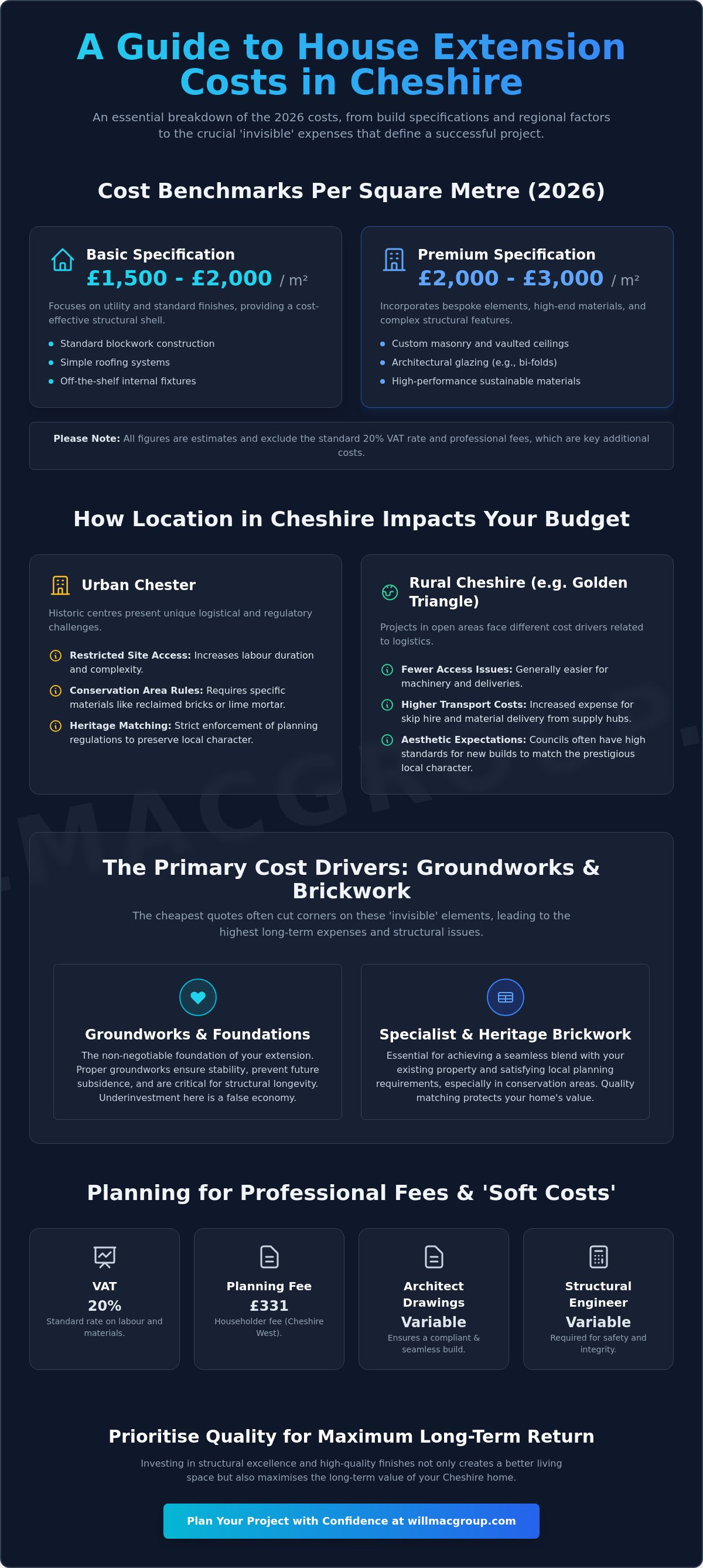
When calculating the total house extension cost Cheshire homeowners must look beyond the physical materials and labour. These “soft costs” represent the administrative and technical foundation of your project. They ensure that your build is legal, safe, and insured. Neglecting to budget for professional fees often leads to financial strain mid-project, as these expenses typically arise before the first spade hits the ground. From council fees to structural calculations, these requirements are mandatory for any high-quality residential development.
Professional fees generally range from 3% to 15% of the total construction cost. For a standard extension, you might expect to pay between £1,000 and £2,500 for planning drawings, whilst more detailed technical packs for building regulations can rise to £5,000. Investing in a comprehensive technical pack is a prudent move; it reduces the likelihood of “on-site” surprises by providing your builder with a precise roadmap. A structural engineer is equally non-negotiable. Their calculations, which typically cost between £1,000 and £2,500, ensure that steel beams and load-bearing walls are correctly specified. If your property is terraced or semi-detached, you must also budget for a Party Wall surveyor to manage legal agreements with your neighbours.
The route you take through the planning system significantly impacts your timeline and initial spend. For a householder application in Cheshire West and Chester, the fee for 2026 is £331. If your project falls under Permitted Development, applying for a Lawful Development Certificate is highly recommended to provide proof of compliance when you eventually sell the property. You should also check if the Community Infrastructure Levy (CIL) applies to your specific postcode, as this can add an unexpected charge to larger developments. Regardless of your planning route, always maintain a contingency fund of 10% to 15%. This buffer is essential for managing unforeseen structural issues or ground condition changes that only become apparent during excavation.
Managing these regulatory hurdles requires a methodical approach and a clear understanding of local council expectations. By securing professional oversight early, you protect your investment and ensure the longevity of the structure. If you are ready to move from the planning stage to physical construction, consult an experienced Cheshire builder to turn your technical drawings into a reality.
High property values across the North West mean that a well-executed build significantly boosts market appeal and long-term equity. Selecting a builder based solely on the lowest quote often leads to a higher house extension cost Cheshire in the long run due to remedial work or poor material selection. Structural excellence and precise brickwork aren’t just aesthetic choices; they are the markers of a project that will stand the test of time. When your extension seamlessly matches the original architecture, it ceases to be an “add-on” and becomes a permanent, value-adding asset to your home.
To ensure your investment is protected, use this checklist when vetting potential contractors:
Finished photos only tell part of the story. A reputable builder should encourage you to visit an active site. This allows you to observe their organisation, site cleanliness, and the quality of their house extension cost Cheshire management in real-time. Local knowledge is equally vital. A contractor familiar with North West terrain understands how to manage the specific challenges of Cheshire clay and which local suppliers offer the best value for reclaimed materials. Willmac Group organises every project with a methodical focus on transparency. This ensures that you are informed of progress and budget status at every milestone, removing the anxiety often associated with large-scale builds.
Reputable builders in Chester often have lead times ranging from six to twelve months. It is wise to begin your search as early as possible to secure your preferred start date for the 2026 season. Once you have finalised your technical drawings and structural calculations, move from a rough estimate to a detailed, fixed-price contract. This document is your primary protection against “price creep,” as it clearly outlines the scope of work, material specifications, and payment schedules. A clear, written agreement ensures that both parties understand their responsibilities, fostering a relationship built on professional reliability rather than assumptions.
Your home is likely your most significant investment. Entrusting its expansion to a specialist ensures that the final result enhances both your daily lifestyle and your property’s market value. If you are ready to begin your journey with a partner who values craftsmanship and structural integrity, contact Willmac Group for a professional extension consultation to discuss your requirements and secure your place in our 2026 schedule.
A successful project depends on balancing your vision with a realistic understanding of the house extension cost Cheshire requires. By prioritising the structural “invisible” elements like groundworks and ensuring a perfect match for your property’s brickwork, you protect both the safety and the market value of your home. Navigating the 2026 planning fees and professional requirements is much simpler when you have a methodical framework to follow. It’s about making informed choices today that ensure longevity for decades to come.
With over 25 years of industry experience, Willmac Group provides the technical precision and local knowledge needed for high-quality residential builds. As specialists in structural brickwork and groundworks, we have a proven track record across Chester and the North West. We’re here to help you move from initial budgeting to a finished space that enhances your lifestyle. Discuss your Cheshire house extension project with Willmac Group and take the first step towards a seamless construction experience. Your dream home is within reach when you partner with professionals who value craftsmanship as much as you do.
For a standard 30-square-metre extension, homeowners should budget between £45,000 and £90,000 depending on the level of finish. Basic specifications start at approximately £1,500 per square metre, whilst premium builds with bespoke glazing and high-end masonry can reach £3,000 per square metre. It’s essential to remember that these figures represent the construction phase and typically exclude VAT and professional fees, which are vital components of the total house extension cost Cheshire.
Not all extensions require a full planning application, as many fall under Permitted Development rights. However, properties within Chester’s numerous conservation areas or those involving listed buildings almost always require formal consent. You should check with the Cheshire West and Chester planning department before starting work. Even if permission isn’t required, obtaining a Lawful Development Certificate is a prudent step to confirm your project’s legality for future property sales.
A well-executed kitchen extension is widely regarded as one of the most effective ways to increase a home’s market value. In affluent areas such as the “Golden Triangle,” a high-specification kitchen addition can provide a significant return on investment by creating the open-plan living space modern buyers prioritise. Beyond the immediate equity gain, it also enhances the saleability of the property by modernising the home’s most functional “wet” room.
It is possible to remain in your home during construction, though it requires careful planning to manage the disruption. You should expect significant noise, dust, and periods where utilities may be temporarily disconnected. Many homeowners choose to set up a temporary kitchen in another room if the project involves a rear extension. If the work involves major structural alterations to the main living areas, some families find it more comfortable to relocate for the most intensive weeks of the build.
Unforeseen ground conditions, such as the heavy clay soil common in the North West, are the most frequent cause of budget increases. If standard foundations are insufficient and require piling, costs will rise quickly. Other factors include making changes to the architectural specification mid-build or discovering inadequate existing drainage that requires a complete realignment. Maintaining a 10% to 15% contingency fund is the most effective way to manage these unpredictable structural requirements.
You should look for a contractor with a documented portfolio of heritage matching and structural masonry projects across the county. Ask to see active sites to observe their craftsmanship and site management first-hand. A specialist will have deep knowledge of local material suppliers and the skill to blend new courses seamlessly with your existing property. This level of expertise is essential for protecting the house extension cost Cheshire residents invest in their homes.
A shell-only build provides a watertight structure, including the foundations, external walls, and roof, but leaves the interior as a blank canvas. This option is often chosen by those who wish to manage their own internal fit-out or decorating. A turn-key extension is a comprehensive service where the builder handles everything from the initial groundworks to the final painting and flooring. This approach offers the most convenience and ensures the entire project meets a consistent standard of finish.
Standard trench-fill foundations are typically included in a builder’s base rate per square metre. However, more complex civils and groundworks, such as piling for unstable soil or building over public sewers, are usually quoted as additional items. Because these costs depend entirely on the specific conditions of your plot, they cannot be accurately generalised. A thorough site survey is the only way to determine if your groundworks will require a specialist budgetary allocation beyond the standard framework. For a deeper understanding of how these structural decisions affect your project from the outset, the guidance available for rear extension builders across the North West covers the critical planning and foundation considerations in detail.