
Did you know that approximately one-third of all planning applications submitted to Cheshire West and Chester Council are for house extensions? While the desire to expand is common, the reality of delivering high-quality house extensions Chester residents can trust involves handling a complex web of local regulations and technical challenges. You likely feel the weight of this investment, especially with the 2% increase in Building Control fees that took effect in 2025. It’s natural to worry about structural settling or the nuances of the 2021 House Extensions SPD, as these factors often dictate the long-term success of your project.
We believe a premium extension is defined by its invisible quality, specifically the expert groundworks and specialist brickwork that ensure structural permanence. This guide provides the professional knowledge you need to master the planning and build process with total confidence. We’ll guide you through the essential stages of construction, explaining how to manage local building standards and ground conditions to ensure your new space adds lasting value and stability to your home.
For a modern Chester homeowner, a house extension represents a strategic evolution of their existing property rather than just a simple addition of square footage. It involves the professional integration of new structural elements, including groundworks and brickwork, to create a cohesive living environment. When homeowners explore the process of Understanding the Value of House Extensions, they often find that the decision to build is driven by a desire to preserve their place in the community whilst adapting their home to modern requirements.
The current market for house extensions Chester wide is heavily influenced by the “improve don’t move” trend. With the UK construction sector facing various cost pressures in 2026, many residents are choosing to reinvest in their current assets rather than facing the volatility of a new purchase. Moving home involves substantial “dead money” costs, such as estate agent fees, legal charges, and Stamp Duty Land Tax. By choosing to extend, these funds are instead channelled directly into the property’s fabric, resulting in a permanent increase in both lifestyle quality and financial equity.
In sought-after areas like Hoole or Curzon Park, larger family homes are increasingly scarce. Homeowners who’ve secured a property in these prime locations are often reluctant to leave, yet their needs for space naturally grow over time. The demand for open-plan kitchen and dining areas is particularly high in Chester’s older Victorian and Edwardian terraces. These properties, whilst full of character, frequently feature narrow, dark layouts that don’t suit contemporary family life. A well-planned extension allows for the creation of light-filled, communal spaces that become the heart of the home, without the need to relocate to a different school catchment area.
Beyond the immediate lifestyle improvements, the financial return on investment for extensions in the North West remains compelling. Adding an extra bedroom, particularly one with an en-suite bathroom, significantly alters a property’s bracket in local valuations. A well-executed extension can increase property value by up to 20%. Maintaining “kerb appeal” is vital in a historic city like Chester; the new structure must harmonise with the existing architecture through precise brickwork and sympathetic design. This attention to detail ensures the extension looks like a natural part of the original building, which is essential for protecting the long-term resale value of the home.
The longevity of the house extensions Chester residents invest in depends entirely on what lies beneath the surface. Whilst the visual finish of a new room often receives the most attention, the structural integrity of the build is determined during the first few weeks of construction. A foundation is more than just a concrete base; it’s a technical response to the specific land conditions of your site. In the North West, ground conditions can vary significantly, often featuring heavy clay or areas with high water tables that require precise civils and groundworks to prevent future movement.
Skipping over the complexities of soil analysis or drainage can lead to structural settling, which manifests as cracks in masonry or internal damp. Professional site preparation ensures that the transition between the original house and the new structure remains stable over decades. When preparing your application via Cheshire West and Chester Council’s planning portal, you’ll find that building control standards are stringent regarding these initial phases. This is why employing a specialist builder with a background in complex civils is essential for any high-value project.
Professional groundworks involve a methodical approach to site clearance, excavation, and drainage installation. We ensure that the base is perfectly level and that all utility connections are correctly routed before any brickwork begins. Poorly managed drainage is one of the most common causes of extension failure in Cheshire. By prioritising the civils stage, you protect the structural skeleton of the building from the effects of ground heave or subsidence. This phase is non-negotiable for anyone seeking a seamless addition to their home.
Achieving an “invisible” extension requires a high level of masonry skill. It isn’t enough to simply buy the same colour brick; a specialist must consider the mortar’s texture, the specific bonding pattern, and the weathering of the existing house. Structural brickwork is the art of ensuring the new walls bear loads correctly whilst perfectly mirroring the historic aesthetic of Chester’s architecture. At Willmac Group, our heritage is rooted in specialist brickwork. We understand that general builders often lack the refined masonry experience needed to match Victorian or Edwardian facades. Using a specialist ensures that the new addition looks like a natural extension of the original property rather than a disjointed afterthought.
Chester’s architectural diversity means that a “one size fits all” approach to building is never appropriate. From the compact Victorian terraces in Handbridge to the more expansive detached properties in Christleton, the choice of extension style must reflect both the property’s character and the homeowner’s lifestyle needs. When considering house extensions Chester residents often look to balance the requirement for internal space with the preservation of outdoor garden areas. Choosing the right configuration is a decision that impacts both daily comfort and the long-term resale value of the property.
Single-storey rear extensions are the most frequent choice for creating open-plan family hubs. These projects typically focus on expanding the kitchen and dining areas to create a seamless transition between the home and the garden. By incorporating structural elements like roof lanterns and bi-fold doors, we can transform a previously dark, cramped kitchen into a light-filled communal space. These additions often fall under “permitted development,” but you should always consult the UK’s official Planning Portal to confirm the specific limitations for your property type.
For those living on corner plots, a “wraparound” extension offers a unique opportunity. This style combines a side and rear extension, effectively creating an L-shaped addition that significantly increases the ground floor footprint. It’s an excellent way to add a utility room, a home office, and a larger kitchen simultaneously. These projects require meticulous planning regarding drainage and structural junctions where the new walls meet the existing building.
If your primary goal is to add bedrooms or ensuites, a double-storey extension is often the most cost-effective solution. Whilst the initial investment is higher than a single-storey build, the cost per square metre is typically lower because the expensive groundworks and roofing costs are shared across two floors. These projects demand significant structural expertise. As mentioned in our previous discussion on civils, the existing foundations must be assessed to ensure they can support the additional vertical load before any second-level brickwork commences.
Double-storey builds are particularly effective for growing families who don’t want to sacrifice their entire garden. By building upwards, you gain the necessary living space whilst maintaining the outdoor area that adds so much value to homes in the North West. Whether you’re adding a master suite or a dedicated guest wing, the key is ensuring the new roofline and brickwork blend perfectly with the original house to maintain a balanced, professional appearance.
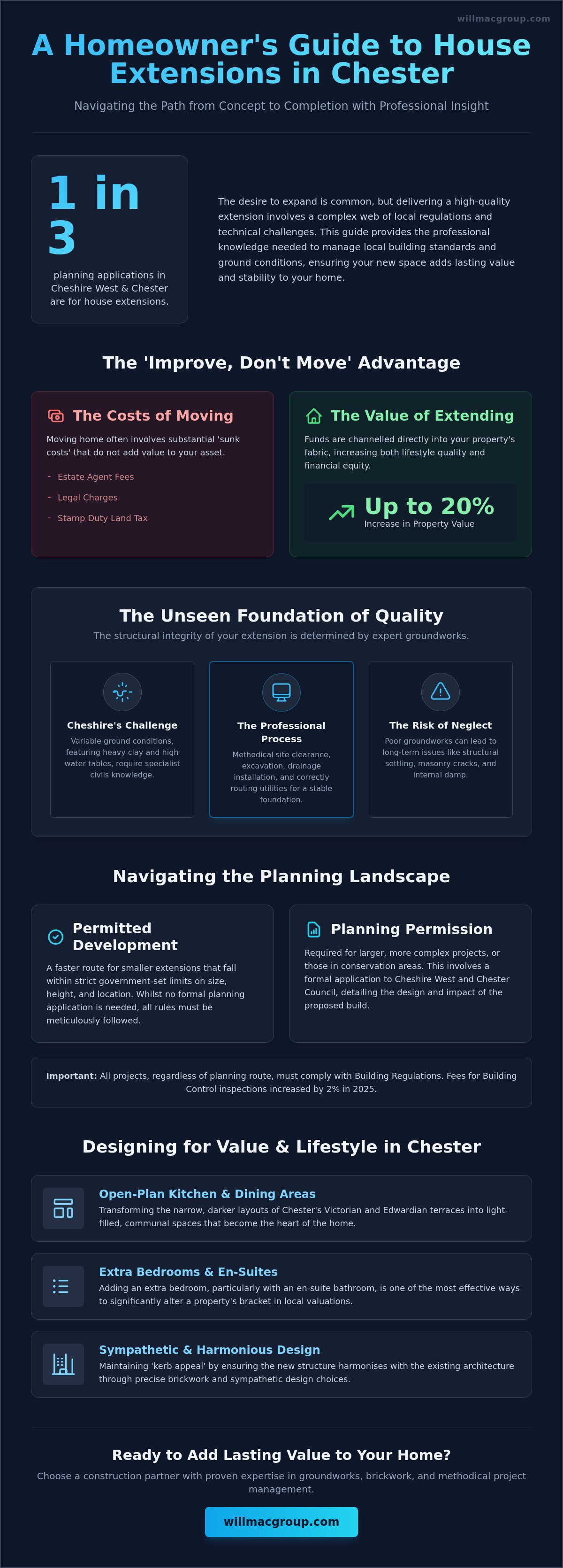
Securing legal compliance is the most critical administrative phase of any construction project. In 2026, the regulatory landscape for house extensions Chester residents must navigate is more rigorous than ever, reflecting updated national standards and local policy shifts. Whilst national frameworks provide a general guide, Cheshire West and Chester Council apply specific local standards, particularly regarding the city’s unique architectural heritage. For those living in one of Chester’s many Conservation Areas, such as the Garden Quarter or Boughton, traditional Permitted Development rights are often restricted or removed entirely. This ensures that any new addition respects the historic aesthetic that defines our city.
The local planning environment is also in a state of transition. Cheshire West and Chester Council are currently updating their Local Plan, with the Pre-Submission Plan scheduled for Autumn 2026. This move may lead to stricter environmental and design policies in the near future. Understanding these nuances early prevents the frustration of rejected applications or, worse, enforcement action against a completed build. If you are unsure how these evolving rules apply to your specific site, consulting an experienced builder during the feasibility stage can provide the clarity needed to proceed safely.
Many homeowners aim to build under Permitted Development (PD) to bypass the full planning process. To qualify, your extension must meet several strict criteria, such as not exceeding 50% of the land around the original house and matching the existing masonry materials. However, if your plans exceed height limits or involve a side extension on a corner plot, you must submit a full application. We always recommend obtaining a Certificate of Lawfulness even for PD projects. This document serves as legal proof that your build was compliant at the time of construction, which is vital when the time comes to sell your property.
While planning permission deals with the appearance and location of your build, Building Regulations focus on safety and structural integrity. Since April 1 2025, Cheshire West and Chester Council increased their Building Control fees by 2%, and these costs are a mandatory part of your project budget. Inspections occur at fixed stages, including the excavation of foundations, the installation of drainage, and the completion of the structural roof. Modern standards also place a heavy emphasis on thermal efficiency. Following the May 2024 updates to the Approved Documents, your extension must meet high insulation targets to comply with Part L of the regulations. Building Control sign-off is essential for the legal completion of the build and is required by mortgage lenders and insurers alike.
Selecting a partner for house extensions Chester projects is a decision that impacts your property’s safety and value for years to come. A professional construction company differs from a general builder through its technical depth and methodical project management. Whilst a generalist might handle cosmetic updates, a specialist firm understands the structural complexities of groundworks and masonry. This expertise is particularly vital in Chester, where varied soil conditions and heritage brickwork require a nuanced, experienced approach.
When vetting potential contractors, you should look beyond simple star ratings and focus on technical competence. Use this checklist to ensure your chosen builder can deliver a high-standard finish:
Our reputation is built on a commitment to high-quality structural finishes. We manage the full lifecycle of the project, ensuring that the precision of the initial groundworks is mirrored in the final brickwork. By maintaining in-house control over these critical stages, we eliminate the risks and delays often associated with multi-layered sub-contracting. This creates a more stable construction programme. It ensures that every element of the build meets our rigorous standards for longevity and craftsmanship, providing you with a seamless addition to your home.
Transparency is at the core of our dialogue with homeowners. We provide clear, itemised quotes and realistic timelines to ensure you feel fully informed before any work begins. Our team starts with a thorough site assessment to identify potential ground condition challenges or specific structural requirements early. This methodical start prevents unexpected delays and builds a foundation of trust. If you are ready to discuss your project, you can enquire about your house extension in Chester with Willmac Group today to arrange a professional site assessment.
Extending your home is a significant undertaking that requires more than just a vision for a new room. It demands a technical understanding of the ground conditions beneath your feet and a commitment to the masonry standards that define Chester’s historic architecture. By prioritising specialist groundworks and navigating the specific planning rules of Cheshire West and Chester Council, you ensure your investment is protected for the long term. This methodical approach is what separates a standard build from a premium addition.
Successful house extensions Chester residents can take pride in are built on a foundation of transparency and skill. With directors bringing over 25 years of industry experience, our team focuses on the technical precision of structural groundworks and specialist brickwork. We have a proven track record across Chester and the North West for delivering stability and high standards. Contact Willmac Group for a Professional Extension Consultation and take the first step towards a seamless addition to your home. We look forward to helping you create a space that adds lasting value to your property.
You don’t always require full planning permission if your project meets the specific criteria for Permitted Development. However, many properties in Chester are located within Conservation Areas or have restricted rights, making a formal application to Cheshire West and Chester Council necessary. It is always advisable to obtain a Lawful Development Certificate to provide legal proof that your build complies with all local requirements.
The total investment for house extensions Chester residents undertake depends on the scale of the project and the complexity of the groundworks. Market data from early 2026 indicates that construction costs have risen by 6.6% across the UK, which impacts the pricing of materials and labour. Your budget should account for structural requirements, specialist brickwork, and the mandatory Building Control fees that increased in 2025.
A standard extension project generally takes between 12 and 24 weeks to complete once the groundworks begin. The initial phase of excavation and foundation laying is critical and can take several weeks depending on soil conditions. This is followed by the structural brickwork, roofing, and internal fit-out. We provide a methodical schedule at the start of every project to help you manage your expectations during the build.
Most homeowners choose to remain in their property during the construction process. We take great care to minimise disruption by using temporary partitions and maintaining a clean, organised site environment. If your project involves significant structural changes, such as removing the entire rear wall for a large open-plan space, you might find it more practical to vacate the home during those specific weeks.
A general builder manages the overall project, but a specialist brickwork contractor provides the refined masonry skills needed for structural permanence and aesthetic matching. Using a firm with specialist expertise ensures that the new masonry blends perfectly with Chester’s unique architectural heritage. This level of skill is particularly important for ensuring the new walls bear loads correctly and match the existing mortar and bonding patterns.
A professionally constructed extension typically adds significant value, often increasing a property’s market price by up to 20%. The increase is most notable when adding functional space like a master bedroom or a large kitchen-diner. However, the work must be completed to a high standard. Poorly executed projects with mismatched bricks or structural issues can actually hinder a future sale and negatively impact your home’s valuation.
We achieve a seamless match by sourcing bricks from suppliers who specialise in local Cheshire clay types and historical finishes. Matching the mortar’s texture and colour is equally vital for an “invisible” transition between the old and new structures. Our background in specialist masonry allows us to replicate traditional bonding patterns, ensuring the extension looks like a natural, original part of your property rather than a modern addition.
Building regulations are mandatory safety standards that cover structural integrity, fire safety, and energy efficiency. In Chester, these are enforced through inspections by the local authority at key stages, such as foundation pouring and drainage installation. You must also comply with the latest thermal efficiency targets set in the 2024 updates to the Approved Documents. Final sign-off from Building Control is essential for insurance and future property transactions.