
Why do two identical-looking extensions in Manchester and Chester often come with vastly different price tags? Many homeowners find themselves caught in a cycle of confusion when trying to pin down the true cost of house extension North West projects, especially when initial figures start to fluctuate mid-build. It’s a common frustration that stems from a lack of transparency regarding what actually happens beneath the surface and behind the structural brickwork.
We believe in professional reliability and grounded advice. This guide provides a comprehensive breakdown of the factors that dictate extension costs across the region for 2026. You’ll gain a clear framework to evaluate builder quotes and understand how regional logistical drivers and structural requirements impact your budget. We will explore everything from essential groundworks to the implications of new building safety levies, ensuring you can move forward with your project feeling fully informed and in control of your investment.
The construction sector in the North West has seen significant shifts over the last few years. Whilst older online forums might suggest figures from 2020, those numbers rarely reflect the 2026 reality of material prices and skilled labour availability. When calculating the cost of house extension North West projects, you must consider that market conditions are now influenced by stricter building safety regulations and updated fire safety standards. These changes mean that a budget set even two years ago may no longer be viable for a modern, compliant build.
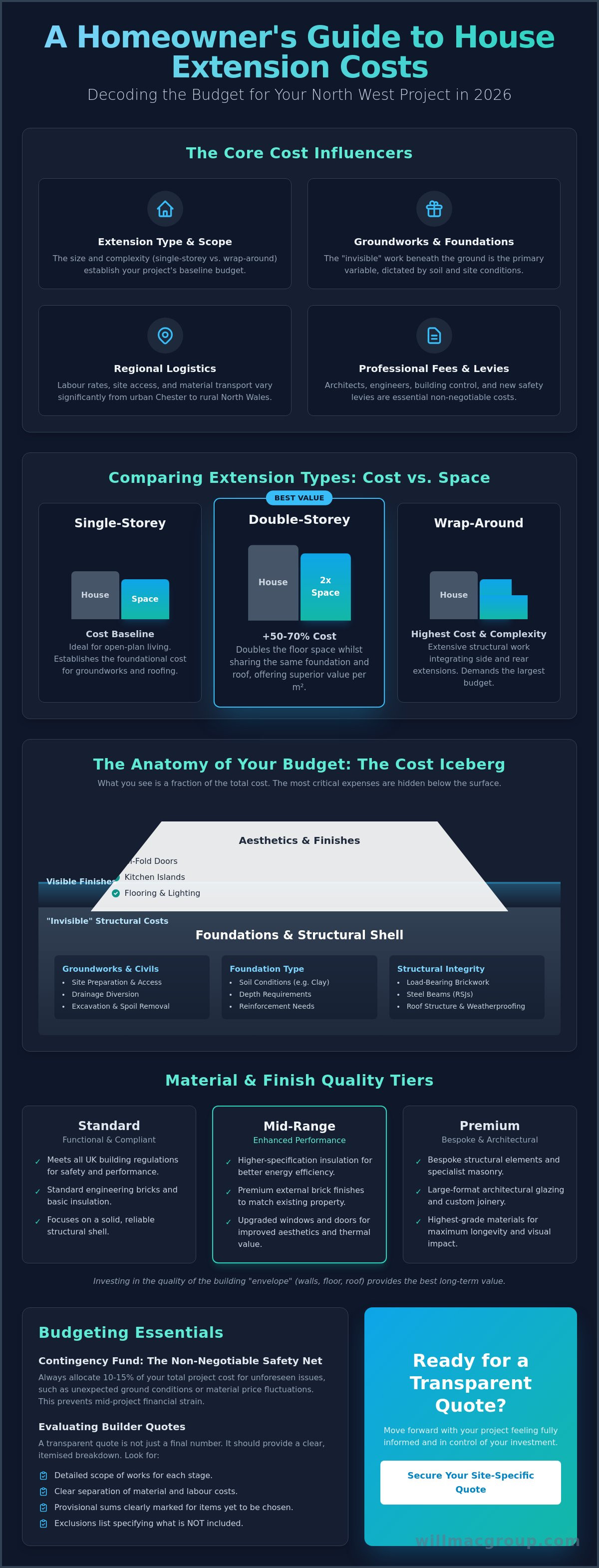
The type of extension you choose serves as the primary baseline for your investment. A single-storey rear extension is often the most accessible route for creating open-plan living areas, but it’s not always the most cost-effective in terms of price per square metre. In contrast, a double-storey extension shares the expense of the foundations and the roof across two floors, often providing a better return on your initial outlay. Wrap-around extensions, which extend both to the side and rear, represent the highest level of complexity due to the extensive structural brickwork and groundworks required to support the existing building while integrating the new space.
Your project’s scope is the most significant variable in your financial planning. Many homeowners begin by understanding the renovation process through the lens of a “shell-only” build. This approach covers the essential structure, including the civils, groundworks, and external brickwork, leaving the internal fit-out for a later date. This can be a practical way to manage cash flow, though most prefer a full turnkey service. When deciding between levels, you should consider that a single storey vs. double storey comparison reveals that adding a second floor typically adds only 50% to 70% to the cost of a single-storey project, despite doubling the floor space.
The materials you select will dictate the longevity and aesthetic appeal of your home. We categorise these into standard, mid-range, and premium tiers. Choosing specialist brickwork to match a period property in a conservation area will naturally require a higher investment than using standard engineering bricks. However, investing in high-quality structural materials and professional-grade civils ensures the building remains stable and energy-efficient for decades. We often find that homeowners who prioritise the quality of the “envelope”-the walls, floor, and roof-see a much better long-term value than those who spend their entire budget on high-end interior finishes while compromising on the core construction.
The foundations of your extension are often where the most significant budgetary surprises occur. Whilst many homeowners focus on the aesthetics of kitchen islands and bi-fold doors, the real variables in the cost of house extension North West projects lie beneath the soil. Unlike interior finishes, which can be adjusted to suit a budget, structural integrity is non-negotiable. It requires a methodical approach from the outset to ensure the longevity of the build and compliance with UK building regulations. Skimping on the “invisible” elements of a project often leads to remedial costs that far exceed the price of doing the work correctly the first time.
Site preparation is a complex process that involves more than just digging a trench. In the North West, ground conditions vary from the heavy clay of the Cheshire plains to the more varied, rocky terrain found as you move towards North Wales. Clay soil, for instance, often requires deeper foundations to account for seasonal expansion and contraction. Site access also plays a critical role in your budget. If your property is a terraced house in a tight urban centre, we may need to utilise specialist micro-machinery or manually move materials, which increases the labour hours required. Professional civils and groundworks ensure that drainage is correctly diverted and that the load-bearing capacity of the earth is properly managed before a single brick is laid.
Once the groundworks are complete, the structural brickwork becomes the primary component of the “shell” cost. This stage is not merely about stacking blocks; it involves precise engineering to ensure the new structure integrates seamlessly with your existing home. The choice of materials significantly influences the investment. Using standard facing bricks is a cost-effective route, but many North West properties require reclaimed materials or specialist masonry to match historical aesthetics. Precision in this phase is vital. Poorly executed brickwork can lead to issues with damp proofing or structural settling, which are expensive to rectify. High-quality craftsmanship ensures that the expansion joints, lintels, and wall ties are installed to a standard that prevents future maintenance headaches.
By engaging a builder with specialized knowledge in both civils and masonry, you reduce the risk of foundation errors that often plague less experienced teams. A specialist contractor identifies potential issues during the initial site survey, allowing for a transparent quote that accounts for the specific geological and logistical realities of your property.
Geography is a silent but significant influencer on your final project invoice. Whilst industry publications often provide a baseline for average extension costs, these benchmarks shift as you move from suburban developments into historic city centres or rural landscapes. The cost of house extension North West projects is dictated by the local labour market and the logistical complexity of reaching the site. In major urban hubs, trade availability is higher, but this is often offset by the increased costs of parking, permits, and restricted working hours.
Constructing an extension in Chester requires a deep understanding of the local architectural heritage. Many projects within the city and surrounding villages fall under conservation area regulations, which directly impacts the budget through material selection. You may be required to source specific reclaimed bricks or use traditional lime mortars to match the existing masonry. Site constraints are another factor; navigating narrow lanes with heavy machinery requires meticulous planning and occasionally smaller, more specialised equipment. A builder familiar with the Cheshire West and Chester planning department can often anticipate these requirements early, preventing the kind of administrative delays that lead to mounting indirect costs.
Moving into North Wales introduces environmental factors that demand specialised construction choices. Properties near the coast are subject to salt-laden air and higher wind loads, which influence the specification of external renders, window frames, and roofing systems. Choosing materials based on their longevity in these conditions is essential to avoid premature maintenance issues. Logistics also play a larger role here; for remote or mountainous sites, the cost of transporting materials and the travel time for skilled tradespeople must be factored into the initial quote. Using a contractor that operates across the border ensures that these regional nuances are respected, providing a stable bridge between urban standards and rural requirements.
Labour rates also fluctuate between these regions. In more affluent parts of Cheshire, the demand for high-end craftsmanship can drive up daily rates for specialists like master bricklayers or skilled groundworkers. Conversely, rural North Wales may offer more competitive labour rates, but these savings can be absorbed by the increased delivery fees for materials sourced from major distribution centres. A transparent builder will break down these regional logistical costs, ensuring you understand exactly how your location influences the project’s financial structure. This methodical approach ensures that the build remains viable from the first site visit through to the final inspection.
Managing a budget for a construction project requires more than just looking at the builder’s estimate. When calculating the total cost of house extension North West projects, many homeowners overlook the statutory and professional fees that accrue before the first spade hits the ground. These expenses are fixed and essential for legal compliance. For instance, the Party Wall Act 1996 may require you to appoint a surveyor if your neighbours don’t provide written consent for work near a shared boundary. This can add several thousand pounds to your initial projections if not handled with transparency from the start.
Industry experts recommend maintaining a contingency fund of 10% to 15% of your total project cost. This isn’t for elective upgrades; it’s a buffer for “unseen” structural challenges. As we discussed in the previous section, groundworks in the North West can reveal unexpected drainage issues or old foundations that require extra civils work. A contingency is a sign of a well-planned project, not a failing one. It provides the financial stability needed to handle surprises without halting the build. Without this buffer, a single discovery during the excavation phase can cause significant delays and stress for the entire household.
Professional fees typically account for 12% to 15% of the total build cost. This includes the structural engineer responsible for ensuring the long-term stability of the masonry and the steelwork. You must also factor in the householder planning application fee, which stands at £258 in England as of 2026. Building control inspections are another standardised cost, ensuring your extension meets all safety and energy efficiency standards. You can see how these stages fit into the project lifecycle in our Real Timeline guide.
The structural engineer plays a pivotal role that goes beyond simple calculations. They specify the steel beams and foundation depths required to support your new brickwork, directly influencing the volume of materials needed. Without their precise input, you risk over-ordering or, worse, under-specifying the structure. Similarly, neglecting the administrative side can be costly. If you’re building on a detached house in Wales, your permitted development rights allow for a 4-metre rear extension, but exceeding this by even a few centimetres without approval can lead to expensive enforcement action.
New regulations, such as the Building Safety Levy effective from October 2026, may also impact residential developments. Staying ahead of these changes requires a partner who understands the local regulatory environment. If you’re ready to move beyond estimates and secure a transparent breakdown of your project, contact the Willmac Group for expert guidance on your build.
Moving from general research to a project-specific budget is a critical step in your construction journey. Whilst online calculators provide a convenient starting point, they often present a best-case scenario that fails to account for the structural realities of your specific site. To truly understand the cost of house extension North West projects, you need a professional assessment that considers ground conditions, site access, and specific masonry requirements. This transition from a general estimate to a fixed, transparent quote is where the long-term success of your build is decided.
A professional quote should be comprehensive and leave no room for ambiguity. You should look for a detailed schedule of works that breaks the project down into logical phases, from initial civils and groundworks to the final structural brickwork. Be cautious of “prime cost” (PC) sums, which builders often use as placeholders for items not yet fully specified. Whilst these are sometimes necessary for finishes, an over-reliance on them in the structural phase can lead to significant budget creep. It is a common industry reality that the cheapest initial quote often becomes the most expensive final bill because it lacks the thoroughness required to identify potential issues before the work begins.
With over 25 years of industry experience across the North West, we have built a reputation for professional reliability and high standards. Our approach is grounded in transparency; we provide a methodical breakdown of costs that reflects the actual work required for your property. Whether we are managing a large-scale residential extension or a complex commercial project, our focus remains on the quality of the structural finishes and the longevity of the construction. We understand that a home extension is a significant investment, and we take pride in delivering results that reflect our commitment to craftsmanship.
We organise our projects to ensure that the build proceeds at a steady, predictable pace. This methodical flow minimises disruption to your daily life whilst ensuring that every stage of the masonry and groundwork meets our exacting standards. If you are ready to move forward with a partner who values precision and clear communication, the next step is a site-specific consultation. By evaluating the logistical and structural needs of your site from the ground up, we can provide a framework that allows you to budget with confidence. Contact us today to discuss the requirements for your North West extension.
Building an extension is a significant undertaking that requires a balance of architectural vision and structural reality. We’ve explored how the cost of house extension North West projects is influenced by everything from the geological conditions of your site to the specific logistical challenges of historic centres like Chester. By prioritising high-quality civils and maintaining a realistic contingency fund, you ensure your project remains on a stable financial footing. These structural foundations are the most critical part of your investment, providing the stability your home needs for decades to come.
Our dedicated local team brings over 25 years of industry experience to every build. We specialise in high-quality brickwork and complex civils, serving homeowners across Chester, the North West, and North Wales with a commitment to transparency and craftsmanship. When you’re ready to move from general estimates to a professional plan, we invite you to request a transparent, professional quote for your North West extension. We look forward to helping you create a space that adds lasting value and functionality to your home.
The 2026 market framework suggests a 30-square-metre extension in the North West typically starts from approximately £57,000 for a basic finish. This figure can rise significantly depending on the specification and the complexity of the groundworks required for your specific site. High-end finishes for a space of this size can exceed £120,000 when accounting for premium materials and bespoke structural elements.
A double-storey extension is generally more cost-effective per square metre than a single-storey build. This is because the most expensive elements, such as the foundations and the roof, serve two levels of living space instead of one. Whilst the total project cost will be higher, the value added to your property is often far greater with a two-storey addition.
You will almost certainly require a structural engineer to provide the technical calculations needed for Building Regulations approval. They ensure that the steel beams, lintels, and structural brickwork are capable of supporting the new loads safely. Even for small projects, these calculations are essential for your building control certificate and the long-term stability of your home.
The groundworks and structural shell are typically the most significant financial investments in any project. Foundations are highly variable because soil conditions and existing drainage can’t be fully assessed until the excavation phase begins. Ensuring the structural integrity of the masonry and the civils is where the majority of your budget is concentrated during the early phases.
We recommend setting aside a contingency fund of 10% to 15% of the total project budget. This buffer is vital for managing the cost of house extension North West projects when unexpected issues, such as old utility lines or unstable ground, are discovered during the structural phase. Having this fund in place ensures the project can proceed without financial strain if surprises occur.
Whilst self-management appears to save on professional fees, it often results in higher costs due to scheduling errors and lack of trade discounts. A professional builder provides a dedicated project manager to ensure the work is completed to a high standard without costly delays. Their expertise in coordinating civils and brickwork prevents the kind of expensive mistakes that frequently occur with DIY management.
Yes, costs fluctuate based on local logistics and planning requirements across the region. Building in historic Chester often involves conservation area constraints that don’t apply to modern developments in Manchester or Liverpool, impacting the choice of materials and labour time. Access issues in tight urban centres can also increase the cost of machinery hire and waste disposal.
Always look for exclusions such as VAT, professional fees for structural engineers, and the cost of building control inspections. A transparent quote should clearly define the scope of the civils and brickwork to avoid surprises during the construction phase. You should also check if the quote includes the cost of skips, scaffolding, and the rerouting of any existing underground utilities.