
A premium rear extension is defined by its structural integrity and masonry precision, not just the aesthetic of its interior design. Most homeowners across the region feel a mix of excitement and genuine anxiety when planning a project of this scale. You likely worry about the complexities of Permitted Development versus Planning Permission, or the risk of hiring rear extension builders North West families can trust to avoid the nightmare of subsiding foundations and poor craftsmanship.
We understand that your home is your most significant asset, and any addition must be built to endure. This guide provides a clear roadmap to help you master the essentials of a high-quality build, from securing solid structural foundations to navigating the specific building regulations required by local authorities. We will examine the critical steps of the construction process, how to identify contractors with genuine technical expertise, and the architectural styles that define our local North West landscape.
Across Cheshire and Chester, a clear shift has occurred in how families approach their living space. More homeowners are choosing to “improve not move” to avoid the escalating stamp duty and estate agent fees associated with relocation. For many, the sentimental value of a home in a specific North West postcode is irreplaceable, and a well-executed extension allows you to adapt your existing property to meet modern lifestyle requirements without the logistical disruption of a house move. This approach preserves the stability of your family life whilst significantly increasing the functional square footage of your property.
Property values in the North West are heavily influenced by the quality of the external finish and the structural integrity of the build. High-quality brickwork and professional masonry ensure that an addition feels like a natural evolution of the original building rather than a secondary afterthought. A successful build balances the desire for modern, open-plan living with the character of traditional British architecture. It’s about creating a space that feels contemporary internally whilst respecting the heritage of the original brickwork externally. When you engage experienced rear extension builders North West homeowners rely on, the focus stays on matching existing materials and ensuring structural longevity.
Moving house often involves hidden costs that can easily exceed £20,000 when considering taxes, surveys, and legal fees. Investing those funds into your current property often yields a far better return. Modern families require multi-functional spaces that older British housing stock wasn’t designed to provide. A rear extension can house a dedicated home office, a bright garden room, or a sprawling kitchen-diner that becomes the heart of the home. These additions significantly improve the flow of natural light into deeper parts of the house, transforming dark, compartmentalised rooms into airy, open environments that connect more naturally with the garden.
The single-storey rear extension remains the most versatile choice for the majority of North West homes. It offers a balance between increased floor area and the preservation of garden space. For those with a side alley or redundant space adjacent to the kitchen, a “wraparound” extension provides the maximum possible footprint expansion by combining a side and rear addition into one seamless L-shaped space. Choosing the right rear extension builders North West ensures that these complex structural decisions are handled with technical precision.
Design choices often come down to the roofline. Flat roofs with large glass lanterns are popular for their contemporary aesthetic and ability to flood the room with sunlight from above. Conversely, pitched roofs with traditional tiles can offer a more seamless match for period properties. Before starting your project, it’s essential to understand the basics of Planning permission in the United Kingdom to see how these designs fit within local guidelines and Permitted Development rights.
While the finished interior often receives the most attention, the longevity of your project depends entirely on the structural skeleton. Groundworks represent the most critical unseen phase of any build. They form the literal foundation upon which everything else rests. Failure to execute this stage with precision can lead to catastrophic issues later, including subsidence, rising damp, and structural cracking that can compromise the entire property. This is why choosing rear extension builders North West homeowners can rely on for civil engineering expertise is a non-negotiable requirement for a stable home.
Our approach prioritises precision from the very first day on site. Site preparation is not merely about moving earth; it is about understanding the specific demands of the land. We ensure that every excavation is handled with technical accuracy, providing a stable base that prevents future movement. If you are beginning to plan your project, consulting with specialists in civils and groundworks ensures that your extension is built on a foundation of professional reliability.
The process begins with professional site clearance and excavation. In the North West, soil types vary significantly, from heavy clay to sandy deposits. Each requires a specific approach to drainage and foundation depth. Typically, foundations for a rear extension should be 900mm to 1000mm deep, though proximity to trees or poor soil conditions often necessitates deeper trenches. Professional site preparation ensures that waste disposal is handled correctly and that all work aligns with Permitted Development Rights and building regulations. This phase requires specialist engineering and heavy-duty equipment to ensure the site is safe and structurally sound before a single brick is laid.
The challenge of a rear extension is making it look as though it has always been there. This requires more than just standard masonry; it demands an eye for detail and a deep knowledge of local materials. Whether your home is built from aged Cheshire red brick or North Wales stone, matching the mortar colour and brick texture is essential for a seamless transition. Brickwork serves both a structural and decorative purpose, and the skill of the mason defines the final finish. Toothing in is the process of bonding new bricks into existing masonry for structural continuity. This technique ensures the new walls are physically integrated with the old, preventing the unsightly vertical cracks that often appear when an extension is simply “butted up” against the original house. Choosing rear extension builders North West with a focus on heritage masonry ensures your new space complements the existing character of your property.
Planning permission serves as a vital framework for maintaining the character of North West communities. In regions like Cheshire or the historic centre of Chester, the rules often reflect the unique heritage of the local architecture. Understanding the distinction between Permitted Development and full Planning Permission is a fundamental part of the build process. Whilst many single-storey additions fall under Permitted Development, certain criteria regarding height, depth, and boundary proximity must be strictly followed to avoid legal complications. Professional rear extension builders North West residents trust will always prioritise these regulations to ensure the long-term security of your investment.
For many homeowners, Permitted Development (PD) rights allow for significant improvements without the need for a full planning application. As of June 2026, single-storey rear extensions for detached properties can generally extend up to 4 metres from the original rear wall, while semi-detached or terraced homes are limited to 3 metres. If your project requires more space, the Larger Home Extension Scheme provides a route for extensions up to 8 metres for detached homes, subject to a prior approval process. To qualify, the extension height must not exceed 4 metres, and the materials used must be similar in appearance to the existing house. We recommend obtaining a Lawful Development Certificate before starting any work. This document provides formal proof that your build was legal at the time of construction, which is essential when you decide to sell your home. A householder planning application in England, which cost £258 as of April 2025, is a necessary step if your project falls outside these specific PD limits.
While planning permission addresses the external impact of a building, Building Regulations focus on its structural integrity, safety, and energy efficiency. Compliance is mandatory for every extension, regardless of whether it required planning permission. This involves a series of scheduled inspections at key stages of the architectural process, including the excavation of foundations, the installation of drainage, and the placement of structural steels. These inspections ensure the project meets strict thermal efficiency standards, keeping your new space comfortable throughout the year whilst managing energy costs.
We manage these inspections methodically, ensuring that every element of our construction work meets or exceeds the required standards. This disciplined approach guarantees that you receive a final completion certificate, which is a critical document for house insurance and future property transactions. In areas with specific environmental challenges, such as the North Wales coast, our rear extension builders North West teams adapt their techniques to ensure the structure remains resilient against local weather conditions and coastal exposure.
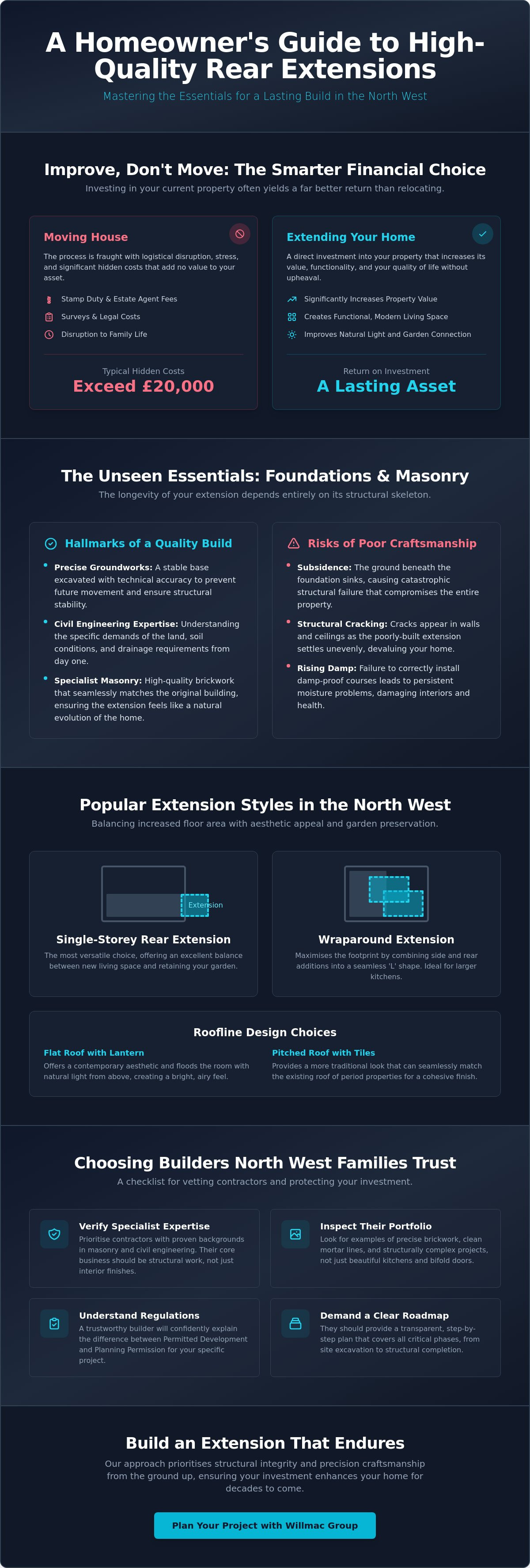
Selecting the right rear extension builders North West families can trust is about more than just checking online ratings. You need to identify a firm with a proven track record in civil engineering and high-end masonry. The most challenging parts of a build are the structural elements that remain hidden once the project is complete. We recommend visiting past sites to inspect the masonry quality first-hand. Look for consistency in mortar lines and how well the new structure integrates with the original property. If a builder is hesitant to show you their previous work, it’s often a sign that their standards may not meet your expectations.
A professional firm should provide clear evidence of public liability insurance and a robust health and safety policy. These aren’t optional extras; they’re essential protections for your home, your family, and your neighbours. Technical competence must be matched by administrative transparency. This ensures that the project is not only built well but is also managed with the professional rigour required for such a significant investment.
General builders might be capable of many tasks, but they often lack the specialised precision required for complex structural steels or deep-trench groundworks. When you interview potential contractors, ask specific questions about their site preparation methods and their experience with local soil conditions. A specialist who understands the full lifecycle of a project, from the initial civils phase to the final structural finish, provides a level of security that a generalist simply cannot match. They possess the heavy-duty equipment and the engineering knowledge to handle unexpected site challenges without compromising the build quality.
It’s common to receive a wide range of prices for the same project. Be cautious of “low-ball” quotes that seem significantly cheaper than others. These often exclude critical costs such as professional waste management, drainage alterations, or the specific groundworks required for your soil type. A reliable builder provides a detailed programme of works and a transparent payment schedule tied to specific milestones. Their local knowledge of North West suppliers is also a major asset. It allows them to navigate material shortages effectively, which is vital given that tender prices in the region are expected to rise by approximately 3.5% through 2026.
Professional project management involves a steady rhythm of updates. You shouldn’t have to chase your builder for information; they should provide a clear timeline of which trades will be on site and when. If you’re looking for a partner who prioritises technical excellence and transparent communication, you can request a consultation with our construction team today.
Willmac Group brings 25 years of specialist experience in brickwork and civils to every residential project. We understand that a successful build is the result of methodical planning and technical precision. Unlike general contractors who may outsource the most critical structural phases, we maintain direct control over the entire lifecycle of the construction. This comprehensive service starts with the first excavation and continues through to the final structural finish. By managing the transition from groundworks to masonry in-house, we eliminate the communication gaps that often lead to delays and structural inconsistencies.
Our reputation amongst homeowners in Chester, Cheshire, and North Wales is built on a foundation of quiet confidence and professional reliability. We don’t rely on aggressive sales tactics; instead, we let the quality of our craftsmanship and our commitment to high standards speak for itself. We take immense pride in being a dependable local partner for both residential and commercial clients, ensuring that every project we undertake is built to endure for generations. When you work with rear extension builders North West residents trust, you’re investing in a legacy of stability and skill.
Our extensive background in large-scale brickwork contracts provides a significant advantage for your home extension. We apply the same rigorous engineering standards to a domestic kitchen-diner as we do to major infrastructure projects. This ensures structural excellence and aesthetic perfection, particularly when matching complex heritage brickwork. We also recognise that a building site is also your home. Our team manages site logistics with disciplined care to minimise disruption to your daily life, keeping the workspace organised and ensuring that progress remains steady and predictable.
The first step towards a successful project is a professional consultation. We offer site visits across the region to assess the specific requirements of your land and existing structure. Our process is highly collaborative; we work closely with your chosen architects and planners to ensure that the structural reality of the build aligns perfectly with your design vision. This early involvement allows us to identify potential site challenges before they impact your timeline or budget.
If you value a builder who prioritises technical integrity and transparent communication, we invite you to begin the dialogue. You can contact Willmac Group to discuss your requirements and arrange a site assessment. We provide the expertise and the heavy-duty resources needed to deliver a high-standard build that enhances both the value and the liveability of your home.
A successful rear extension is a significant investment that requires a disciplined approach to both planning and construction. By prioritising structural integrity through professional groundworks and precise masonry, you ensure that your new space is as durable as it is beautiful. Navigating the regulatory landscape and conducting thorough vetting will protect your home from the common pitfalls of poor craftsmanship. This journey is about more than just adding square footage; it’s about enhancing the long-term value and stability of your property.
Willmac Group brings more than 25 years of industry experience to every project, offering specialist expertise in civils and brickwork across Chester, Cheshire, and North Wales. Our methodical process ensures that your build meets the highest standards of safety and aesthetic continuity. If you are ready to take the next step, you can discuss your rear extension project with Willmac Group to see how our technical expertise can bring your vision to life. Choosing the right rear extension builders North West homeowners trust is the most critical decision you’ll make for the future of your home. We look forward to helping you build a space that truly endures.
You don’t always need full planning permission because many single-storey projects fall under Permitted Development rights. For detached houses, you can usually extend up to 4 metres from the original rear wall, whilst semi-detached or terraced homes are limited to 3 metres. It is always advisable to obtain a Lawful Development Certificate to provide formal proof that your build is legal, which is essential for any future property sale.
A rear extension adds value by significantly increasing the functional square footage and improving the internal flow of a property. In desirable areas like Chester, a high-quality kitchen-diner or an open-plan living space makes a home far more attractive to prospective buyers. The exact increase depends on the quality of the masonry and how seamlessly the new addition integrates with the original character of the house.
Most projects take between 10 and 16 weeks to reach a structural finish. The initial groundworks and foundation phase typically requires 2 to 3 weeks, followed by the construction of the brickwork shell and roof installation. Experienced rear extension builders North West homeowners engage will provide a detailed programme of works to manage these stages efficiently, though timelines can vary based on the complexity of the site.
Matching the materials of older properties is a standard part of our specialist brickwork service. We source bricks that replicate the colour and texture of your original 1930s masonry and use specific mortar tints to ensure a consistent finish. By using the “toothing in” technique, we bond the new bricks directly into the existing walls, ensuring structural continuity and an aesthetic blend that looks natural rather than bolted on.
If we encounter unstable soil or unexpected drainage issues, the foundation design must be adjusted to ensure long-term stability. This often involves excavating deeper trenches or moving to a different foundation type, such as a raft or piled system, to reach load-bearing ground. We manage the dialogue with building control officers during these discoveries to ensure the revised structural plan meets all safety regulations without unnecessary delays.
The best choice depends on your aesthetic preferences and the specific height restrictions of your site. Flat roofs are popular for contemporary designs and allow for large glass lanterns that flood the room with natural light. Pitched roofs offer a traditional appearance that often matches the existing house more closely and can provide impressive vaulted ceilings internally, though they may require more complex structural planning to meet height limits.
A general builder manages the overall project, whilst a specialist brickwork contractor focuses on the technical precision of the masonry and structural shell. Hiring rear extension builders North West with a background in both civils and brickwork ensures that the “skeleton” of your home is built to industrial standards. This specialised knowledge is critical for handling complex structural steels and ensuring the foundations are perfectly suited to the local soil conditions.
Structural steel beams are mandatory whenever you remove an original external wall to create an open-plan connection between the old house and the new extension. A structural engineer must calculate the exact specifications of these beams to ensure they can safely support the weight of the upper floors. These calculations are a vital part of the building regulations process and are required to secure your final completion certificate.