
The most expensive part of your construction project isn’t the brickwork or the premium finishes; it’s the mistakes hidden beneath the soil. Many developers across the region know that the North West’s heavy clay and high rainfall can turn a site into a logistical nightmare before the first brick is even laid. Ensuring you have the right groundworks and civils North West partner is the only way to protect your budget and your timeline from the start.
It’s common to worry about unforeseen ground costs or regulatory delays regarding Sustainable Drainage Systems (SuDS), especially with the new Building Safety Levy coming into effect in October 2026. You need a foundation that is stable, compliant, and passes building control inspections without a hitch. This guide explains how professional groundworks and civil engineering provide the structural and regulatory certainty required for successful projects. We will explore how to achieve transparent site preparation costs and why a contractor who understands local topography is essential for avoiding weather-related delays.
In the construction industry, the terms groundworks and civils are often used together, yet they represent distinct disciplines that must work in perfect harmony. Groundworks refers to the first physical activities on a site, encompassing everything from clearing the land to digging foundations. Civil engineering, or “civils”, is the broader engineering of the built environment. It involves the complex design and implementation of infrastructure, such as drainage networks, utility ducts, and access roads. For any project involving groundworks and civils North West based, these two elements form the structural skeleton that supports every subsequent trade.
These disciplines are inextricably linked because the success of the groundworks depends on the precision of the civil engineering. In the North West, where varied soil types and high rainfall are common, this relationship is even more critical. Groundworks sit at the very start of a project’s “critical path”. If these initial stages face delays or errors, it creates a domino effect that impacts the entire timeline. A delay in pouring footings doesn’t just stall the ground team; it stops the bricklayers, joiners, and electricians from starting their work. Effective timeline management begins with a contractor who treats the ground as a controlled environment rather than an unpredictable variable.
Much of the most vital work on a building site is buried once the project is finished. It’s often said that 80% of a project’s structural risk lies beneath the surface. Professional civils work acts as an insurance policy against future issues like settlement or subsidence. Beyond structural integrity, the precision of this phase dictates the ease of the build. Accurate site levels are essential for the subsequent brickwork and flooring phases. If the levels are out by even a small margin, it can lead to significant complications when the building begins to rise above the damp proof course.
A comprehensive civils and groundworks package is about more than just moving soil. It’s a methodical process of preparing the land to accept a permanent structure. This starts with site clearance and bulk earthmoving. During this stage, Earthworks in civil engineering are used to manage the topography and ensure the site is stable and correctly graded.
A typical package includes several essential services:
By integrating these services, a developer ensures that the site is not just ready for building, but is a fully functioning environment equipped with the necessary infrastructure to support the new construction.
The transition from a greenfield or brownfield site to a construction-ready plot requires a methodical sequence of events. It begins with site clearance, a process that involves the safe removal of existing structures, vegetation, and topsoil. This isn’t just about clearing space; it’s about preparing a clean, stable environment for the heavy machinery to follow. Once cleared, excavation and earthmoving begin. This phase creates the precise voids required for foundations and utility runs, ensuring that every trench is dug to the exact specifications outlined in the engineering plans. Proper utility ducting is also installed at this stage, ensuring the site is fully serviced and water-tight before any structural building work commences above ground.
Choosing a team with experience in groundworks and civils North West ensures these initial steps are handled with a deep understanding of local soil conditions. Following the high standards set by the Institution of Civil Engineers (ICE), professional contractors ensure that every element of the infrastructure is built to last. This level of precision is what separates a standard build from one that remains stable for decades. It’s about more than just moving dirt; it’s about creating a engineered platform that supports the entire lifecycle of the building.
Managing water is a significant challenge in our region. Sustainable Drainage Systems (SuDS) are now a mandatory consideration for most North West developments. These systems use attenuation tanks, permeable paving, and soakaways to manage surface water runoff, preventing the local sewage network from becoming overwhelmed during heavy storms. This is particularly important given the North West’s reputation for high annual rainfall. Building control approval often hinges on a robust drainage design that proves the site can handle intense rainfall without impacting neighbouring properties or the wider environment.
The type of foundation used depends entirely on the building’s load and the quality of the soil. While trench fill or strip foundations are common for residential extensions, larger new builds on softer ground may require raft foundations to distribute weight more evenly. In areas with “bad ground” or historical contamination, specialist groundworks teams may need to implement piling or soil stabilisation techniques to reach a solid bearing. Foundation depth is ultimately determined by the density and load-bearing capacity of the local soil. If you are planning a new build or extension, choosing an integrated builder who handles both civils and construction can prevent costly delays and ensure the project remains on track.
Successful construction in our region requires more than just standard engineering; it demands a deep familiarity with local geography. The North West presents a diverse range of geological conditions that can catch an inexperienced contractor off guard. One of the most significant hurdles is the “Clay Challenge” prevalent across Cheshire. Much of the county sits on high-shrinkage clay soils that are highly sensitive to moisture levels. This soil expands during wet winters and contracts during dry summers. If foundations aren’t designed with this specific movement in mind, the risk of structural cracking increases significantly over time.
Coastal projects across the Wirral and North Wales offer different hurdles altogether. In these areas, contractors often deal with shifting sandy subsoils or significantly higher water tables that require specialized dewatering techniques. Conversely, in urban environments like Chester city centre, the challenge shifts from geology to logistics. Restricted access in historic quarters requires smaller, specialised plant machinery and meticulous coordination to avoid disrupting the surrounding heritage structures. Managing a site in a confined urban space is a distinct skill set within groundworks and civils North West, requiring a methodical approach to material storage and spoil removal.
Weather-proofing is another vital consideration. The North West is known for its high average rainfall, which can quickly turn a well-organised site into an unworkable environment. Without a robust plan for water management from day one, plant machinery can become bogged down and excavations may collapse. Professional contractors prioritise temporary drainage and track mats to ensure the project remains on track, regardless of the British weather.
Clay-heavy soil doesn’t just impact foundation depth; it also complicates tree root protection. Building near existing vegetation requires specific foundation designs, such as heave protection boards, to mitigate the impact of roots drawing moisture from the clay. Because of these variables, specialist geotechnical surveys are essential before any digging commences. These reports provide the data needed to determine whether strip, trench fill, or raft foundations are the most cost-effective and safe option for the specific plot. In low-lying areas of the Cheshire Plain, managing high water tables is also a priority to ensure excavations remain dry and stable during the sub-structure phase.
Navigating the regulatory landscape is as important as the physical digging. Working within conservation areas in historic Chester requires a sensitive approach to site boundaries and noise levels. Liaising with local water authorities, such as United Utilities, is a standard part of the process for securing new sewer connections and ensuring SuDS compliance. In North Wales, developers must also comply with specific planning frameworks that focus on coastal erosion and sustainable land use. A partner who understands these groundworks and civils North West requirements ensures that every legal and environmental standard is met before the first brick is laid.
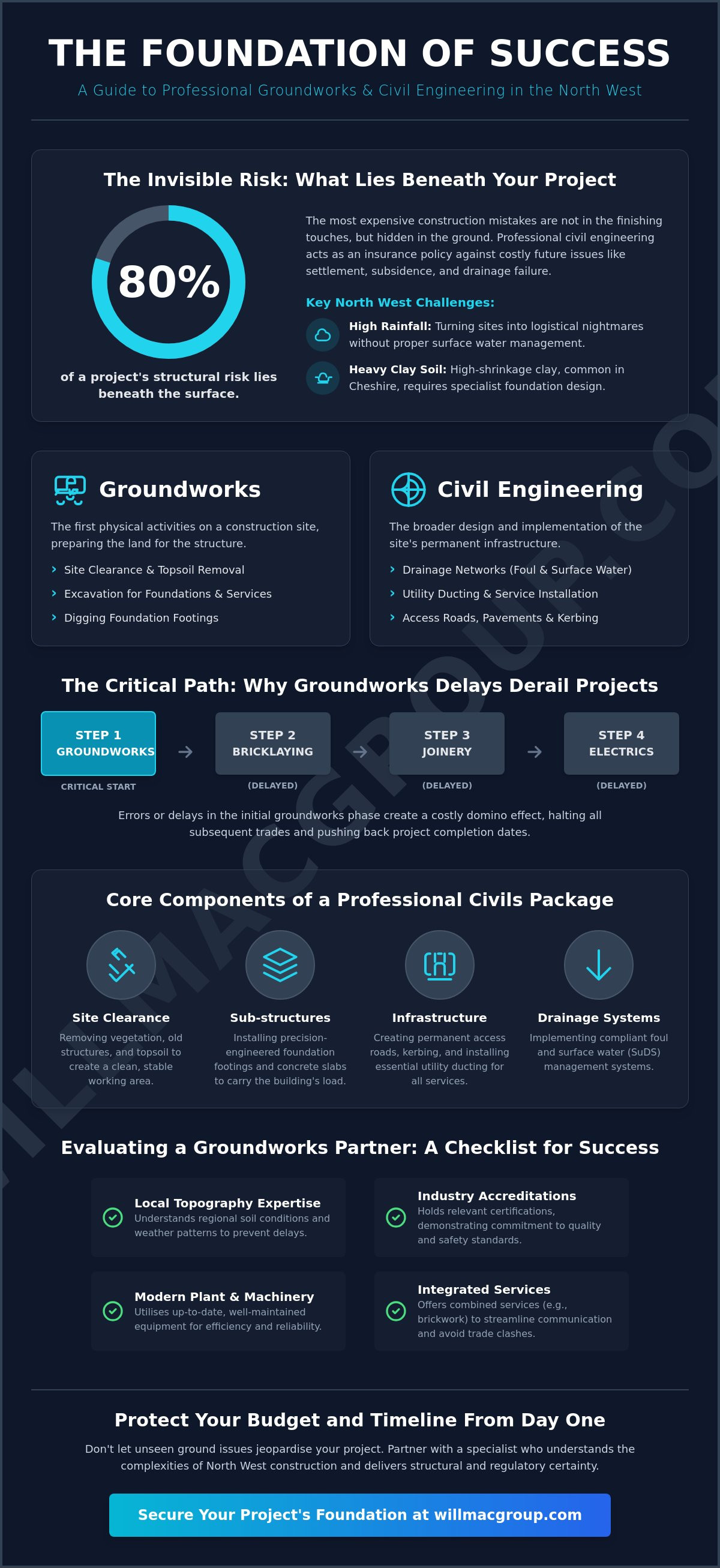
Choosing a contractor for groundworks and civils North West requires a methodical vetting process. A common mistake is focusing solely on the bottom line without verifying the operational capacity of the team. You should begin by checking for industry-standard accreditations. Operators must hold valid CSCS (Construction Skills Certification Scheme) or CPCS (Construction Plant Competence Scheme) cards to ensure they are qualified for high-risk site environments. Ask whether the contractor owns their plant machinery. Relying on third-party rentals can lead to significant delays if equipment isn’t available when needed, whereas an established, owned fleet suggests financial stability and higher maintenance standards.
Verification of insurance and local track record is equally critical. Public and employer liability insurance should be comprehensive enough to cover the specific risks of deep excavation and heavy infrastructure work. A contractor’s relationship with local authority building control departments in areas like Cheshire or Greater Manchester is also a strong indicator of quality. If their previous work consistently passes inspections without remedial requirements, it reduces your project’s regulatory risk significantly. Prioritising a partner who understands the nuances of local terrain ensures that the structural integrity of your build is never compromised.
Rigorous safety standards are non-negotiable in modern construction. Every site must have specific Risk Assessments and Method Statements (RAMS) tailored to the plot before work begins. To prevent strikes on existing infrastructure, professional teams use Cable Avoidance Tools (CAT) and Ground Penetrating Radar (GPR) to map underground services with precision. Environmental responsibility is another key factor. Ensure your partner manages “muck-away” and waste disposal through licensed channels, maintaining a clear audit trail for building control and environmental agencies. This transparency protects you from potential fines and ensures the site remains compliant with UK waste regulations.
Transparency is the foundation of a successful partnership. Red flags often appear in quotes that significantly under-price essential elements like drainage or site preparation. With the average base salary for a groundworker in the North West reaching £19.66 per hour as of May 2026, a quote that undercuts the market often suggests a compromise on safety or material quality. A reliable contractor provides clear timelines and regular progress reports to keep you informed. There is also a distinct advantage in choosing a partner who offers integrated services. By using a single team for both groundworks and brickwork, you eliminate the common communication gaps that occur when transitioning between different trades. If you are looking for a dependable builder to handle your project from the ground up, prioritising this dual expertise is essential for a seamless build.
Willmac Group offers a comprehensive structural solution that bridges the gap between initial site preparation and the rising walls of a new build. By maintaining dual expertise in both specialist brickwork and comprehensive groundworks, we provide a unified approach that is rare in the regional market. This integration is particularly valuable for projects involving groundworks and civils North West wide, as it ensures that the technical requirements of the foundations align perfectly with the needs of the subsequent construction phases. We deliver tailored solutions for everything from residential extensions to large-scale commercial new builds across Chester, the North West, and North Wales.
One of the greatest frustrations for developers is the “blame game” that often occurs between separate groundworks and brickwork teams. When levels are slightly inaccurate or drainage runs interfere with wall placements, the project can stall whilst contractors argue over responsibility. We eliminate this risk by taking full ownership of the structural lifecycle. Because our teams work under a single management structure, the transition from the ground to the first course of bricks is seamless. This professional reliability is the foundation of our reputation, ensuring that every project is built on a stable and compliant base.
Our groundworks team operates with the next phase of the build in mind. They prepare the site with surgical precision, ensuring that the footings and floor slabs are perfectly level and ready for our brickwork contractors to begin their work immediately. This clean site management and focus on technical accuracy reduce waste and accelerate the overall project timeline. Our directors bring over 25 years of industry experience amongst them, providing the seasoned oversight necessary to handle complex geological or logistical challenges with quiet confidence.
Every successful build begins with a thorough understanding of the site’s unique characteristics. We approach every project with a detailed site survey and an initial consultation to identify potential risks, such as high water tables or restricted access. Our pricing structure for civils and foundation packages is transparent, ensuring that developers can budget with confidence without the fear of hidden costs appearing once the first trench is dug. If you are ready to secure a stable and compliant foundation for your next project, Discuss your project with the Willmac Group team today.
Success in construction starts before the first brick is laid. By prioritising precise site preparation and understanding the unique geological challenges of the region, you protect your investment from future settlement and regulatory delays. Choosing a partner who manages the transition from sub-structure to brickwork ensures a seamless build and eliminates the common communication gaps that often stall modern projects.
For developers and homeowners across Chester, Cheshire, and North Wales, the Willmac Group provides this essential stability. Our directors bring over 25 years of industry experience to every site, offering specialist expertise in both groundworks and brickwork. When you invest in professional groundworks and civils North West, you aren’t just preparing a site; you’re securing the structural integrity of your entire build.
Get a professional quote for your groundworks and civils in the North West today. We look forward to helping you turn your plans into a solid reality.
Groundworks typically refer to the initial physical activities required to prepare a plot for building, such as excavation and foundation laying. Civil engineering, or civils, encompasses the broader design and construction of the built environment, including infrastructure like access roads and complex utility networks. While groundworks are a subset of the construction process, civils provide the engineered framework that allows a site to function within the wider local landscape.
Planning permission for groundworks is usually granted as part of the overall approval for your building project. However, specific activities such as significant changes to site levels, the installation of certain drainage systems, or work within conservation areas may require separate consent. You should always verify the specific requirements with your local planning authority before commencing any major earthworks or infrastructure installations on your property.
The cost of groundworks for a house extension depends on several variables, including the soil type, the depth of the foundations required, and the ease of site access. Factors such as the proximity of existing trees or the need for specialist drainage systems like soakaways will also influence the final figure. Because every site has unique geological characteristics, it’s advisable to obtain a bespoke quote based on a professional site survey.
Groundworks for a standard new build home typically take between two and four weeks to complete. This timeline includes site clearance, excavation, foundation pouring, and the installation of essential drainage and utility ducting. Complex sites with significant topographical challenges or those requiring extensive civil engineering work may take longer. A well-managed project ensures these stages are completed efficiently to allow the subsequent brickwork phases to begin without delay.
If unexpected ground conditions like soft spots, high water tables, or buried obstructions are discovered, work is paused to allow for a reassessment. A structural engineer or building control officer will typically inspect the site to determine if the foundation design needs adjustment. This might involve deepening the trenches or switching to a raft foundation. Professional groundworks and civils North West contractors use their experience to manage these variations transparently and safely.
Groundworks can proceed during the winter months, provided the site is managed correctly to handle the region’s high rainfall. Contractors use temporary drainage, track mats, and specialised equipment to maintain site stability and prevent machinery from becoming bogged down. Whilst extreme frost can occasionally delay concrete pouring, modern additives and protective covers often allow work to continue safely throughout the colder periods of the year.
Drainage is critical because the North West experiences high average rainfall and often features heavy clay soils that do not naturally drain well. Without effective surface and foul water management, a site can suffer from flooding, which compromises the structural integrity of foundations. Implementing robust groundworks and civils North West solutions, including Sustainable Drainage Systems (SuDS), ensures the project remains compliant with building regulations whilst protecting the property from water damage.