
Did you know that as of July 2026, the legal framework for construction in Wales has diverged significantly from the English system? Many property owners assume that a standard approach works everywhere, but the technical reality of hiring builders North Wales involves navigating a unique set of coastal structural requirements and specific Welsh building safety regimes. It’s natural to feel a sense of unease about fluctuating material costs, such as the 8.5% rise in structural steel seen this year, or the anxiety that poor groundworks might lead to long-term structural failure on challenging rural sites.
We understand these concerns and believe that clarity is the foundation of any successful project. In this guide, we’ll provide the technical insight you need to avoid common contractor pitfalls and ensure your project meets the stringent 2026 standards. You’ll discover the truth behind five persistent construction myths, from the reality of local authority building control to the specific requirements for higher-risk buildings. By the end, you’ll have a clear roadmap for finding a reliable partner and keeping your build both compliant and on budget.
Identifying a professional contractor involves more than checking a local directory. In the 2026 market, builders North Wales must be defined by their ability to manage a project’s entire lifecycle, from the initial civils and groundworks to the final structural brickwork. A handyman might handle minor repairs, but a full-build contractor like Willmac Group operates with a level of precision and insurance coverage essential for large-scale developments. This professional standard ensures that every structural element adheres to the evolving UK building regulations, protecting your investment from legal and safety risks. Without comprehensive insurance and registration, a property owner assumes all liability for structural failures or site accidents, which can be financially devastating.
Quality construction begins below the surface. A professional contractor treats groundworks and civils as non-negotiable foundations rather than afterthoughts. This integration is vital because the stability of a new build or extension depends entirely on how the site’s geology is handled. A professional service includes:
For instance, rural sites in North Wales often present complex drainage and soil stability issues that require sophisticated civil engineering solutions before the first brick is laid. Specialist brickwork is another distinct pillar; it requires a deep understanding of load-bearing requirements and material durability that general masonry often lacks. In 2026, efficient project management is the thread that ties these skills together, ensuring that complex builds stay on schedule despite external market pressures. It’s about having a single point of accountability for the entire structural shell.
There’s a common misconception that a builder must live in the same village to understand the land. While local knowledge is valuable, it’s the technical site assessment that truly matters. A firm based in Chester, for instance, often possesses superior equipment and a wider network of skilled trades whilst maintaining specialised expertise in North Wales conditions. Willmac Group brings over 25 years of industry experience across the North West and Wales, proving that professional reliability is built on a track record of successful projects rather than just a postcode. True local knowledge in construction isn’t about knowing the shortcuts to the site; it’s about understanding how the coastal salt air affects mortar longevity or how the high-wind loads of the region dictate specific structural reinforcements. We prioritise these technical realities to ensure every build by professional builders North Wales stands the test of time.
A common misconception amongst property owners is that standard construction techniques are universal across the UK. In reality, builders North Wales must contend with environmental pressures that don’t exist in inland urban areas. High-wind loads and salt-air corrosion are constant factors for any project within five miles of the coast. If a contractor uses standard mortar mixes or low-density bricks in these zones, the structural shell will begin to degrade within years. Professional construction in this region requires durable brickwork tailored for harsh conditions, often involving higher cement-to-sand ratios and sulphate-resisting materials to withstand the aggressive maritime climate.
Building near the sea requires a technical approach to both the visible shell and the hidden foundations. Sandy or shifting coastal soils demand specialised groundworks to prevent future subsidence. In 2026, the cost of essential raw materials like gravel and sand has risen by 7.7%, making it even more critical to get the foundation strategy right the first time. Efflorescence is the migration of a salt to the surface of a porous material, where it forms a white coating that can degrade structural integrity if left unmanaged. Professional brickwork prevents this by using appropriate damp-proof courses and breathable membranes that are specifically designed for high-moisture environments. Ensuring your project receives Building Regulations Approval often hinges on demonstrating that these coastal-specific risks have been mitigated through proper material selection.
Moving inland toward regions like Snowdonia presents a different set of challenges, primarily related to topography and water management. Sloping terrains are common, requiring extensive cut-and-fill operations or reinforced retaining walls to create a stable building platform. Without robust civils and drainage systems, rural builds are highly susceptible to water ingress and soil erosion during the heavy rainfall typical of the Welsh mountains. Effective site preparation isn’t just about clearing land; it’s about engineering a system that directs water away from the structure while maintaining the integrity of the surrounding landscape. If you’re planning a project on a challenging site, choosing a partner with deep expertise in civils and groundworks ensures that your build starts on a stable, dry foundation.
Choosing the cheapest estimate is a tempting prospect, but in the 2026 construction market, a “low-ball” figure is often a red flag. With material price inflation for new housing rising by 3.2% in the 12 months leading to April 2026, and specific items like structural steel increasing by 8.5%, a quote that seems too good to be true usually is. When you compare builders North Wales, it’s vital to look beyond the bottom line. A significantly lower price often indicates that a contractor hasn’t accounted for these market fluctuations or, worse, intends to use substandard materials to protect their margins. This approach frequently leads to project abandonment when the builder realises the job is no longer financially viable, leaving the property owner with an unfinished structure and a legal headache.
Incomplete quotes often omit essential services that the homeowner is later forced to pay for as “extras”. Common omissions include professional waste removal, local authority building regulation fees, and comprehensive site preparation. While a “labour-only” quote might look attractive on paper, it lacks the security of a comprehensive project management service. At Willmac Group, we ensure transparency in every new build and extension quote, including the necessary civils and groundworks from the outset. Following impartial advice on choosing a builder involves verifying that all logistical costs are covered. Skimping on the initial build often results in remedial work that costs three times the original “saving” just to bring the structure up to a safe, legal standard.
Structural integrity should be viewed as a long-term investment rather than a one-off cost. In the North West and North Wales property markets, a professionally executed extension or new build adds significant value, but only if the craftsmanship is verifiable. Expert bricklayers and groundworks specialists ensure that the building’s skeleton is resilient against the elements, which is particularly important for the coastal conditions discussed previously. We don’t cut corners because we understand that the longevity of the structure depends on the quality of the initial masonry and foundations. Professional builders North Wales who prioritise technical excellence over the lowest possible price provide the best return on investment. By choosing a partner that integrates specialist brickwork with robust infrastructure, you’re protecting the future resale value and structural safety of your home.
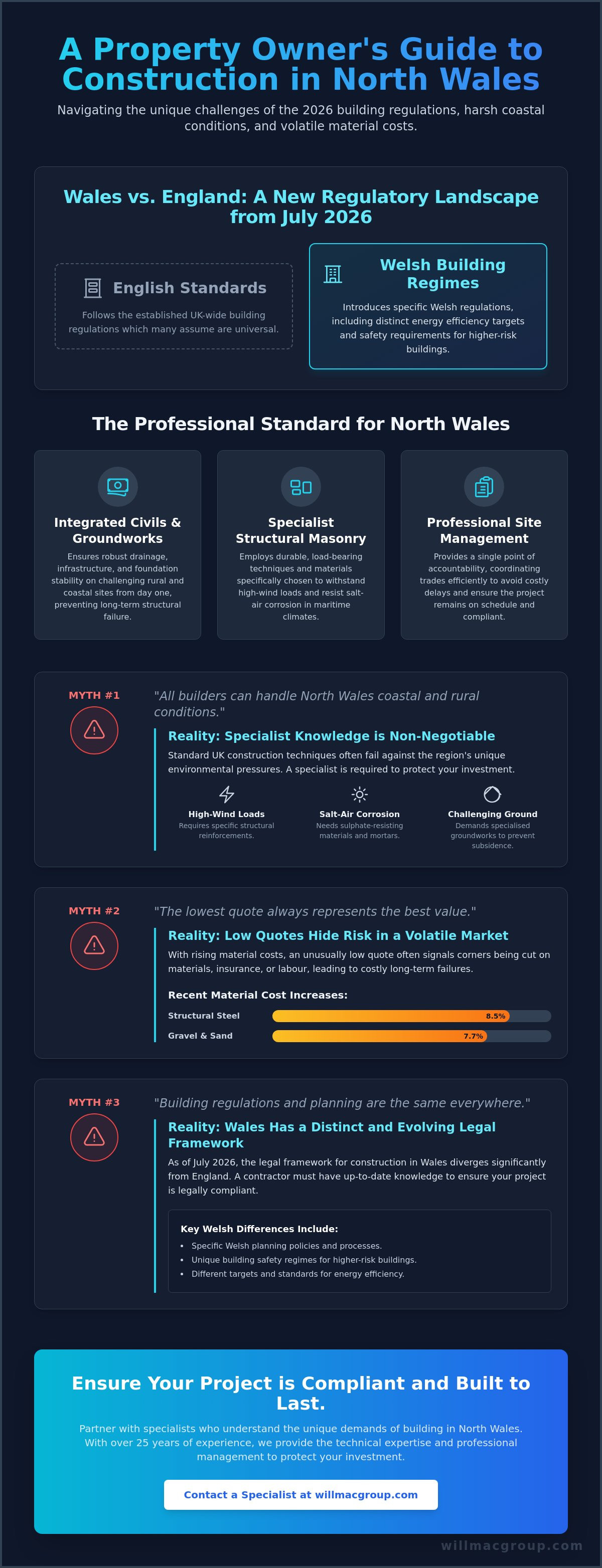
Construction in Wales is governed by a distinct legal framework that has diverged significantly from English law. Professional builders North Wales understand that the Welsh Planning Portal operates under different criteria, particularly regarding the new building safety regime coming into force on July 1, 2026. While planning permission fees for a typical householder application remain at £338 as of June 2026, the procedural requirements for technical approval are becoming increasingly stringent. Local authorities in Conwy, Denbighshire, and Gwynedd now act as the primary building control authorities even for higher-risk buildings. This creates a localised regulatory environment that requires specific regional expertise. Your contractor must also be well-versed in local county borough council fee schedules. These were updated as recently as April 2026 to reflect the rising costs of regulatory delivery. Professionalism in this area isn’t just about filling in forms; it’s about ensuring every structural detail adheres to the specific safety duties mandated by the Welsh Government.
Securing approval requires a methodical approach. First, you must determine if your project falls under “Permitted Development” in Wales. These thresholds often differ from English standards. Second, you need to submit detailed structural plans that include comprehensive groundworks and civils specifications. Finally, your contractor must liaise directly with local building control officers for stage-by-stage inspections. This ensures that every phase, from the initial foundation pour to the final roof installation, meets the necessary quality benchmarks.
The Welsh Government has set ambitious targets for energy efficiency. The 2026 standards place a heavy emphasis on sustainability and carbon reduction. This isn’t just about renewable energy; it’s about the technical performance of the building’s shell. Brickwork insulation and the prevention of thermal bridging are now strictly monitored during inspections. Quality builders North Wales stay updated on every legislative change to ensure projects exceed these requirements. We prioritise high-specification insulation to ensure your new build or extension is future-proofed.
If you’re ready to start your project with a team that understands the complexities of the Welsh regulatory system, you can contact us for a professional consultation today.
Choosing a partner for a major construction project is a decision that impacts the longevity and safety of your property for decades. Whilst many builders North Wales offers might provide general contracting services, the Willmac Group approach is rooted in the belief that structural integrity requires specialised, in-house expertise. We’ve built our reputation on the technical mastery of civils, groundworks, and brickwork, ensuring that every project is managed by professionals who understand the lifecycle of a building from the soil upwards. This level of specialisation is the only way to navigate the complexities of the 2026 construction landscape, where regulatory precision and material efficiency are paramount.
The primary advantage of working with an integrated contractor is the seamless transition between project phases. When a single team manages the civils and the structural masonry, the risk of miscommunication between separate trades is eliminated. This “ground-up” methodology ensures that the foundations are perfectly aligned with the requirements of the brickwork above, reducing the likelihood of delays that often plague fragmented projects. Structural excellence is not an add-on; it is the foundation of every Willmac project. By keeping these core competencies in-house, we maintain total control over the quality of materials and the standard of craftsmanship, providing a level of consistency that generalists simply cannot match.
With over 25 years of director experience in the construction industry, we bring an authoritative perspective to every site we manage. We’ve seen the industry evolve and have consistently adapted our methods to meet the highest standards of reliability and transparency. Our geographic reach extends from the heart of Chester to the furthest reaches of North Wales, allowing us to bring high-calibre resources to both urban developments and remote rural sites. Whether you’re planning a complex new build or a structural extension, our team provides the dependable guidance needed to ensure your investment is protected. We invite you to move beyond the common myths of the industry and partner with a firm that values consistent results and long-term relationships.
Contact Willmac Group today for a professional consultation on your North Wales build.
Success in the 2026 construction landscape requires more than just local proximity. It demands a technical understanding of the unique environmental pressures found in the region and a strict adherence to the latest Welsh building safety regimes. By debunking common myths around low-cost estimates and universal regulations, it’s clear that the most reliable builders North Wales has to offer are those who prioritise structural integrity from the ground up. Choosing a partner that integrates civil engineering with specialist masonry ensures that your investment remains safe, compliant, and durable against the elements.
Willmac Group brings over 25 years of industry experience to every site, providing a stable and transparent service across Chester, Cheshire, and North Wales. We specialise in the complex structural brickwork and civils that form the backbone of any high-quality development. If you’re planning a new build or a significant extension, we’re ready to provide the professional reliability your project deserves. Discuss your North Wales construction project with our expert team today and take the first step toward a build that stands the test of time.
You don’t strictly need a builder based in the same village; a Chester-based firm often offers superior resources and infrastructure whilst maintaining deep technical knowledge of North Wales conditions. Willmac Group operates across both areas, ensuring that specialised equipment and a seasoned workforce are available for projects in more remote locations. This reach allows for a higher standard of project management and consistency than a general handyman might provide.
A typical house extension in 2026 usually takes between 12 and 20 weeks to reach completion, depending on the complexity of the groundworks and the scale of the structure. Factors such as the new Welsh building safety regime coming into force in July 2026 may influence inspection schedules. It’s essential to account for these regulatory stages when planning your project timeline to ensure a smooth handover.
Welsh building regulations have diverged from England, particularly with the new safety regime effective from July 1, 2026. In Wales, a higher-risk building is defined as being at least 18 metres high or having seven storeys with a residential unit. Unlike England’s national regulator, local authorities in Wales act as the building control authority for these structures, requiring builders North Wales to maintain close ties with county borough councils.
Coastal properties are exposed to salt-air corrosion and high-wind loads that can quickly degrade standard masonry. Specialist brickwork involves using high-density materials and specific mortar mixes that resist sulphate attack and prevent efflorescence. This technical approach ensures the structural shell remains resilient against the aggressive maritime climate, protecting the property’s long-term value and structural safety in exposed locations.
Willmac Group is a comprehensive contractor that manages everything from the initial civils and groundworks to the final structural brickwork. Handling these phases in-house reduces the risk of miscommunication between trades and ensures a seamless transition from the foundations to the structural shell. This integrated approach is a core part of our standard, providing property owners with a single, accountable point of contact for the entire build.
You should always verify a contractor’s insurance coverage and their registration for large-scale structural work before signing a contract. In the 2026 market, it’s also vital to check their familiarity with the specific Welsh planning portal requirements. Professional builders North Wales will be able to provide a transparent quote that includes waste removal, building control fees, and a clear breakdown of material costs to avoid hidden extras. The same methodical vetting process applies when searching for how to find a reliable builder Chester residents and those in the wider North West region can trust.
To receive an accurate quote for a new build project in the North West, you should provide detailed structural plans and site assessment data. We recommend scheduling a professional consultation to discuss the specific requirements of your site, including any complex groundworks or civil engineering needs. This allows us to provide a comprehensive estimate that accounts for 2026 material market rates and the full scope of the technical work required.
Rural areas in North Wales often have strict planning restrictions related to landscape preservation and topography, particularly near Snowdonia. Local authorities like Gwynedd and Conwy have specific policies regarding site drainage and the visual impact of new structures. A professional contractor will help you navigate these requirements, ensuring that your groundworks and structural designs comply with both environmental protections and the latest Welsh energy efficiency standards.